

Nate Leaman wants a beer.
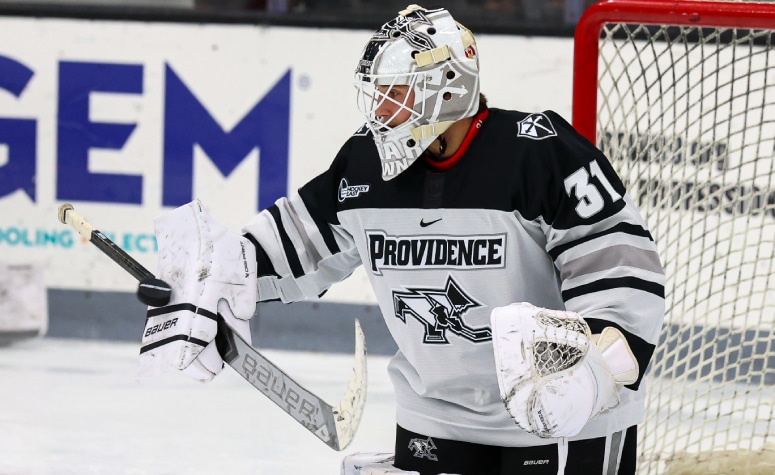
He could talk about this for hours. Coaches seldom chomp at the bit to answer questions in postgame press conferences, but as he sits in the Conte Forum press room after his surging Providence team's overtime victory over Boston College, Leaman, the 15th-year head coach, is asked about midseason roster additions. The Friars just went through the mad dash to add goalie Michael Simpson in early January, an eight-day process that involved Simpson flying to Montreal, stepping out of the airport, then walking right back in to return to New York. And that's not even what the reporter or Leaman are most hung up on.
Because Simpson, like three others who joined an NCAA program this past January, was already a professional player. He'd played in 26 games in a season and a half bouncing between the AHL and ECHL before dropping everything to head to college, an unprecedented move before this season.
So, Nate. What's going on here?
"You got a beer?" asks Leaman, sitting up in his chair. "This is a good question!"
Midseason roster additions have always been a part of the sport. But never like this. Simpson is one thing. But over the last two seasons, there’s been a significant, if still small, surge of young, high-end NHL prospects bolting from the USHL to join their NCAA team a half-season early. We will explore that crop of players in Part 2 of this series.
"Midseason adds have been happening since I've been in college hockey," says Vermont head coach Steve Wiedler. "The part that has people raising eyebrows is the caliber of player being brought in."
Right. So why — and how — are former professionals making these moves? And is this trend here to stay?
Sixty teams worth of NCAA-eligible players became available with one bang of the gavel in November 2024. The impact of the CHL ruling on hockey — but especially college hockey — is difficult to fully grasp. "We added 60 teams of eligible players from Canada, and we added zero roster spots," says Providence assistant coach Joel Beal. "So it's a trickle-down effect."
INSIDE THE NUMBERS: Part 1 — How many recruits make it to college hockey? | Part 2 — How many August commits, goalies made it?
One of the downstream impacts, undoubtedly, is a sudden increase in midseason roster additions in 2025-26. It’s difficult to track the exact number of adds, but a New England Hockey Journal study found that 20 players were added this season compared with nine in 2024-25. Six of the 2025-26 additions were former CHLers, compared with — obviously — zero last year. And four of them, including Simpson, had already spent time in the AHL or ECHL.
The explanation for that is simple. College hockey is, many believe, the best non-professional league in the sport. It's a natural and, in many cases, necessary developmental stop before players turn pro. But following the end of his junior career, Simpson, thinking the NCAA would never be an option for CHL players, had no choice but to sign in the AHL in June 2024, a couple months before the ruling. Not yet aware of the impending changes to the NCAA’s eligibility rules — which allow professional players to retain college eligibility so long as they don't receive compensation beyond "actual and necessary expenses" — he didn't explore opportunities to join an NCAA program in the summer of 2025, even after the CHL ruling went into effect. He thought he'd missed his chance and, as a young and unseasoned goalie, struggled to stick with an AHL or ECHL team.
When he went home for Christmas this past December, friends asked him if he would've played in college if he could have.
"I was like, 'Yeah. I think it'd be awesome,'" Simpson says. "And then three weeks later, Providence comes calling."
All of a sudden, a huge crop of players who needed time in the NCAA can actually use it.
"When players realize how hard it is to make it and stick in the AHL, especially coming from junior," Beal says, "they understand that their game needs a little more seasoning to give themselves the best chance."
The appeal for Providence to add Simpson midseason instead of waiting until the start of the next season is obvious. Starting goalie Phillip Svedebäck suffered a significant injury at the start of January, and the Friars, now the Hockey East regular-season champions, needed a second netminder to compete with freshman Jack Parsons. With a few exceptions (more on those in Part 2), nearly every NCAA program looks to a midseason addition because of injuries.
The appeal to join midseason for former CHLers, or indeed any player over the age of 21, is pretty simple, too. Once a player turns 21, they lose a year of NCAA eligibility for every season they play the sport at an organized level. So by bolting for college in January, Simpson (who's 23), or Mats Lindgren (a 21-year-old fourth-round pick who left the AHL for Colorado College), or Davis Codd and Aidan Litke (both 22-year-olds who've spent time in the ECHL and joined Niagara), gained a half year of eligibility against that running clock.
Simpson's eligibility runs out after next season. He plans to remain at Providence in 2026-27 before — if he develops in college the way he hopes — signing an NHL contract, or at least finding a way to stick in the AHL.
BOYS BEST OF NEW ENGLAND: Top 50 ’07s | Top 50 ’08s | Top 50 ’09s | ’10s to watch
"You see a lot of guys who go to school and come out when they're 24," Simpson said. "And they just have that maturity in their game … and AHL teams are like, 'OK, we got to see what this kid's got.'"
The CHL ruling caused the trend, but it also might be why it doesn't last. The crop of former CHLers who might need to leave for the NCAA only exists because CHLers just became NCAA-eligible this season. In three or four years' time, that group of players will likely be phased out, because any CHLer who wanted to play in college would already be doing it. Players and coaches would've had time to go through a normal recruiting process, as opposed to the midseason sprint ensuing this season as a result of the ruling's suddenness.
"You might see another year of it," UConn associate head coach Tyler Helton says of adding players like Simpson midseason. "But I don't know if it's going to continue."
The House v. NCAA settlement, which also went into effect this season, plays a role here, too. Schools that opted into the settlement — 37 of the 64 with Division 1 hockey programs did so in 2025-26 — are technically limited to 26 roster spots. But in order to protect current athletes from getting cut as a result of the roster limits, the NCAA allowed college programs to submit a list of Designated Student-Athletes, or DSAs, that didn't count against the limit. But four years from now, like the CHLers caught in no-man's-land, DSAs will be phased out. Programs like BC, which is carrying DSAs and used the room they created to add a player (17-year-old Oscar Hemming) midseason, won't have that luxury for long.
"I think it'll become less common," Eagles coach Greg Brown said of the midseason additions in a January press conference. "Right now, we're able to [add players], under the rules."
But once DSAs are gone, they won't be, unless they carry fewer than 26 players to start the season. That's not unheard of — Providence and UConn both carried 25 this year (without any DSAs) before making a midseason addition their 26th — but given the growing consensus that 26 as a limit in itself is too low, it's unlikely many teams will follow the Friars' and Huskies' path. And even then, the Friars stayed under the limit mostly because they felt it would've hurt players' development by carrying a larger roster, according to Beal. As for the Huskies? They actually tried to carry 26, but couldn't find a player that fit their program in time.
"I'd love to have 27," Helton says.
Given that nearly all midseason additions are caused by injuries, remaining under the limit to clear room for a January add is, in some sense, a logical fallacy. Why rely on the uncertainty of a potential midseason addition as an injury fail-safe, when a team can carry that 26th player from the start of the year? In the end, the Friars were fortunate Svedebäck got hurt on Jan. 3, eight days before the start of the second academic semester at PC. Had the injury occurred a week later, Simpson wouldn't have been an option.
"I find it hard to think we would," says BC assistant Brent Darnell, when asked if the Eagles would consider carrying a sub-26-player roster. "Because you're rolling the dice."
A midseason replacement will likely be a higher-end player than a 26th player who warmed the bench before an injury. Still, it's a huge risk. Plus, adding a new player to a locker room in January opens up another can of worms. Several of the coaches interviewed for this story said they only add a player midseason when they absolutely have to.
So — unless the NCAA expands the limit — the House settlement, once it's all said and done, will actually make midseason additions harder than they were a decade ago, or even in 2024-25.
"The number of schools that are able to add a player right now is probably 60 to 64. It's literally everybody," Beal says. "If you fast forward a few years, that'll lower drastically."
The consensus on the sudden explosion of midseason roster additions, then?
READ MORE: Tracking every move in the college hockey portal
"I think it's a flash in the pan," Beal says.
But in a rapidly changing sport, the pan's been flashing quite a lot as of late. We'll explore another new trend in Part 2 of this series, one that appears more likely to endure. And in three years' time, when cases like Simpson's are history, the rules could have easily changed again.
"In case something comes along, you have to be ready all the time right now," Leaman says.