

Steve Wiedler does not care.
He almost welcomes it, if anything, which is a bit odd. Because if there’s anyone who should be concerned about the apparent explosion of midseason roster additions in college hockey, it’s probably Vermont’s head coach. He’s already up against it, both on the recruiting trail and at the rink, as the leader of a small program (by relative terms) in a conference stacked with bluebloods. And now, on the rare occasion Boston University is underperforming, or Boston College is struggling with injury, those name-brand programs can just go and add a future first-round pick midseason?
Come on. That must be at least frustrating, if not actively damaging to a smaller program’s chance to compete. But Wiedler doesn’t budge. He’s been coaching “smaller” Division 1 programs in the NCAA for 11 years. He’s convicted and resolute.
“It’s the best part of coaching in Hockey East. It’s the part I love the most,” UVM’s third-year head man says. “We get to go against the best in the country every night, and that’s what you want to do. It makes it fun.”
Not everyone in his position will have the same enthusiasm on the topic. Wiedler acknowledges that. Still, as New England Hockey Journal spoke to more and more coaches about midseason roster additions, we found that Wiedler’s utter lack of panic hardly put him on an island. Indeed, the prevailing reaction among the eight coaches from the NCAA, USHL and CHL interviewed for this story was a metaphorical shrug.
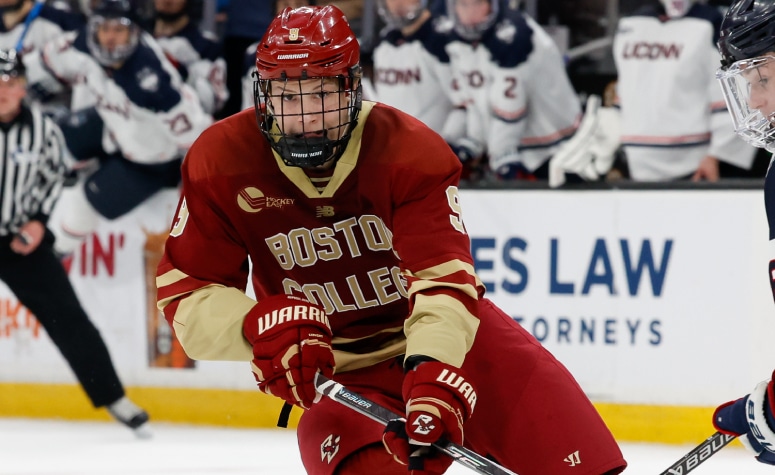
Midseason additions have always been a part of the sport, but never like this. A pair of first- or second-round NHL Draft picks bolted for their college programs in each of the last two Januarys. In 2025, goalie Mikhail Yegorov left USHL Omaha for BU as a former second-rounder and one of the highest-touted 18-year-old goalie prospects. 18-year-old Will Horcoff left the USNTDP for Michigan last January, and he was drafted in the first round the following June. This season, BU and BC added two 17-year-olds — Tynan Lawrence and Oscar Hemming, respectively — and both are projected first-rounders.
This is not normal. Before Yegorov and Horcoff, there wasn’t a single first- or second-round pick from the prior nine drafts (at least) that joined an NCAA program midseason, according to a NEHJ study.
BOYS BEST OF NEW ENGLAND: Top 50 ’07s | Top 50 ’08s | Top 50 ’09s | ’10s to watch
The sudden crop of high-end young talents making the move is part of an apparent increase in midseason additions overall. While it’s difficult to track the exact number of additions, the NEHJ study found that 20 players were added to Division 1 rosters over the 2025-26 winter break, after only nine were added to D1 rosters midseason in 2024-25. Nearly every coach in this story acknowledged midseason additions appear to be occurring at a higher rate.
NEHJ explored another crop of players contributing to that increase — former CHLers who left professional leagues to join the NCAA — in Part 1 of this series.
But what about Yegorov, Horcoff, Lawrence and Hemming? Why is this happening now? And why, if blueblood programs are adding seriously high-end talents simply when they feel like it, are coaches so unmoved?
Not long ago, there were barely any high-end 17-year-olds playing in the NCAA, let alone parachuting in midseason. From the nine drafts between 2015 and 2023, only three players were 17 during the entirety of their freshman season in the NCAA before being selected in the first- or second-round. A tiny minority of those picks even spent their draft years in college, and most did it because an awkwardly timed birthday forced them to. To choose to do it, which means choosing to do it at 17, was extraordinarily rare. Matthew Wood, a forward at UConn from 2022-24 and at Minnesota in 2024-25, and Noah Hanifin (Boston, Mass.) and Zach Werenski, defensemen at BC and Michigan, respectively, in 2014-15, were the only ones to do it over that nine-draft period leading up to 2024.
According to some projections, there will be four such players in the first round of the 2026 Draft alone. That includes Lawrence and Hemming.
“Guys used to worry about being ready for Division 1 at that age,” Wiedler says. “Then, all of a sudden, Macklin Celebrini comes along.”
You may have heard of him. The Canadian, now a legitimate Hart Trophy Contender, skipped a second USHL season to join BU as a 17-year-old in 2023-24. He won the Hobey Baker Award and was selected first overall that June. Wood, Hanifin and Werenski were all productive NCAA players as 17-year-olds. Celebrini took their level and shattered it, scoring almost 1.7 points per game in 38 college appearances, a man amongst boys, even if he was, literally, a boy amongst men.
Yegorov, Horcoff and Lawrence all left the USHL in the middle of their second season to join the NCAA. In fact, BU originally explored the possibility of Lawrence forgoing his second season at Muskegon entirely to join the program on Celebrini’s timeline. While Yegorov, Horcoff, Lawrence and Hemming all made their moves for different reasons, (Hemming, a unique case, had tried to play in the CHL in 2025-26 but the Finnish government wouldn’t let him — he wasn’t playing for anyone when BC came calling in December), their lack of hesitation to jump to college hockey so early in their development path was the common denominator. Plenty of high-end players were trapped in poor situations in the USHL, like Yegorov was in Omaha, over the last decade. Yegorov was the first to get airlifted to the NCAA.
“It seems to be that way,” says USHL Fargo assistant coach Jimmy Mullin, when asked if junior players are more eager to spend their draft years in the NCAA. “I think [Lawrence’s move] had everything to do with: ‘Let me go put my game on blast in college, I’m going to show that I can play with men, and that I’m the potential No. 1 pick.’”
Lawrence finished with only two goals and seven points in 18 college games. His stock hasn’t risen as he’d perhaps hoped, though he’s still a consensus first-round pick. The other three fared much better. Yegorov almost immediately took over BU’s net upon arrival before backstopping the Terriers to a Beanpot final and a national championship game. Horcoff (four goals, 10 points in 18 college games last year) went 24th in 2025 after starting the season as a ‘B’ prospect (a second- or third-round candidate) on NHL Central Scouting. Hemming finished with one goal and eight points in 19 games, most of them spent in BC’s top six. His stock appears to have risen.
Some argue Celebrini was simply a once-in-a-lifetime player, one that shouldn’t serve as a precedent for accelerated development paths. A few coaches interviewed for this story agree. Many do not. Wiedler still remembers Hemming skating out of the corner of the offensive zone during the first period of a February clash between Vermont and BC, protecting the puck against a heavy Catamount defenseman, making an intelligent pass, then crashing right to the net.
“I was watching video between the first and second, and I’m like: ‘Man, that’s a good play.’ We need an answer for that,” Wiedler says. “And he’s 17! He’s the real deal.”
It’s also not all about the draft. By bolting for college midseason, all four technically lost a half-season of potential time in college (they lose a full season of NCAA eligibility even if they only play half a season). But high-end talents like Yegorov, Horcoff, Lawrence and Hemming won’t spend four seasons in the NCAA anyway; in all likelihood, they will never use that half-season they lost. So, joining midseason is actually a chance to maximize their time in the premier development league in the sport.
READ MORE: Tracking every move in the college hockey portal
“They’re gaining half a year,” Providence assistant coach Joel Beal says.
Lawrence, the Clark Cup MVP as a 16-year-old in the USHL in 2024-25, had clearly outgrown the level by the middle of his second junior season. As far as his development is concerned, there likely wasn’t much to be gleaned from 30 more games in Muskegon. He didn’t light the NCAA on fire like some thought he would. That doesn’t mean he didn’t get better.
“He was a man amongst boys in the USHL, by a long way,” says Mullin, a former assistant at Merrimack. “You could gameplan against him, but he was just toying with it.”
Following the first semester in 2024-25, Merrimack’s staff held a meeting to discuss adding a player midseason. The Warriors’ roster was lacking in a specific area, and they had a committed recruit, now a freshman on the 2025-26 team, enjoying a dominant season in a junior league. To bring him in during the winter break would’ve provided a needed boost during the back half. BU made a similar calculation when it added Yegorov and Lawrence.
Merrimack never pulled the trigger. Its recruit will almost certainly spend four seasons in the NCAA, so pulling him from juniors midseason would cost him that half-season in college. The Warriors also couldn’t be sure they’d be bringing the player in for a legitimate postseason push; as it turned out, MC finished 13-21-1 and lost in the first round of the Hockey East tournament. BU and Michigan, however, knew they were offering Lawrence and Horcoff extra time in the NCAA, and they knew — because they’re BU and Michigan — they’d be pushing for trophies come March.
Most midseason additions happen because programs have no other option to replace injured players, which NEHJ explored in Part 1. Those moves are available to smaller programs and bluebloods alike — Vermont did it with goalie Cullen DeYoung this season. But to add a recruit midseason simply as a means to improve the roster isn’t always possible for the bottom 90 percent of college hockey programs.
“It’s selfish. Because you’re taking the recruit out of something that’s comfortable,” Mullin says. “Unless you’re chasing down a championship, I don’t think it’s fair to that individual.”
But neither Mullin nor Wiedler concedes that a potential surge in high-end midseason additions would put them at a disadvantage. Merrimack and Vermont build their programs mostly around undrafted players they think will stay all four years. Their edge over a blueblood like BU or BC is the continuity and experience those archetypes provide. Whereas BU actively sells its recruits on its ability to get them to the NHL as fast as possible, programs like Vermont, as Wiedler says, need to “figure out a way to get your guys bleeding Green and Gold.” UVM is betting, in a sense, that its culture will outplay BU’s talent.
That kind of strategy doesn’t align with midseason additions anyway. While smaller programs still explore those moves, NEHJ found that coaches at those programs, like Wiedler and UConn associate head coach Tyler Helton, were usually more concerned about the effects of a midseason addition on a locker room. Smaller programs are probably less capable of reinforcing their roster midseason, but they’re also probably less willing to begin with.
“You got to be really calculated on who you bring in,” Wiedler says. “Anybody you bring into your locker room midyear, how do you acclimate him to the culture?”
Helton, of all the college coaches interviewed for this story, was the most hesitant to add a player midseason. UConn, which made its first NCAA tournament in 2024-25 and did again this season, probably has or is about to break through “small program” status. Still, the Huskies are far from a blueblood, and they operate that way.
“We’d like to avoid it as much as we can,” says Helton, who has helped add three players midseason, including one this winter, during his 11 seasons at UConn. “I wouldn’t say we’re totally against it, because sometimes there’s a need. But fit is the most important thing to us. We’ve tried the opposite side of that at times, and it doesn’t work.”
PART 1: The future of midseason additions in men's college hockey
UConn was, of course, the program that brought Wood in as a 17-year-old. The Huskies didn’t make it past the Hockey East quarterfinals in Wood’s two seasons. Then they enjoyed the best season in program history right after he transferred to Minnesota. If Yegorov, Horcoff, Lawrence and Hemming are truly the start of a new trend among high-end prospects, well, programs like UConn aren’t trying to live in that world anyway. Besides, BU already had 10 first- or second-round picks on its roster before Lawrence arrived, and UConn beat the Terriers, 8-4, in October. What’s one more high-end guy?
“We want guys that want to be here at the end of the day. That’s the most important,” Helton says. “We’re not looking for someone to come here as a stepping stone.”