
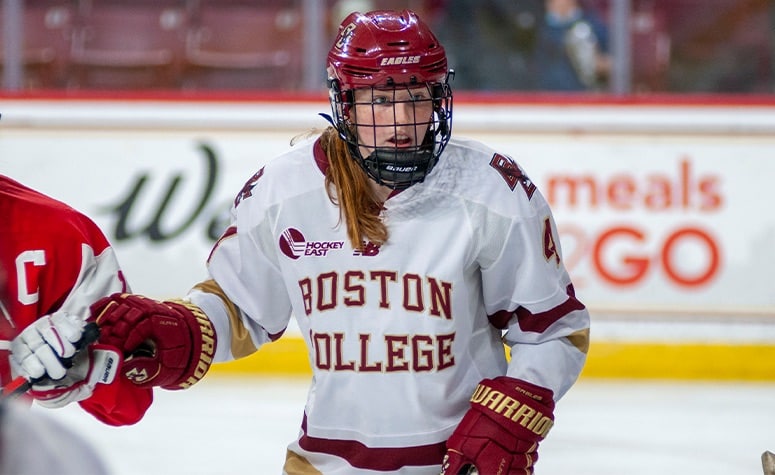

Keri Clougherty remembers exactly where she was and what she was doing.
She was in her dorm at Deerfield Academy during her junior year in 2019, and she just decided she was going to commit to play Division 1 hockey at Boston College.
“I can tell you what I was wearing, and I can tell you who I called first,” Clougherty said. “It’s actually one of the most memorable days of my life.”
After calling Eagles head coach Katie King-Crowley (Salem, N.H.), Clougherty began to spread the news to family, friends and other BC recruits she knew.
“I told one of my best friends. She freaked out, and then everyone freaked out,” Clougherty said.
For Clougherty (Lynn, Mass.) and many other players in her position, that day was the culmination of years of working toward the goal of landing a college commitment, taking stock of different schools and programs, trying to show well in a showcase or the prep season and finally getting those phone calls.
The June 15 benchmark looms large on the girls side, when those phone calls begin as college coaches can start formally contacting and making verbal offers to rising juniors. On the boys side, coaches can begin contact on Jan. 1 of a player’s sophomore year, and verbal offers can start on Aug. 1 entering a player’s junior year.
But what happens after a player gets those offers and makes a decision?
READ MORE: Did the CHL ruling have an impact on Aug. 1 commitments?
“How I approached it, which I think is just from the programs that I played for and the family that I grew up in, was like, ‘OK, now the real work starts,’ ” Clougherty said. “You worked for eight years to get that commitment, but now you need to work for those next two years for that first day on campus, that testing day, that first practice or even your first captain’s practice.”
Clougherty knew she wanted to go to BC. It was a “no-brainer” for her and her family when the opportunity arose.
For others, like Mike Posma, the path isn’t always as clear.
Posma, now a forward with the ECHL’s Wheeling Nailers after graduating from BC in 2025, originally committed to Air Force when he was 16.
As he continued learning about the college hockey landscape, different programs and different leagues, he wasn’t sure the military academy was the right fit for him. He received an offer from BC two seasons later, which meant an opportunity he couldn’t pass up.
“When I committed (to Air Force), it was awesome, just a great feeling, like my parents being proud of me and all the work that we put in comes full circle,” Posma said. “Once I got the offer from BC, which was a dream school for me, I just remember being so happy again and my parents being proud of me, just excited to be part of such a historic program.”
It also meant a difficult conversation with the staff at Air Force.
“When it did come time to call them and say I wasn’t going there anymore, it was definitely hard,” Posma said. “Ultimately, (head coach) Frank Serratore is such a good guy, and I think he understood the situation. He wished me the best of luck. It was obviously tough, but I think military schools are kind of used to it more than others.”
Posma’s path wasn’t all that different from what many others go through. Situations, coaching staffs, opinions and more can change. Decommitments happen.
From May 2019 to September 2024, 147 of 965 (15.23 percent) men’s college hockey commits had previous commitments. Of those 965 players, 538 (55.75 percent) made it to college hockey. Of those, 450 (83.65 percent) made it to the college they committed to. Looking at players who committed in August, 69 of 88 (78.41 percent) ended up at their original commitment.
INSIDE THE NUMBERS: How many recruits make it to college hockey? | How many Aug. commits, goalies make it to college destinations?
If Posma, a former standout at Kent, had to give his younger self any advice, it would have been to learn as much as possible about the higher levels and the next steps, whether it was junior or college hockey.
“I never really asked any questions or understood what was going on, and once it got time to go to juniors, I didn’t really know what the process was like or understand the differences between the BCHL and USHL or Atlantic Hockey and Hockey East until I was 18 years old,” he said.
Phillips Exeter coach Sean O’Brien (Boston, Mass.) has seen it from all sides. He played at New England College before embarking on a career that has taken him from being a scout with the Florida Panthers to Harvard’s director of hockey operations and to coaching at the Hill School and Pittsburgh Penguins Elite. A message continually rings true.
“For me, not necessarily knowing what exactly to do was a big question mark,” O’Brien said. “The advice I got, I think, is still very similar: Do what you’re comfortable doing and go where you’re wanted. It’s easy to get caught up in all the various opportunities that are out there.”
Like Clougherty, Posma knew the real work was ahead as he moved on to the higher levels, be it juniors or Division 1. It was important for him to continue to prove himself.
INSIDE THE PROCESS: What it’s like to be recruited in women’s college hockey
“Once I got to BC, it was like, they’re gonna have first-round picks and a lot of draft picks there,” Posma said. “For someone who was undrafted, I felt like I needed to start working that much harder so that I was ready to go when I was there.”
Players are always under scrutiny. Before they commit, there’s pressure to perform in showcases and during the season whenever college coaches are watching. After they commit, the pressure still exists, but in a different way.
As Clougherty put it, fewer eyes are watching, but there are more important eyes watching. Now an assistant coach with Robert Morris after graduating from BC, she has a greater understanding of the dynamic as she tries to lean on her experiences as a player.
“Looking at the coaches’ side of things, we’re always watching. I know that sounds crazy, but it’s in a good way because we’re trusting you with the future of our program,” she said. “That seems like such a daunting task, but it’s a belief thing. There’s a healthy pressure on it. … If you embrace the right mindset, it’s really rewarding and fun because I always loved playing for something bigger than myself.”
New Hampton girls coach Craig Churchill has had plenty of players come through his program and move on to the collegiate ranks during his 15 years with the Huskies. This past season’s team had nine college commits on the roster, plus two more who committed following the season.
BEST PRACTICES: What should prospects be doing leading up to Aug. 1?
Churchill is transparent with his players about when college coaches are coming to watch to normalize the experience and alleviate the pressure. He preaches being “extraordinary at ordinary,” doing the little things right and learning from failures.
“We have a saying on our team — ‘hug the cactus’ — embrace your mistakes,” Churchill said. “You don’t have to be perfect. Just go out, work hard, compete and do the best you can. … There’s nothing you can do other than just go out and play your game.
“The moment they get to New Hampton, we talk about these things all the time.”
Kennedy Walker (Middleton, Mass.) was a key fixture for the Huskies over the past four seasons, helping them to three straight NEPSAC Small School tournament titles. Walker is about to begin her freshman season at Yale.
Churchill recalled a conversation from July while Walker was at USA Hockey’s Girls National U-19 Training Camp: “She called me after the first day, and she said, ‘I know I was too tight and trying to impress them too much. I wasn’t playing my game.’ I said, ‘What are you doing? You’re going to Yale. It doesn’t freaking matter what they think. Go and play the game you know how to play.’
“Then she calls me the next day, like, ‘Oh my god. I was amazing today.’ Get rid of that pressure (on yourself). You don’t need it.”
After a player commits, the coaches at a given college continue to be key points of contact, checking in and providing feedback.
“Let’s talk to the college coach and say, ‘What is it that you see?’ ” Churchill said. “They’ve watched a kid play in a tournament or during our season. What are they seeing? What do we need to work on? Then you can get authentic feedback and make it more developmental. … That shows that growth mindset to the coach, and it shows them why they committed you in the first place.”
MEN'S RECRUITING: 10 takeaways from recent college hockey recruiting
Clougherty said, “It’s owning your skill-set because that’s why you were recruited. I think that makes it fun. In those conversations, they’re not going to tell you X’s and O’s of systems and ‘D’ zones, but maybe they would say something like, ‘Hey, why don’t you focus on your skating?’
“It becomes about trusting that the eyes that are on you care and want you to improve because that’s why they took that chance on you. It alleviates the pressure of trying to impress a ton of people and creating that player-coach relationship where you can have those conversations on development before you even get to college.”
Adding strength is also a major priority for the higher levels. Players are no longer playing against others from the same birth year, like they would in AAA or club hockey.
“I think some of these younger kids commit when they're playing birth-year hockey, and it's a false sense of reality, because if you're going to have success in junior hockey, in prep hockey, in college, you have to play against older, stronger players,” O’Brien said. “You quickly have to shift your mindset into, ‘The work begins now,’ and start to focus on, ‘How do I have success against older players?’ ”
Clougherty and Posma both emphasized strength and speed being the biggest differences as they moved on to the higher levels. There were always older, stronger and faster players. It made for adjustment periods. In Posma’s case, one of the biggest transitions came in his first USHL season in Cedar Rapids.
“Each year, it kind of went up,” Posma said. “When I got to the USHL, it was like, ‘All right, I just graduated high school and I’m 170 pounds, and now I’m playing against some guys who are 200 pounds.’ Once you get to college, pretty much every guy is like 190 or 200 pounds.”
As an 18-year-old freshman, Clougherty sometimes found herself in a 1-on-1 against a well-seasoned fifth-year senior. She had to make sure she wouldn’t get knocked off the puck.
READ MORE: What it's like to be recruited in men's college hockey
Prioritizing the right things in the offseason became critical.
Clougherty trained with her brothers — Michael, Clarkson’s men’s video coach, and Brian, who played Division 3 at Worcester State — which helped with getting stronger. Striking a balance was important, skating two or three times a week and working out three or four times a week in addition to taking weekends off.
“I would be a 16-year-old kid,” Clougherty said. “Maybe a tournament here or there, but it definitely was the definition of a summer tournament to play with my friends. That’s what summer is for: finding that balance and putting the work in, but also not burning yourself out. I’ve seen so many girls burn themselves out, and it’s not fun to go through.”
Coaches preach balance, too. Churchill recalled a conversation with a former Division 1 coach who opined about a wave of fatigue injuries and burnout. When some players got to college, they were “broken,” the coach said.
“Coaches tell me all the time to remind these kids to take some time off,” Churchill said. “Look at the college players and look at the pros. They’re working out, they're taking a break and they're recovering. They’re getting some skill development, but they’re not hitting the tournament schedule hard.” O’Brien always reminds players that less is more, whether they’re committed or not.
“You don’t need to worry about playing in certain tournaments or certain camps,” he said. “Just focus on the maintenance and the development, both on and off the ice. That’s the critical piece as you get older. Allow yourself some downtime. The rest and recovery time becomes critical, and I think you can pick your spots where you’re going to have the most impact.”
WOMEN'S RECRUITING: 10 takeaways from recent college hockey recruiting
No matter what, the work is only beginning as the next level awaits.
“Players say to me, for instance, ‘I wish I knew then what I know now,’ ” O’Brien said. “I think a lot of parents and players are naive in thinking that just because they commit, they’re all set. More and more people are realizing that a commitment doesn’t mean much at all until the day you matriculate. I tell families all the time, ‘Don’t be naive. Have your eyes wide open and don’t take anything for granted.’
“If you’re going to end up committing, that’s great. You’ve got to be prepared to put the work in and continue to get better every year.”