
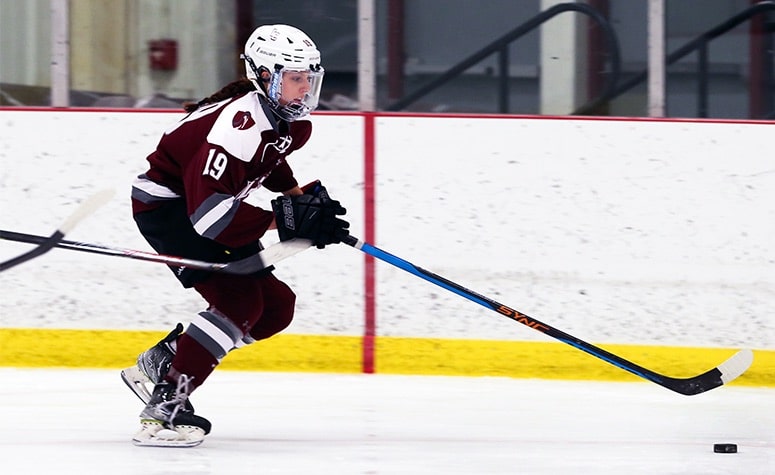

Catie Collins and her father, Terry, did their homework.
It was June 15 last summer, the first day Division 1 women’s college hockey programs could begin reaching out to rising juniors. Collins (South Burlington, Vt.), a standout defender at Loomis Chaffee, was home preparing for whatever came her way.
“I didn't know what to expect at first,” Collins said. “I'd had friends go through it, but I don't have any older siblings who had gone through it, and my parents hadn’t. We were unsure. I talked to my school and club coach a little bit about what to expect.
“I was prepared for anything. Whether I had no calls or a few calls, I was just excited.”
She and Terry developed a plan after listening to Youth Hockey Hub’s “The Minnesotan” podcast, which had a “Recruiting 101” episode. They heard other hockey parents share their experiences from the first day of communicating with schools. Terry took the day off to be home and help Catie stay organized.
“It's a lot coming at Catie at one time,” he said. Even with their preparation, they weren’t quite ready for the amount of schools that would make contact — and how early in the day they would reach out.
“There were a couple schools when I woke up that already sent an email or text, which was a shock,” Catie said. “I already had an email from 12 a.m. the night before.”
Terry said, “That morning, I went for a run and came back about 7:30. It was clear I was already late to the game. I had to jump in and help Catie get organized around reaching out to certain coaches, returning calls and helping her field the incoming stuff.”
For Collins and other women in the pipeline to play Division 1 hockey, that opening day of the recruiting window is just one point in a long process that’s filled with uncertainty, even for some of the best players. So when they wake up on June 15 to an inbox that’s filling up with recruiting messages, there’s a lot more work to be done.
The first round of calls
In 2019, the NCAA instituted new rules for women’s college hockey recruiting.
Coaches could no longer communicate with recruits prior to June 15 following a recruit’s sophomore year. Beginning that day, coaches and recruits could communicate via phone, email, text and direct message. Coaches can begin making verbal offers as well.
Players can still express interest to schools prior, but coaches can’t respond until the legal contact period opens.
Starting Aug. 1 before a recruit’s junior year, official visits can begin and off-campus contact is permitted.
U18 SELECT CAMP: 7 New England forwards who stood out | 6 New England defenders who impressed
Without those rules, Morgan McGathey (Braintree, Mass.), a star forward at Thayer Academy, likely would have heard from schools much earlier. Nevertheless, McGathey had plenty of coaches touch base on the first day of calls last summer.
“I wouldn’t say it was stressful, but it was definitely busy,” she said.
Molly MacCurtain (Reading, Mass.), a standout forward at Noble & Greenough, also had a hectic morning.
Her plan was to wake up around 7 or 8 a.m. and start her day. Some coaches had other ideas.
“My dad woke me up earlier because I was going to answer a call right then,” MacCurtain said. “It was like, ‘Oh my god.’ There were so many emotions. I was nervous, but I was excited.”
For several days, MacCurtain scheduled and returned calls. She knew she wanted to stay local, so she was glad to hear from Boston College, Brown and Northeastern.
True Thompson recalls hearing from Colgate first. The productive defender at New Hampton was on the ice with Little Caesars 16U that morning and had an influx of texts. She got to work scheduling calls over several days. She was ready for it, thanks to her coaches at Little Caesars, as well as the East Coast Wizards and New Hampton.
“I had three coaches prepping me,” Thompson said. “When I got those calls, I was pretty well-prepared.”
For some, having a parent or sibling go through a similar process is a key benefit. That was the case for Thompson, whose sister, Taze, plays at Northeastern.
Groton’s Maddie Cronan (Ashland, Mass.) had a big resource in her dad, Earl, who played at St. Mark’s before a collegiate career at Colgate and a four-year run in the pros. Earl, the scouting director with his former agent, Sports Management Group, deals with recruiting in boys hockey. He and Maddie were ready.
“In our process, something we’ve done on the boys side, was giving these schools Maddie was interested in a heads-up by writing some of these emails that they couldn’t respond to because of the way the rules work,” Earl said. “We chatted with Maddie about staying the course, knowing you’re putting yourself on people’s radars. Come June 15, they can reach out and reconnect with you based on what you sent off.”
Cronan heard from Princeton, one of her top choices, initially via text that morning.
“The night before, I was so excited I couldn’t sleep,” Cronan said. “I got a bunch of calls and texts. It was super exciting to hear from people and schools that I've been dreaming about hearing from for so long.”
Collins was thrilled to hear from Princeton coach Cara Morey. Morey was running a hockey camp, but texted Collins to schedule a talk later that afternoon.
She and her family got ahead of things like the Cronans did.
“We tried to be proactive about expressing interest to schools that were on Catie’s short-ish list,” her father, Terry, said. “Being proactive and expressing interest is really important because you need to make it happen. You need to get them interested in looking at you and talking to your coaches.”
Each path is different
Not everyone will be inundated with Division 1 interest from the start.
Take Julia Loughlin (Scituate, Mass.), a New Hampton standout who will return for a post-grad season this year.
“I got a lot of Division 3 interest from coaches,” Loughlin said. “I didn’t really get a lot from Division 1.”
It was never a guarantee that Division 1 opportunities would come.
“Julia didn't go the same path as a lot of people you might talk to,” said Lori Loughlin, Julia’s mother. “She didn't do a lot of phone calls. She didn't do a lot of visits at schools.”
All it took was being in the right place at the right time.
UNDER-18 SERIES: 9 New Englanders make U.S. Women’s Select U18 Roster
Loughlin was playing in an NA Elite showcase in December 2022, her junior year at New Hampton. She drew interest from UNH staffers.
“I don't even know if they were there for her,” Lori said. “They talked to the coaches right after the game, saying they were super interested in her. That's when the conversations kind of started.”
UNH continued to watch Loughlin play before having her in for a visit and later giving her an offer.
Loughlin, listed at 5-foot-2, is smaller than many other Div. 1 recruits. Her father, Tom, feels that kept her from garnering interest.
“A lot of schools are looking for bigger players or players that played in some of the USA Hockey camps,” he said. “Julia was kind of being overlooked because of her size.”
But Loughlin caught the attention of Sam Faber, a UNH assistant. Faber, the school’s fifth all-time leading scorer, was listed at 5-foot-4 as a player.
“She liked the way Julia played and could appreciate a smaller player,” Tom said. “I think that benefited Julia quite a bit.”
Faber became a critical resource for Loughlin.
“She called me multiple times over the year,” Loughlin said. “She’d ask questions about me, getting to know me better as a person and a hockey player, and I’d get to ask her questions about what I thought of UNH and just anything.”
Learning from visits
Visiting a school offers recruits a chance to get a better feel for a school as they hear from more coaches, players and even alumni.
Thompson’s mother, Liz, helped keep things in perspective and sort through all the information coming their way with each visit.
“After several visits, she narrowed down things she liked, things she wanted and things she didn’t want,” Liz said. “I always told her, ‘You'll know when it’s the right school.’ ”
Thompson had official visits with three other schools before visiting UConn. She also saw her sister at Northeastern a few times. She didn’t hear from UConn until later in the process, but once she stepped foot on campus in Storrs, Conn., she fell in love with it.
“It’s so cliché, but I was like, ‘Mom, I need to come here.’ I absolutely loved it,” Thompson said. “It was a combination of all the good things from every other school I visited and none of the bad. I was pretty stressed out, like, ‘How do I know if this is the right place for me?’ When I got to UConn, it definitely felt like a place I wanted to be, which my mom told me would happen.”
MacCurtain took admissions tours at other schools in the area, including BC, before going on official visits. Northeastern was her first — and last — visit.
The coaches showed her around campus. After lunch, she watched practice and met up with old friends from Nobles — Ellie Mabardy (Winchester, Mass.), a sophomore forward at NU, and Eliza Teplow (Wellesley, Mass.), a sophomore goalkeeper on the women’s soccer team.
“They made it feel very comfortable instantly and like a place that was very welcoming,” MacCurtain said. “When I watched the practice, that mirrored something I wanted to be part of with what they did and how the players carried themselves, the intensity and love for the sport. It seemed like a very close group of girls, which is something I was looking for.
“Nobles hockey is my favorite part of school and my favorite group of girls. They’re my best friends. I wanted that to carry over to the school I go to. I got that vibe from Northeastern.”
SUSTAINED SUCCESS: Inside Nikki Petrich’s plan at Lawrence Academy
When McGathey visited Harvard, being around the players, especially potential future teammates, was a major help.
“She went and stayed over a couple nights, hung out with the team and did their regular routine,” her father, Dan, said. “That’s when you get a real feel.”
Cronan went to Stonehill, Princeton, Harvard and Yale either through camps or official visits. Her trip to Colgate, however, was different.
“The Colgate girls and the team feel similar to me as a person, how we work and all that with hockey and off the ice as well,” she said.
As well as things went at Colgate, Earl didn’t want to rush into anything.
“We got in the car, and she’s like, ‘Dad, I’m going here. This place is the best,’” Earl said. “I said, ‘You’re not making that decision yet. We have a three-and-a-half-hour ride home. You’re going to take some time, take some notes, talk about it and think about what was different from other experiences.’”
Getting to the finish line
As exciting as the recruitment process is, it’s also a stressful, confusing time for players and families.
It’s a massive decision. It can be hard to keep track of everything. It’s also hard not to see what others are doing and maintain one’s course.
“Slowly as people start to commit, that creates a lot of anxiety, even if it wasn’t a school I was interested in,” MacCurtain said. “That would still provoke anxiety for me, like ‘All right, well, they already have theirs done. I guess I gotta get mine finished up.’ “That stressed me out. I did my best with it, and I was able to be happy for my friends and also separate that from my process. I had this weird feeling like I knew I was going to end up in this spot that was meant for me.”
Cronan’s parents reminded her to focus on her own process.
“Naturally, you’re gonna feel pressure because you’re always around these girls, and I’m a very competitive person,” she said. “You have to stay in your own lane. Everyone’s process is different. Knowing that and always keeping that in the front of my head was important.”
For Collins, Ivy League schools were a focus.
“That was really important for myself and my parents, that I go somewhere with rigorous academics,” Collins said. “That’s something I looked at in the prep school process, and it’s why I ended up at Loomis.”
She ultimately chose Princeton, and said attending camp there helped her establish important connections with Morey and the coaching staff.
“Having those conversations and figuring out who I aligned with and clicked with and had priorities I was interested in, that was ultimately what I was looking for,” she said.
McGathey also hoped to go the Ivy League route. She chose Harvard.
“When I went to visit, it kind of sold the deal,” she said. “It was clear to me what I wanted, just being on campus.”
Loughlin had attended camps at Merrimack and Holy Cross, but nothing came of those. More importantly, UNH and coach Hillary Witt wanted her. After touring the campus with her parents and coach at New Hampton, Craig Churchill, she got the call she was hoping for.
LATEST MAGAZINE: Check out the July/August edition of New England Hockey Journal
“A week after my visit, I got a call from coach Witt asking about it, and she offered me,” said Loughlin, who like MacCurtain, benefited from already knowing players at the school she chose.
For MacCurtain, her decision became clear, too, especially with how well her visit went at Northeastern.
“As summer went on, I came to the realization that I specifically wanted to be in Boston,” she said. “I loved Northeastern. I knew that if I had my official visit there and got an offer, I would definitely love to go there.”
While Thompson came to love UConn during her visit, it was her conversations with the coaching staff that pushed her toward her decision.
“When I met the coaches in person, everything they had to say was what in my mind sealed the deal,” she said. “I talked to them a couple times after the visit, but that initial meeting was really what made me want to go there.”
Cronan was enamored with Colgate after her visit. She and Earl’s meeting with coach Greg Fargo was a big reason why she chose to follow in her dad’s footsteps.
“Some of the other schools in the recruiting process, it was more about what the school was, who they were, why they’re going to be ranked higher because they have this player and that player,” Earl said. “I feel like Greg Fargo and the assistant coaches at Colgate did a wonderful job explaining how she’s going to develop, why she’s going to develop and why they wanted her in that mix.”
Along with that, the biggest selling point for Cronan? The family atmosphere created by Fargo, who recently resigned to become the head coach of PWHL New York, and his assistants, including Stefan Decosse, who will succeed Fargo.
“As I got to know them and got more of a feel for the program and the coaches, they were very caring people, and they cared about me,” Cronan said. “That made it special because it wasn't just like, ‘Oh, you're good at hockey.’ It was, ‘Oh, you're a great person as well, and we want you to come here.’
“I felt very loved.”
Editor's note: A previous version of this story listed the first date of players committing as Aug. 1. It's June 15, which has been updated in the story.