


Carter Meyer informed the U.S. National Team Development Program on Friday that he won’t be returning next season. The news broke later that night.
It was hardly a surprise, given there was a chance the Winchester, Mass., native wasn’t even going to attend the NTDP’s Evaluation Camp in 2025.
Meyer, who at the time was thought to be one of the top ‘09s in the United States, had serious USHL interest. One team pursued him aggressively as a tender.
But Meyer dreamed of suiting up in Red, White and Blue. So he went to the evaluation camp, made the team and accepted the offer.
The outside pulls from other teams didn’t stop there.
In June’s QMJHL Draft, the Québec Remparts picked him in the first round. The Remparts picked Sam Pandolfo (Winchester, Mass.), one of Meyer’s best friends who also played for the NTDP this past season, in the fourth round of that draft. They were more than happy to bring in his older brother, Freddy (Winchester, Mass.), who played for the Remparts all season.
Meyer was making his choice in a time when it was taboo to pick anything else over — or leave — the NTDP.
Then came J.P. Hurlburt, who broke down the wall.
The star forward, who put up 37 points in 56 games with the NTDP’s U17 team in 2024-25, opted for the WHL’s Kamloops Blazers midway through last summer. He followed that up with 42 goals and 97 points in 68 games. Come the NHL Draft, he should hear his name called before the end of the first round.
READ MORE: A new college coach has never coached in Division 1. Here's why he's uniquely positioned to succeed
All of this to say it’s not a surprise Meyer is leaving the NTDP. USA Hockey still needs to grant his release, but he intends to play for Québec in the QMJHL next season.
There will be those who think Meyer did this for selfish reasons, like money or to pad those stats to boost his NHL Draft stock come 2027. The Boston University commit is already a projected top-five pick, at the least. Some might beat their chest and wonder why he would opt not to play for his country.
But the reality is Meyer is one of the first prominent names to experience the hockey landscape in its very new form.
When the ink dried on the CHL ruling, which allowed players in the Quebec Maritimes Junior Hockey League (QMJHL), Ontario Hockey League (OHL) and Western Hockey League (WHL) to be eligible to play NCAA Division 1 hockey, everything changed. Suddenly, the CHL became a legitimate option for players who dreamed of college hockey.
Players never had this before. High-end NTDP talent like Will Smith (Lexington, Mass.), Ryan Leonard (Amherst, Mass.) and Cole Eiserman (Newburyport, Mass.), all first-round picks, never had the chance to go the CHL route. They wanted to play college hockey, which made the CHL road undriveable.
That’s no longer the case. Players now have a lot of options.
The NTDP is its own case study. It’s long been the top place for the best United States players before college. There was always a sentiment that if a player wasn’t a top-six forward or top-three defenseman with the NTDP, they were typecast as bottom-of-the-lineup players in college and after. Goalies were shelled with shots in their two years.
But players went. The feeling was always that if a player was mentally and physically strong enough to make it through the grueling U17 season (have fun playing — and often being routed by — older and stronger USHL teams) and the U18 season (add in playing Division 1 college programs), they were better off for it.
NTDP DREAMS: Sam Lee’s path to the NTDP | Jack Queally’s path to the NTDP
There are countless examples of that.
Having players taken in the first round has also become a strong selling point for the NTDP. They made headlines when eight of their ‘01s were taken in the first round of the 2019 NHL Draft. In 2022, six were picked in the first round; the next year, it was four.
The ‘07s, however, struggled. While many were drafted, none were taken in the first round. At the U18 Worlds, they fell to Sweden in the semifinal and won bronze over Slovakia. This year, Latvia (yes, Latvia) crushed Team USA (mostly made up of '08s), 5-2, in the quarterfinals, ending their time at Worlds.
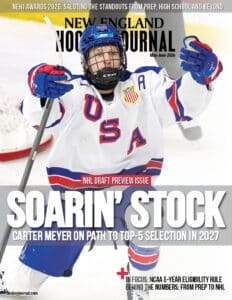
Meyer was on that U18 Worlds team as the fourth line left wing. After putting up 18 goals and 45 points in 41 games with the U17 team, he got bumped up to the U18 squad, for which he had 25 points in 29 games. On top of all that, he wore a letter for the U17 team, too.
Legitimate success and promotion, yet Meyer is still choosing to leave. The NTDP is caught in a perfect storm.
For starters, players can now be paid in junior hockey and still be eligible for college thanks to NIL. The NTDP doesn’t have a system to pay players, and their players now know full well their earning abilities elsewhere.
Bigger than that: players just have more choices. Prospects can opt to play for a USHL or CHL team and develop around older players. Those teams are also often more than happy to bring in those players. The NTDP’s hard-nosed, old-school environment works for some, but not for others.
The NTDP’s U17 squad went 4-34 against USHL teams this season. They were outscored 224-82 across their 38 games. That builds character, no doubt about that. But in times like these, that might not be a fit for everyone.
Meyer is likely not the only ‘09 to leave the NTDP. If others follow, what’s the point of having the NTDP if it’s not the best of each birth year? How will the ‘10s react to a notoriously hard U17 year? Once Meyer goes, won’t CHL teams close in even more on rising U18s — and USHL squads on 15O prospects?
READ MORE: How a new NCAA rule could cause seismic changes to college hockey and the levels below it
These are legitimate questions that surround the future of one of USA Hockey’s crown jewels.
But it’s very much an example of the changing times, which Meyer made the most of, charting his own path that others will most definitely try to replicate.