

Burned by the system
In Part 1 (click here), we examined "How did it happen?" How have legislation, geographic factors and select hockey taken tangible tolls on the quantity and quality of Mass. hockey?
Burned by the system
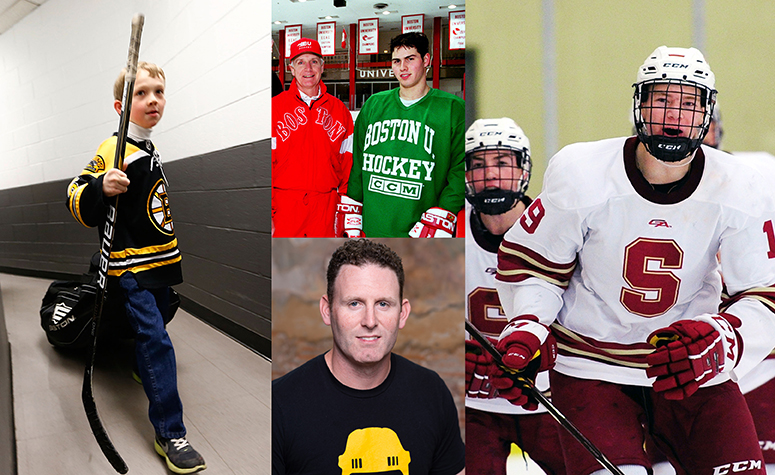
Mike Sylvia (Newton, Mass.) is a former Boston University hockey star. A three-sport athlete at Catholic Memorial, he came to BU in 1994. Playing alongside classmate Chris Drury (Trumbull, Conn.), they won the 1995 NCAA title as freshmen and never lost a Beanpot game in four years. Sylvia now has three children and is giving back as a dedicated youth hockey coach.
Prior to this season, he spent three years coaching Mites and Squirts for the Assabet Valley Patriots, an elite program in the competitive E9 circuit, one of the two premier development leagues in the Greater Boston area. A meticulous planner, Sylvia took pride in drawing up his own drills to supplement the USA Hockey system of half-ice games and stations.
“I dove in headfirst,” said Sylvia. “It’s better to be involved than sitting in the stands and complain about the coaching.”
In 2018, he and his oldest son, Mateo, won a Squirt championship with the Patriots, but that joy was short-lived. Every February during Sylvia’s three years with Assabet, he would get disquieting phone calls and emails. “Hey, Billy’s not going to be at practice,” said Sylvia. “You find out a month or two later he’s practicing with another team. Crazy conversations would start happening, ‘Are you not going to stay in the league?’ Two weeks later another parent came to me and said, ‘We’re going to this team,’ and two weeks later another.”
Sylvia learned the hard way that there are no allegiances. Parents, in search of the best route to the top of the hockey pyramid, would play hopscotch with their child, jumping from one program to another. They frequently were coerced from the E9 league to its supposedly superior counterpart the Eastern Hockey Federation. Raiding teams is the current reality in Massachusetts youth hockey, as programs try and create super-teams for prestige and profits.
“There’s people that get kids on teams that are 61-2 at 12 years old,” said legendary BU coach Jack Parker. “They think that’s good for the kid, ‘We travel all over and beat up everybody.’ Even those kids aren’t coming out and being Tony Amonte, you know?”
For Sylvia, an honest coach trying to develop an entire team for all the right reasons, players’ jumping from program to program year after year became all too normal.
“It was challenging when my assistant coach and his son decided to leave," he said. "He had an opportunity to be a head coach in a program closer to home, so I understood it 100 percent made sense for his family. The difficult thing was I knew the ripple effect from that decision would cause other parents to consider leaving our team, and that’s exactly what happened. Even a day before tryouts, I had another parent who said, ‘Our son is not returning to the team and is going to play here.’ The chaos that ensued the following weeks, being on the phone with the parents non-stop, ‘Are you guys staying, are you going?’ The stress that the team and my family was under …”
Sylvia trailed off, immersed in the bittersweet memories of having five players abandon his championship squad of 2009-born Mites, a team that had won the league title game in joyous overtime. He has since found peace.
He now coaches all three of his sons — Mateo (10), Sebastian (8) and Cam (5) — helping them develop while surrounded by new friends in their own neighborhood. The rink is only minutes from their house, and they enjoy nearly unlimited ice time. This youth hockey nirvana is not in Massachusetts, however. Sylvia up and moved his family to Minnesota, and the hockey suburb of Eden Prairie.
The expat
Sylvia, ever curious about development, has been tracking global hockey trends since playing in the World Junior Championship in 1996. He uses Twitter for its news value, and while following Mike Snee and College Hockey Inc., he learned how much NHL “market share” Massachusetts has lost compared to none from Minnesota. He learned how countries like Sweden and Finland were taking giant slices of the NHL player pie at the expense of Canada, as the Nordic nations inverted Canada’s ratio of games to practice. Europe’s community-based programs are thriving, much like the Minnesota paradigm. Sylvia computed it all.
“I’m a numbers guy,” said Sylvia, “and the numbers don’t lie.”
Stained by his experience in Boston, Sylvia had enough flexibility with his real estate business in Boston to allow him to dive in again, this time into Minnesota’s 10,000 frozen lakes, America’s hockey heartland. The Sylvia clan has lived in the Twin Cities for less than a year, but so far, the hockey life in Minnesota has exceeded expectations.
“There are no regrets,” said Sylvia in January, well before the COVID-19 pandemic shut down hockey in March. He then listed all the new benefits in detail, from the short commutes to ice time both indoors and out. But it was Minnesota’s enhanced sense of community that ruled the day.
“We’ve only been here six months, and our kids already look up to the high school hockey players,” said Sylvia. “We go to most of the games, and all their teammates and hockey friends are there, so they run around the rink together. Same goes for the Bantam double-A team and Pee Wee double-A team. We have friends that have kids on those teams, and we enjoy watching the teams play, so we drive the eight minutes to the community center and watch their games. They have something special here.”
Culture wars
High school hockey, now largely off the elite radar in Boston, is the centerpiece of Minnesota’s developmental success. It is the secret sauce.
“There are 150 to 160 community associations that feed into high school hockey,” said Snee. “Then you move into high school and you have 150 high school teams, 150 power-play units, 150 captains, and so on. You are not told to stop taking yourself seriously as a hockey player until high school is over. There is no narrowing of the pyramid, you are not confronted with your hockey mortality until your last high school game.”
Snee is rarely without his Excel sheet of the Minnesotans currently in the NHL. Of the 52 who have played in “The Show” this season, 46 played high school hockey (92 percent) and, remarkably, 27 NHLers actually stuck around for their senior year in high school (52 percent).
“There’s a photo of Casey Mittelstadt and Nick Lievermann as Mites,” said Snee, “then hugging for a goal celebration as seniors for Eden Prairie High. Both drafted in the NHL (months later in 2017). Teammates from age 5 all the way to 18. That’s not abnormal, that’s normal.”
Harvard coach Ted Donato (Dedham, Mass.), now a Scituate, Mass., resident, realizes that the town’s hockey culture has suffered without community-based hockey.
“Look at Ryan Whitney,” said Donato. “He never really played in Scituate. He played for the South Shore Kings, played for Thayer, and then went to BU. If he walked down the street, nine out of 10 people would say they didn’t know him. He never really represented Scituate. The town’s missed out on celebrating one of its great athletes. You’re not getting the benefit of building a culture.”
Individually, though, Whitney hit a “hockey trifecta” of sorts, parlaying his skills and all that training and ice time into a scholarship to BU, a first-round NHL draft selection, and lengthy and lucrative NHL career.
Whitney conceded that he was a virtual stranger in Scituate until recent notoriety from his popular podcast “Spittin’ Chiclets.” But he benefited from the South Shore hockey culture, with both the South Shore Kings and Thayer Academy in Braintree.
“My dad took me to Thayer games, and I remember Mike Mottau (Avon, Mass.),” said Whitney. “I knew Tony Amonte was from Hingham, and Jeremy Roenick was from (Marshfield). There were so many guys I could look up to, heroes of mine that were from an area I was from. It makes it more realistic.”
Donato has seen Massachusetts transition away from the community-based system and knows how much talent gets lost in its current club-based paradigm.
“If I took a South Shore Kings Squirt team, we would kill every Minnesota team by nine goals,” said Donato. “However, the kids from Minnesota, paying 500 bucks a year, they’re playing in their own town, three, four days a week, and they keep getting better. No one’s seen them all that much, yet. Then, ultimately, you have this second wave of development.”
Minnesota’s second wave
The cost of elite triple-A hockey is so high in Massachusetts that kids who fail to make teams or cannot afford to play travel hockey drop the sport early in childhood. Consequently, today’s Massachusetts hockey pyramid has become extremely narrow, losing a generation of young athletes before puberty.
“From age 12 to 16, genetics are coming into it,” said Donato, who describes a typical Minnesota late bloomer. “You have a kid that’s big and athletic, he plays baseball, hockey and football, and he starts putting more time into hockey. You can still play other sports, go to your local high school, and you can play in the state tournament. You’re not narrowing the field.”
Donato then recited tales of late bloomers who would have fallen through the cracks if raised in Massachusetts today. “Ed Jovanovski did not play on a travel team until he was 15 years old. He was the number one pick in the (NHL) draft when he was 18. What did he miss? My brother Michael, who was 9 or 10 years old the first time he ever played, was ultimately good enough to play Division 1 hockey at Princeton.”
Donato admitted to being “scared” about the current Massachusetts system that weeds out so many players before the age of 10: “How many kids are missing out on playing hockey?”
Former Merrimack coach and Boston College product Mark Dennehy pulls for Massachusetts to return to its rightful place as a primary hockey breeding ground, but he knows it’s a losing battle under the current system.
“I want more kids from New England, Boston in particular, to make the NHL,” said Dennehy. “But it’s pure mass: The more players you have playing, the better chance you have. We’ve excluded a lot of players with this elite hockey at age 8.”
The topic inevitably returned to money.
“Twenty-five thousand dollars,” said Dennehy, calculating the true cost of travel hockey. “It’s socioeconomically elitist.”
The specialized players coming out at the end of the privilege pipeline don’t impress veteran observers.
“The actual quality of hockey has gotten worse. It’s way more diluted,” said former BU strength coach Mike Boyle. “Select hockey is just expensive town hockey. The kids aren’t athletes any more, they are little mom-and-dad robots.”
Coming tomorrow: Part 3: Hope for Massachusetts hockey
Far from the skyscrapers of Boston, one Massachusetts town is going grassroots to fuel youth hockey passion and finding success on and off the ice.