
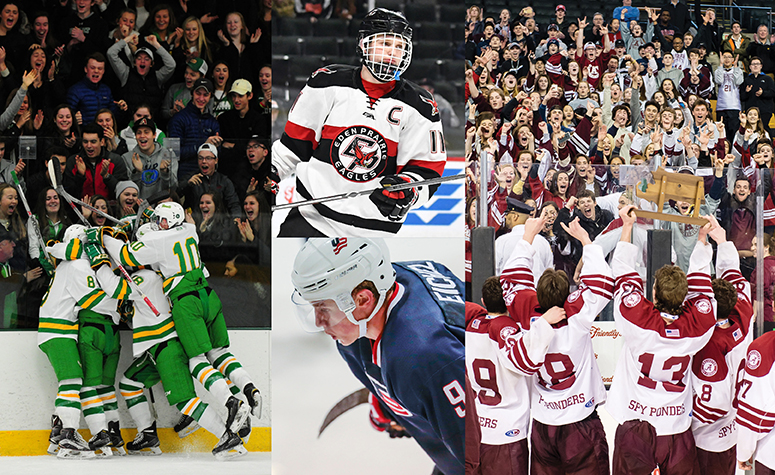

How the mighty have fallen. Massachusetts, the once-proud breeding ground of Olympic, NHL and Division 1 college hockey stars, has lost its place atop the pantheon of American hockey breeding grounds.
The numbers don’t lie. Despite the boasts of prestigious travel hockey programs throughout the Bay State, Massachusetts has dropped like a rock in terms of producing NHL and NCAA Division 1 talent. A generation ago, Massachusetts was the gold standard of American hockey states: 40 NHL players compared to 24 Minnesotans in the 2002-03 season. Today those numbers have flipped, with Minnesota producing more than twice as many NHL players as Massachusetts: 52-24.
If producing NHL players by state was an Olympic competition, Massachusetts wouldn’t even reach the medal stand, fourth behind Minnesota, Michigan and New York. Massachusetts narrowly scores a bronze in producing Division 1 college hockey players: 107 players compared to 201 Minnesotans and 150 Michiganders.
How did it happen?
According to former Merrimack coach and Boston College product Mark Dennehy, much of it was economic. “We’ve excluded a lot of players with this elite hockey at age 8,” said Dennehy. “Twenty-five thousand dollars when you add in travel costs and equipment.”
“When I was growing up, we were getting wooden sticks,” said Scituate, Mass., native Ryan Whitney, who played nine seasons in the NHL. “Now these sticks are so expensive, along with the skates. There’s so many people that can’t play because of financial reasons. … It’s a game changer.”
 Harvard and Team USA legend Bill Cleary (Cambridge, Mass.) concurs: “They’ve got all these travel teams now, too costly for the average family to afford to have their own kids play hockey. … Really conflicts with the high schools, which I think is disgraceful.”
Boston University majordomo Jack Parker (Somerville, Mass.) often is down at Tabor Academy watching his grandson Shane Lachance. “I see a lot of prep school hockey,” said Parker. “It’s better than high school, but it’s still not producing Keith Tkachuk (Melrose, Mass.).”
The strength trainer for Parker’s last two national championship teams was Mike Boyle, who cites another evil leading to the decline of Massachusetts hockey talent — specialization.
“Go back to Tony Amonte (Hingham, Mass.), Kevin Stevens (grew up in Pembroke, Mass.), Jeremy Roenick (Marshfield, Mass.), Joe and David Sacco (Medford, Mass.). They were all good multi-sport athletes,” said Boyle from his gym in Woburn, Mass. “Tony Amonte was the punter on the Thayer football team; Joe and David Sacco were the best baseball players at Medford High.
“Late 1980s, early 1990s, tons of Mass. kids were making the NHL, and the parents just went, ‘I want to make my kid a hockey star. I’m going all-in on hockey,’ and they decided to specialize.”
This is a sticking point with Boyle, who has seen a generation of steady athletic decline from parents who had their kids abandon other sports.
“The parental reaction was to give up everything else,” he said. “Everybody says that’s a thing of the past, but it’s actually why we were good. I think we killed the multi-sport goose that laid the golden egg.”
Losing its market share
Mike Snee, executive director of College Hockey Inc., is confounded by Massachusetts’ plummet from the top of the hockey heap. “I would argue that in the 1980s, Massachusetts was better than Minnesota,” said Snee, a Minneapolis native who serves on the USA Hockey board. “Now, there’s literally no comparison. If you got out a whiteboard and made check marks good and bad, I don’t think you’d have any check marks in the good column (for Mass.). I can’t think of anything that’s changed for the better.”
Tim Lovell, who runs the Boston Advantage program with teams competing in the Elite 9 and Boston Hockey leagues, claims that hockey’s geographic explosion is the reason Massachusetts is shrinking among the NCAA Division 1 and NHL producers.
“You hear stuff like that all the time — ‘Oh, the hockey back in the day, there were more people coming out of Massachusetts,’ but there’s hockey in every state now,” said Lovell. “You’re obviously not going to have as many kids from Mass. because there’s hockey everywhere — California and Florida and all the other places that are doing the same thing you used to do in Massachusetts.”
Snee says Lovell is right that there are so many more California, Texas and Florida kids playing high-level hockey today than before. “But keep in mind, they started pretty much at zero,” Snee said. “So you throw up some rinks and have kids play. You know what they say, a blind squirrel finds an acorn; you’re going to get some players. But if you talk to people who scout there, it hasn’t really taken off. It’s kind of stunted the quality.”
Snee echoes Boyle and others when it comes to the bottom line: “Who has lost that market share? It’s Massachusetts. Minnesota hasn’t lost any of its market share.”
Two models: Community vs. club
Snee asks a rhetorical question: “Why are Mass. numbers so low compared to 20 years ago?”
The answer lies in the generational change within Massachusetts, going from a community-based system, like the one currently used in Minnesota, to a club-based system. The current Massachusetts system sees youth hockey players bounce from private club to private club, triple-A teams that traverse North America in search of notable wins and recognition from scouts. High school hockey has been left in the rear-view mirror, and with it, Massachusetts has lost both its innocence and its market share in the NHL and the NCAA. In contrast, Minnesota has increased its number of NHL players, and its model still revolves around high school.
“Minnesota has it figured out right now, the high school hockey setup, I’ll say that,” chimed in Whitney.
“Our rinks are still publicly owned,” Snee said. “We still play for our association, still play for our high school. How did it occur in Mass. where they flipped that switch from public to private club?”
Dennehy, a Dorchester, Mass., native who attended BC High before playing at Boston College, shares a sobering truth: “We as a society — at least in Massachusetts — have basically said, ‘Our taxes are high enough, we don’t want to fund athletics.’ ”
Dennehy referred to Proposition 2 1/2, the landmark 1980 bill prompted by Massachusetts citizens who cried out for tax relief. The ensuing legislation sparked a series of cutbacks in public funding, sports being a notable casualty.
The Metropolitan District Commission rinks that sprouted up throughout Boston during the Bobby Orr hockey explosion are now being leased out and are showing their age. The new rink owners began pushing for hockey to be played 11 and 12 months a year. Entrepreneurs helped fill that ice time with skills camps and showcase tourneys, exploiting the burning desire of hockey moms and dads to help Junior get his shot at the brass ring — a Division 1 scholarship and the fast track to pro hockey. Local teams, and playing for one’s high school, became quaint anachronisms. A youth hockey arms race roared into the new century, fueled by slick operators trying to make a buck off of wide-eyed parents.
Hockey families, caught up in the “noise” about the best program to place their children, became surrogate general managers for prepubescent youngsters. Today the cost of triple-A hockey is prohibitive, kids are specializing before the age of 10, and the system is spiraling out of control.
“Massachusetts hockey is a joke now,” said Neil Shea, a Colorado Avalanche scout who has navigated two sons, both elite prospects, through the perilous waters of Massachusetts youth sports. “Hockey is all money-driven.”
Following the money
“Capitalism is a wonderful business model, but it’s a horrendous development model,” said Dennehy. “It’s not good for youth sports.”
Hockey starts innocently enough for a child in Massachusetts. Parents put their kids on skates at age 5 or 6, and coaches trained by America’s national governing body await, teaching the game the right way: skills stations, prioritizing fun, and reducing the heavy emphasis.
“USA Hockey does a great job in training coaches, providing instruction and a safe place to start,” said former Hockey East commissioner Joe Bertagna, a product of Arlington (Mass.) High. “The problem is the number of entrepreneurs lurking around, recruiting kids to independent programs. People are getting rich on youth hockey, and doing harm to programs where every kid starts.”
“Select hockey has put town hockey out of business,” said Boyle. “You have people whose livelihood is hockey. They need year-round hockey to make a living. You can’t have a six-month hiatus, so what do you do? You sell spring league, you sell summer hockey, you sell fall league. It’s not about hockey, it’s not about development. Follow the money. Almost all these people know they are wrong, but they have an economic incentive to continue the process.”
Coming tomorrow: Part 2: A 'second wave' of development
How one former Boston collegiate standout found greener hockey pastures for his family in the Land of 10,000 Lakes