
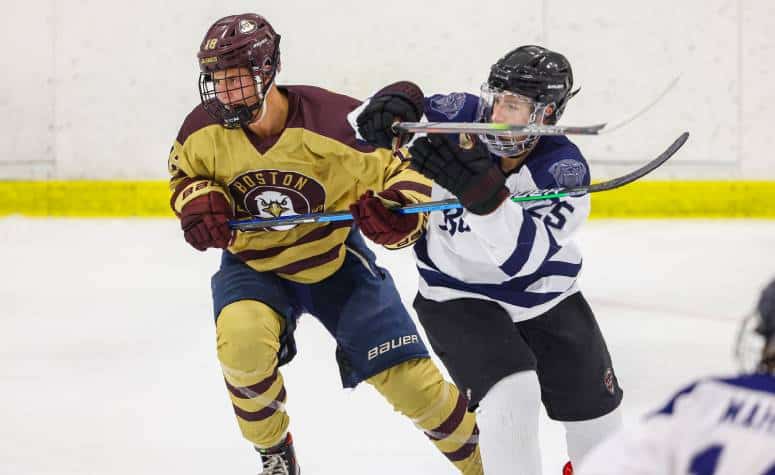

The Foxboro Sports Center was packed during the River Rats Jamboree in August. At the Eastern Alliance Kickoff early in September, the New England Sports Center parking lot was full at all times.
Inside both venues, hundreds of parents and players were moving in every direction — heading to games, grabbing a quick bite to eat or chatting with friends.
Sticking out in those crowds were all the college coaches in their jackets — Boston University, Harvard, UConn, Sacred Heart, Ohio State. The list could go.
This is the case almost every weekend through the fall in New England. College coaches flock to rinks around the region to watch fall split-season teams or academies, as they look for college hockey’s next impact players.
The fall split-season model leads into the New England prep hockey schedule, which has long been scouted by college coaches and NHL eyes. It carries history. It’s what parents have no problem paying lots of tuition money for.
However, fall hockey and its showcases have gained more relevance in recent years. So which brand of hockey is more important in the eyes of college coaches?
The answer is complicated.
“Whether it’s the split season or in prep school, if you want to be not only a Division 1 player but even a good Division 3 player, you have to find success in both,” Michigan State associate head coach Jared DeMichiel said.
Associate head coaches and assistant coaches are the lifeblood of college hockey programs. Typically, they’re the ones most involved in recruiting new talent. Last year, The Athletic ranked DeMichiel as the No. 3 recruiter in college hockey. He was instrumental in executing UMass’ turnaround and national championship through recruiting as an assistant and, eventually, an associate head coach for the Minutemen from 2016-22.
“From my perspective as a college coach, I wouldn’t love for one player to be more focused on one than the other,” DeMichiel said. “If we want to win a championship at the college level, we want guys that are coming to us that want to win a championship at their previous level no matter what they’re doing. We want guys that want to be the best at everything not just sometimes.”
The main difference between the two brands of hockey is that fall features players facing kids their own age, while prep is players across multiple birth years. That can provide different approaches to recruiting.
“It’s a pretty wide-open game, which is good for a lot of reasons,” Providence College assistant coach Joel Beal said of fall hockey. “I think you get to see a lot of players’ creativity and their skill level. …There are certain benefits in terms of the flow of the game and the pace and having some of that unstructured skill.”
While fall hockey is a bit more open, prep hockey is far from it. It’s known for its structure and physical style, which some coaches believe is equivalent to the kind of hockey players will find at the college level.
“You look at some of the prep schools and the postgrads. The game at the prep school level tends to be a little heavier,” Beal said. “It’s probably a little bit more physical with less space. You get to see the progression of a player or how they adjust to a different style of hockey. I know in Hockey East, that’s more of the style that they’re going to have play — less space, a little heavier, a little more physical versus a wide-open game, which we don’t see as much of in our league.
“That’s a real benefit to us to be able to watch the same player over a four or five-month period playing two different brands of hockey and see if they’re able to excel.”
The playstyles in both seasons are different. That doesn’t mean all schools view them through contrasting lenses when recruiting.
“I don’t think there’s a big difference,” Harvard assistant coach James Marcou said of fall vs. prep hockey. “Every time we watch a player we’re looking at, the big thing is the consistency or just seeing some of the positive things that players are doing each time they’re on the ice and taking that and marking it down and then seeing if they consistently are doing those things over time.”
There are times in which players stand out a lot in the fall, but begin to blend in come the prep season. It happens — players go from dominating their own age to struggling against older competition. It’s not the end of the world.
But it does leave college coaches with a decision to make.
“I don’t think you necessarily stop recruiting that player,” Beal said. “But it does give you a little bit of pause to just really make sure that you have a good evaluation. Even if we’re not talking about fall hockey to prep hockey, I think you can see some players that are extremely dynamic 15U hockey players and then at the 16U level they start to slow down a little bit now. …So you’re always trying to figure out how what a player does translates to the college game.”
INSIDE THE TRANSITION: The path from prep school to the USHL isn't always easy
Almost all assistant coaches have experience being recruited themselves. That’s the case for Yale assistant Rob O’Gara, who was recruited to play for the Bulldogs in the early 2010s.
O’Gara, from Nesconset, N.Y., played for the Long Island Royals before heading to Milton Academy in 2010-11. The 6-foot-4, 214-pound defenseman was taken by the Boston Bruins in the 2011 NHL Draft.
“When I went to Milton for what was my first experience, I had a good split-season and in hindsight, it really was when I was able to translate it to prep that things became serious, and I see why now,” O’Gara said.
O’Gara was a self-described “late bloomer” who was recruited later than most of his peers. He went on to have a successful, four-year career with Yale from 2012-16 and spent time between the AHL and NHL until his retirement in 2021.
His success at Milton Academy was a launching pad for that. It’s why he values success in prep hockey over that in the fall.
“Seeing someone play prep, whether it’s a younger guy playing against older guys or an older guy you want to see kind of be the guy at that level — that’s where I think the structure is better,” O’Gara said.
But even in the last 10 years, things have changed dramatically. O’Gara went straight from Milton Academy to contributing as a freshman at Yale. Now players rarely go that route, often spending one to three seasons in juniors before making the transition to college.
Another thing that’s changed the game is the academies.
Over the last decade, schools like South Kent and Mount St. Charles have found success opening academies that blend school and hockey training around a full slate of games from fall on through the winter and into the spring. Since then, others like Lovell Academy, Boston Hockey Academy, Seacoast Performance Academy and more have opened, drawing players from near and far.
The Long Island Gulls have become a full-season team, too, with most of their players going to school online and traveling the country for games on the weekend.
Many of the fall split-season teams play these academies; the prep schools don’t. The growth of the academies has impacted recruitment during both seasons.
“I think it makes it a little harder because now the players are spread out a little bit more,” Providence College associate head coach Ron Rolston said. “It’s not as much one-stop shopping whereas now, you may have to do a lot more digging to find a diamond in the rough that’s playing for the Boston Hockey Academy or whatever academy they’re playing at.
“That will continue to probably evolve over the next 10 years — these different options for players to play in. That’ll continue to spread out the players.”
Even without the academies, there are lots more fall split-season teams than before.
“Early on, there was a select group of teams with some very, very high-end players,” DeMichiel said. “It was kind of like watching the best prep school teams and the best prep school players playing against each other. I would say it’s gotten a little bit watered down where it’s not the same. I think, too, when [fall split-season hockey] first started, I thought it was more competitive and it meant more to the kids. Now, I feel like some kids are just like ‘Oh it’s just fall hockey.’ And it’s like well, no. As colleges and NHL teams, we’re making decisions.
“I know with the NHL, they’re watching the U18 level and the prep level and watching the kids close. If you’re going through the motions in fall hockey, they might just cross you off the list for prep school hockey.”
INSIDE THE PROCESS: What it's like to be recruited to play college hockey
College teams got help chasing the scattered talent this January when the NCAA approved the addition of an extra, paid coach. So schools can now carry another assistant. It’s a big help on the recruiting scene.
“There’s a lot more options nowadays,” Arizona State associate head coach and recruiting coordinator Albie O’Connell said.
That’s true for players. Now, it’s true for colleges, too.