

To stay or to go.
Those five words loom over the top players in New England prep school hockey every season. As the stats get gaudier and the attention becomes greater, players face a difficult decision: Stay at prep school or move on to the United States Hockey League?
It’s a big decision to step up into the premier junior hockey league — and college hockey feeder system — in the United States, and it’s rarely an easy one.
What makes the USHL so different from prep school hockey?
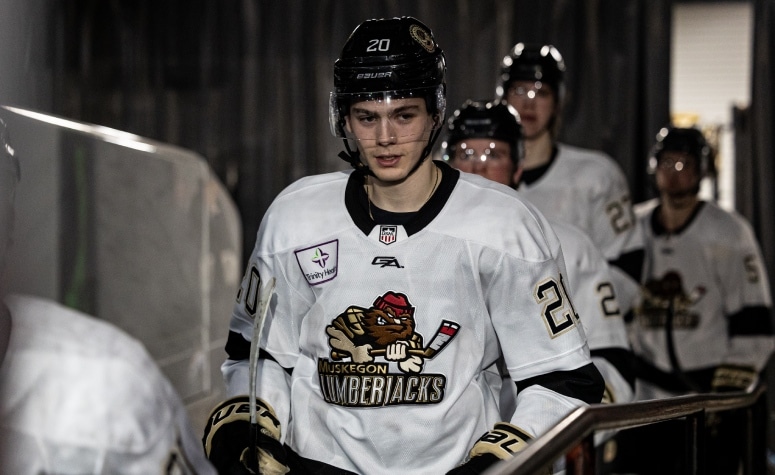
“Everyone’s a Division 1 hockey player,” said Will Hughes (Andover, Mass.), who last year left Dexter Southfield a year early to play for the USHL’s Muskegon Lumberjacks. “Everyone’s fighting for each others’ spots and no one is a step behind. It’s a battle for your spot every day.”
Over the last 10 years, prep school players have increasingly bolted early for the USHL to test themselves against higher level of competition. Not everyone goes before graduation. Sean Keohane (Milton, Mass.) of Dexter Southfield and Ethan Gardula (Princeton, Mass.) of Cushing both stayed in prep school this season and both should hear their names called in June’s NHL Draft.
But a new batch of players around the region is facing the USHL decision now. The league’s teams just drafted 13 New Englanders born in 2007. Even more were taken in Phase 2 of the league's draft.
They will reach out for advice — from family, coaches, players already in the USHL and advisors. They will hear a lot of different opinions as they decide whether to make the drastic change that can transform them from a student who plays hockey to, essentially, an entry-level pro hockey player.
You have to adapt fast
Gavin Cornforth (Milton, Mass.) dipped his toe in the water and realized he was ready for the deep end — even as a rising sophomore at Thayer Academy. The Dubuque Fighting Saints of the USHL drafted the 2006-born forward in the first round (12th overall) of the Phase 1 draft last year.
“I came out [to Dubuque] for a week or two during training camp,” Cornforth said. “They told me just to come to look at what Dubuque is all about. I played a few games and I realized that I could actually fit in and play in this level of hockey.
“It was best for my development to come early on.”
That final sentence has become a popular sentiment among the cream of prep hockey’s crop.
Last spring, goaltender Sam Scopa (Lexington, Mass.), then a sophomore ‘05, had just backstopped Belmont Hill to the NEPSAC Elite 8 championship game and cemented his place as a budding star in prep hockey. Shortly after, he was with the Boston Jr. Eagles at 16U nationals.
The U.S. National Team Development Program offered him a spot to practice, and eventually see game action, with the U17 squad.
“I got really used to this field of play and I felt confident in the games that I played,” Scopa said. “I felt like I was ready to make the jump and also I feel like my season with Belmont Hill and on the Jr. Eagles was really nice, but I wanted to be challenged in a way the next season.”
ABOVE AND BEYOND: 7 prep teams that exceeded expectations in 2022-23
And the challenges are many — on and off the ice. First, there’s a battle for roster spots. You may have been a star in prep school, but when you arrive in the USHL you’re one of many talented players — who all have to earn their spot.
Ryan Walsh, a two-year player for Salisbury, figured that out quickly once he began playing for the Cedar Rapids RoughRiders last year.
“You have to adapt. You’re playing against the best players of your age,” Walsh said. “Every guy up and down USHL rosters is going to a Division 1 college.”
One player who left prep school early was Chris Romaine (Boston, Mass.). The Providence College commit opted to forego his senior season at Milton Academy and head to the Omaha Lancers last year.
If there was anything clear upon arrival, it was the high level of intensity in practice.
“Once you start getting into practice and the speed and flow of practice, that’s honestly the biggest transition,” he said. “Once you hammer that down, the games are kind of a bit easier. Those practices going against your teammates, that’s one of the hardest parts about the transition.”
Cornforth said it took a month or two for him to adjust to the pace of the USHL.
“The first month was definitely hard on my body,” Cornforth said. “I wasn’t used to skating every day. The speed is definitely really fast. It was tough for me to adjust. I had to relearn the game in a way. Moving it quicker, keeping my head up at all times, and playing a structured (defensive) zone. I wasn’t used to there being much structure at all. That was definitely a learning curve for me.”
Walsh credited his adjustment into the USHL with advice RoughRiders coach Mark Carlson gave him to focus on strength training during the summer to “be almost game-ready” when he arrived at camp.
THE FUTURE: 13 New England '07 prospects taken in 2023 USHL Phase 1 Draft
“You pick up the speed pretty quick after training camp,” he said. “You either adjust or you don’t and if you don’t adjust, you won’t play in the league.”
‘Every day is kind of like a job’
When regular students attend college, they look for internships that will gain them real-world experience to ready them for the workforce.
The USHL is like an internship for teenagers with college and pro hockey aspirations. They’re getting a glimpse of what hockey as a professional is like.
Gone is the structure of school, with hockey supplementing classes and schoolwork. Instead, school tends to supplement hockey. Players are students at their own pace, with many taking classes online.
“When you’re in prep school, you have school in the mornings and stuff like that,” Walsh said. “That takes up a pretty big part of your day and you can’t be at the rink for long periods of time.”
And in the USHL?
“You’re there, especially in the beginning of the year during training camp and stuff, you’re there from 8 a.m. until 3 p.m. You have workouts, you have video, your meetings, you have practice,” Walsh said. “Our practices would be two and a half hours long. We’d have an hour and a half practice then we cut the ice and then we go for another 45 minutes to an hour.”
Cornforth, even after a full season in the USHL, said he’s still adjusting to hockey becoming a job instead of an extracurricular activity.
“It’s still hard,” he said. “If you have a bad game, your mindset can totally change. Your confidence can go much lower. For prep, if you have a bad game, you can bounce back the next. For me, it’s been something I’ve had to learn — my mindset has to change where every day is kind of like a job. But it’s also fun — it’s a game.”
Exactly — it’s a game. It’s hockey.
“It’s just a different schedule,” Scopa said. “I love it. I love hockey, so it’s worked out perfectly for me.”
But there’s an off-ice component to the game, too.
Homesickness can be an issue
The USHL is spread across the midwest. The closest franchise to New England is in Youngstown, Ohio. Others are spread across states like Nebraska, South Dakota, Iowa, North Dakota and Wisconsin. They’re not exactly an easy drive from New England.
So, for a league where players join as young as 16 years old, leaving mom and dad behind can be another challenge.
Some players can adjust better, especially if they had experience living away from home for prep school. But for some players, especially those who stayed local for prep school, homesickness can become an issue.
That’s where billet families come in. Each team has families who sign up to house players for the entire season. It’s designed to be a home away from home.
“It’s definitely an adjustment. I’m not going to lie — it’s a little weird,” Hughes said. “But after about a week or two, you kind of become part of the family.”
Michael Callow had just finished his senior season at St. Sebastian’s when he left his home in Boston to play for the Muskegon Lumberjacks. Going from a roughly 30-minute drive home to a three-hour plane ride was an adjustment.
“I was sad,” Callow said, “because, at St. Sebastian’s, I was only 20 minutes away from my house. Going home every day. Saw my parents every day. Just that adjustment right there was a big one — having to call my mom instead of going home at the end of the day.”
But most of the kids on USHL rosters are experiencing similar emotions away from friends and family, which is something that helps bond players from different parts of the globe.
“Off the ice, it’s hard. It’s a different experience for everybody but leaving home and coming out here halfway across the country is definitely not easy,” Romaine said.
PHASE 2: 19 New England prospects taken in 2023 USHL Phase 2 Draft
“There’s a lot of stuff that kind of helps you through it. Your teammates are a big one, I’ve gotten pretty close with my teammates. Everybody’s in the same situation so everybody’s helping each other out.”
Along with hockey, that includes other fun activities like hanging out off the ice and hitting the links when the temperature rises.
“We’re golfing a lot. We’re doing all that fun stuff that normal kids do,” Scopa said. It’s really nice to be able to feel like you’re kind of free. You have some freedom here.”
The USHL can also deliver lessons about the business side of hockey. Romaine, for example, was drafted by Omaha but ended up being traded to Green Bay.
Romaine had a back injury in 2022 that worsened upon arrival in Omaha, and he missed several months. Lots of teammates had already established themselves in the Lancers lineup when he returned in November. He wanted more opportunities.
The Omaha front office obliged and dealt him to Green Bay.
“You may not realize it in the moment but after you get through some adversity, even for example the trade, just kind of having to pack up all my stuff and say bye to my friends was pretty tough,” Romaine said. “But just grinding through that and getting here with a new team and just having that attitude of ready to get started and keeping a positive attitude and putting a positive spin on things has been huge for me.”
All of these elements come after the big decision: How do you know if it’s the right call to leave prep school and enter the USHL?
Jacob Kraft finished his senior year at Kent before heading to Cedar Rapids. Even at 19 years old, there was a decision to be made.
“Honestly, you can never be 100 percent sure,” Kraft said. “It’s just doing what you believe. I wanted to play in this league and stick with it and go through the process of main camp and training camp. …Just wanting to be there is the biggest thing I think.”
The stakes are even higher for players who’ve yet to reach their senior campaign at prep school. It’s a teenager making a decision that will send shockwaves — good or bad — through his hockey career.
One of the big keys is listening to those around you.
“I had a lot of people,” said Romaine, the Milton Academy product, “even coach [Paul] Cannata who obviously had some bias, probably wanted me to stay. Even he told me that was what was best for me and that was the best decision for my development path.”
Lucas St. Louis (Old Greenwich, Conn.) found himself in a similar situation in the spring of 2022. The defenseman was coming off a great junior season with Brunswick. He scored six goals and added 29 helpers in 30 games. The previous year, he has been selected 20th overall in the USHL Phase 1 Draft by the Dubuque Fighting Saints.
He was ready. It was time to go.
“I felt like I was comfortable in prep, comfortable enough to take that next step,” St. Louis, a Harvard commit, said. “I knew I was going to want to take that next step at some point so I just figured why not go a year early and get more comfortable with it so I’ll be more prepared for next year.”
It’s a hard decision followed by a series of tough adjustments that burst the confines of a typical comfort zone.
“Being mentally tough and pushing through that,” Scopa said. “That’s when you start to realize the development coming out.”