
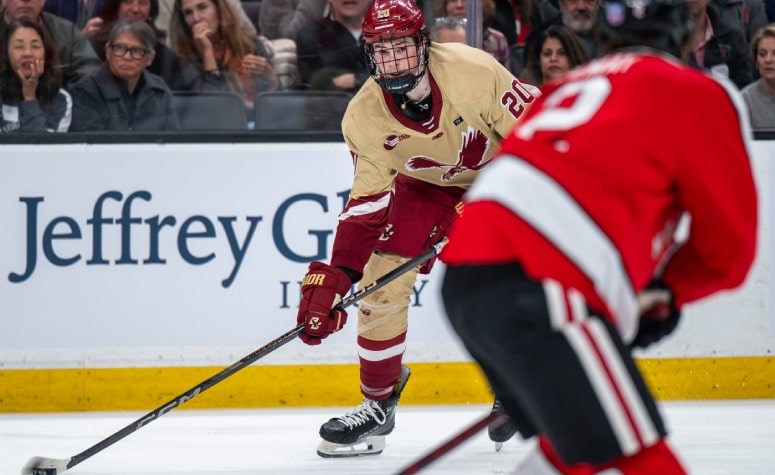

It was a total snipe, a missile to the top blocker-side corner from deep in the circle. The kind worthy of the 25th overall pick in the NHL Draft.
As the puck careened out of the back of the net and University of Minnesota goalie Nathan Airey sat frozen on his knees, Dean Letourneau wheeled around the goal on a single skate with both arms raised at the hostile road crowd.
He looked like a man used to scoring goals.
Which isn’t untrue. When Letourneau buried that gorgeous shot in October, the Boston College sophomore was still the guy who scored 61 goals during his senior year at St. Andrew’s College in Canada's Prep Hockey Conference. Still the guy who SAC coach David Manning fell in love with for his sick hands. Still the 6-foot-7 behemoth whom Boston Bruins general manager Don Sweeney drafted in the 2024 first round because of his “elite shot.”
“That’s kind of been my mindset,” Letourneau said. “Anytime I get a chance to shoot? Shoot it.”
While 2025 Bruins first-rounder James Hagens clearly is BC’s best player, Letourneau has been its most dangerous goal scorer.
Since his first tally against the Gophers, he’s gone bar-down from the top of the circle against Maine’s Albin Boija (one of the country’s best goalies), blasted home a one-timer with an RPI defender in his face, and popped the water bottle from a tight angle against Western Michigan, the defending national champion.
Most of his goals, Manning said, “are unreal.”
Which makes you wonder: What would someone watching Letourneau for the first time this season think if they heard about last season? If someone told them that guy, less than a year ago, was the laughingstock of the NCAA? That Letourneau, between his video-game production in the PHC and his current scoring spree in Hockey East, went nearly 18 months without scoring in a game that counted?
“It’s freakin’ crazy when you think about it,” Manning said.
It sure is; both that the scoring drought happened at all and that Letourneau so easily brushed it off. In making the meteoric (and increasingly rare) jump from prep to college without a stop at the USHL in between, maybe some of Letourneau’s viral freshman-year struggles should have been foreseen. An unreported hand injury that required midseason surgery didn’t help.
READ MORE: Check out the latest edition of the New England Hockey Journal magazine
Still, even though Letourneau, BC and the Bruins knew he’d be drinking from a fire hose, no one expected zero goals.
Letourneau’s stat line (three assists in 36 games) didn’t sit well with Eagles and Bruins fans either, who were bewildered by a first-round pick playing in the NCAA who hadn’t scored a goal. Many on social media made Letourneau a satirical folk hero, which included nicknaming the 2025 Beanpot the “Deanpot.”
Others just made Letourneau a punching bag. “What was being said about him was pretty cruel,” Letourneau’s father, Jeff, said.
“The crazy thing was everybody saying I’m a bust,” Letourneau said. “They don’t really know the true story.”
As if Letourneau, accustomed to being the best player on the ice, wasn’t frustrated enough.
The wake-up call college hockey provides to prep players is so notoriously trying that most are advised against making the direct jump. There’s a reason the USHL — which brands itself as a stepping stone between levels — exists, and why Letourneau originally was set to spend 2024-25 with the Sioux Falls Stampede.
“You are exposing yourself to a level of adversity,” Sioux Falls general manager Tony Gasparini said of jumping straight to college, “that’s very hard to come out of.”
So how did Letourneau survive it? And, even though seemingly everyone thought he jumped to BC a year early — including Sweeney, who admitted it in August — would he really have been better off in the USHL?
While fans ridiculed Letourneau’s meager stat line, his struggles weren’t really about goal scoring.
Letourneau played 18 games on BC’s fourth line — and if you know anything about the role of a fourth-liner, you know he wasn’t out there to score. Of the five Eagles (Letourneau included) who rotated through the fourth line, none finished with more than six points.
Letourneau played just over 10 minutes a game. The Eagles’ staff mostly wanted him to forecheck hard, impose his massive frame on opponents and defend his tail off.
At SAC, Letourneau admits he sometimes felt he needed to score three goals and be the reason his team won. At BC, his focus was on finding the smallest ways to impact the game.
“If the other team’s defenseman is playing 25 minutes a night, and you’re able to hit him and maybe wear his body down, then at the end of the game, he’s not on the top of his game, he has a turnover and we score a goal,” Letourneau said.
Conveniently (and perhaps intentionally, given the Bruins were right down the road), Letourneau’s role set up perfectly to fill the established holes in his game.
Reports when he was drafted read more like that of a toolsy offensive producer than a gigantic enforcer — scouts loved his skating and scoring touch but questioned his consistency shift to shift, his defense and his engagement away from the puck.
READ MORE: What would boys prep hockey look like without juniors and NTDP?
While Letourneau is uniquely talented for a 6-foot-7 player, his NHL ceiling is built in large part on how he can impact games with his frame. Because he became exceptionally tall only a season before arriving at BC — Manning had to get all of Letourneau’s equipment resewed before his senior year at SAC because he grew so much — and because his skill was so dominant in the PHC, Letourneau had no idea how to be 6-foot-7.
“For him to be successful, he’s got to play a game where — not that he’s running around and killing people — but he’s got to impose himself physically,” said BC assistant coach Brent Darnell.
No question, Letourneau was frustrated he wasn’t scoring. He reckons he hit the post eight times (he remembers one late in the season at Vermont intimately) and admits he lost confidence in his shot, a breakaway against UMass, which he passed, the prime example.
“Me, right now? 100 percent would’ve shot it,” Letourneau said.
Still, Letourneau’s role as a fourth-liner helped him grapple with the idea that he might actually go an entire season without scoring.
“My role last year wasn’t really to score points,” he said. “If my role was to score points, and I had just three the whole season, then that would be a bigger issue.”
What was harder to accept was that he was a fourth-liner at all. Not until the final 10 games of the regular season did Letourneau accept he’d remain in that role. Plenty of frustrated texts were sent home before that. He wanted to play more and felt he should.
“The message was, ‘Just go out and win your shift. If you only get one shift a period, make it the best shift you can, then go do it the next time,’” Jeff said. “‘Don’t get frustrated. Don’t worry about how much ice time you’re getting or what your teammates are doing.’”
Jeff would send Letourneau clips or famous quotes from the likes of Tom Brady, Kobe Bryant, Michael Jordan and J.J. Watt multiple times a week.
Tic-tac-goal
💻 ESPN+ | https://t.co/jkFSIdjBVp pic.twitter.com/aNlmv7GWL3
— BC Men's Hockey (@BC_MHockey) January 24, 2026
Brady famously started as the seventh quarterback on Michigan’s depth chart and remembers complaining to his coaches about getting only two reps in practice. He eventually learned to treat those two reps like “they were Super Bowl XLIX,” and voila — more opportunities started coming. Jeff sent his son a clip of Brady telling the story several times. Letourneau loved it.
“You kind of accept that, ‘OK, I’m not moving up in the lineup,’” he said. “So you’ve just got to go out there and impact the game the best you can.”
BEANPOT: 13 former prep standouts to watch in 2026 men's Beanpot
The Bruins, for their part, were pretty happy with Letourneau’s development as the season progressed, despite the hysteria online.
They saw him understanding his frame, winning more battles and using his stick effectively, especially on the kill. They sent staff to nearly every home game and told Letourneau he was improving; they, too, weren’t terribly concerned with his numbers — after all, Letourneau had proved he could score.
“We really felt that once he got up to speed physically and his engagement level was consistent, that the skill level would shine through,” said Bruins director of player development Adam McQuaid.
Though he and his father felt he’d earned it by the end, Letourneau never graduated from the fourth line last season. But with BC losing Ryan Leonard (Amherst, Mass.) and Gabe Perrault to the NHL and eventually Andre Gasseau to injury, Letourneau inherited a spot in the middle six to start his sophomore year.
"He looks faster, he looks thicker, he looks more engaged physically,” said an NHL scout, who was granted anonymity to talk freely about another team’s prospect. “Everything about his game is different.”
With it has come more opportunity. To begin the spring semester, he was the Eagles’ top-line center. He’s been playing nearly 17 minutes a game. Wouldn’t you know it? The goals have followed.
Around 800 active NHL players went through a major junior league, according to a memo sent to USHL teams. Just over 25 did not.
That number is so low because so few try it — only 12 active NCAA players didn’t play in a junior league (three are draft picks), per data from College Hockey Inc. The success rate of Letourneau’s path is hard to quantify because the sample is so small.
But there are horror stories about how the jump from prep to the NCAA can break a prospect.
“I’ve had lots of people tell me, ‘You were crazy to send him to BC last year,’” Jeff said.
Letourneau’s struggles with the pace of college hockey, the day-to-day preparation required and the ability to impact the game without scoring were entirely predictable given the nature of prep hockey. And all would’ve been aided by a year in the USHL.
“The game itself emulates college hockey. The schedule itself emulates college hockey. And it’s set up to train players to have success in college hockey,” Gasparini said.
Letourneau knew all this and had zero hesitation when BC offered him a spot.
READ MORE: Our boys prep midseason report
“It’s a hard thing to say no to, to be perfectly honest,” Jeff said. “If you say no when you get the invite, are you going to get another one?”
It’s an understandable worry. And if it were revealed that Letourneau didn’t go to BC when he was asked, would that have been viewed as an indictment on his confidence and mental make-up? Scouts and front offices are obsessed with that stuff when evaluating prospects.
“It would’ve been viewed as a mature decision,” the NHL scout said. “I don’t think it would’ve been held against him if he’d done that. BC wouldn’t have taken the offer off the table.”
That makes Letourneau’s choice look like an unnecessary gamble. But perhaps it’s unfair to frame the decision through its risk and not its reward.
While Letourneau himself was bullish on his ability to make the jump, everyone around him — his father, his coaches at BC, his advisors — knew what he was about to go through and welcomed it. For a player who relied so heavily on his skill at SAC, the fourth line and the grunt work it requires weren’t the worst thing. Nor was not being the most skilled player on a team that included Hagens, Leonard, Perrault and Teddy Stiga (Sudbury, Mass.).
“(BC head coach) Greg Brown was big on, ‘In the NHL, if you’re not scoring, but you’re playing the right way, you’re going to play,’” Letourneau said. “Not everyone can put up 100 points in the NHL.”
Letourneau would have been thrown into the deep end in the USHL, too. Players often say the jump from prep to junior is far bigger than from junior to the NCAA (which makes Letourneau’s decision look a bit less foolish, because “everything is risky in NHL development,” the scout said).
But the adversity at Sioux Falls wouldn’t have been to the same extent, nor would Letourneau have been as likely to get relegated to the fourth line, where he learned so many valuable lessons at BC.
“The main difference is the (playing time) for Dean, because of his talents, would’ve been greater at Sioux Falls,” Gasparini said. “He would’ve had a little more rope.”
To many, that’s a good thing.
“In today’s landscape, there seems to be a hurry to get to the next level as quickly as possible,” Gasparini said. “I don’t know if that should be the case. I’ve never heard a college coach or player look back and say, ‘Man, I’m disappointed that I was overprepared for that challenge.’”
READ MORE: 7 takeaways from NHL Central Scouting’s Midterm Rankings
But there’s something to be said for drinking from the fire hose. Because whether it’s in the USHL, the NCAA or the NHL, the fire hose is coming eventually. As the Letourneaus see it — better to have experience handling adversity than to learn those lessons in the pros.
“Nowadays, players want the easiest route to be successful,” Jeff said. “It doesn’t always work out that way. So you have to be able to deal with adversity. You have to be able to deal with not playing on the line you want to play on.”
Vote finds Dean for his 14th of the year!
💻 NESN pic.twitter.com/1XVMU2KamU
— BC Men's Hockey (@BC_MHockey) January 31, 2026
Consider Tage Thompson, the Buffalo Sabres' star 6-foot-7 forward named to the U.S. Olympic Team, whom Letourneau is constantly compared to.
Thompson did spend a year playing in the USHL, with the NTDP, before arriving at UConn, where he hit the ground running and eventually left after two impressive point-per-game seasons. He still wound up needing four seasons bouncing between the NHL and AHL and a trade from St. Louis to Buffalo before he broke out in the league.
A similarly slow start to life in the pros could very well await Letourneau whenever he decides to leave BC. He’ll need to be just as tough then as he was last year.
“Something my advisors told me, and the Bruins as well, is that if I do have adversity, it’s going to help me more in the future,” Letourneau said. “I’m going to be able to deal with it, rather than guys who come into college and get every opportunity. Unless you’re Macklin Celebrini, you’re not going to get every opportunity in the NHL.”
It won’t hurt to have some experience on the fourth line.