
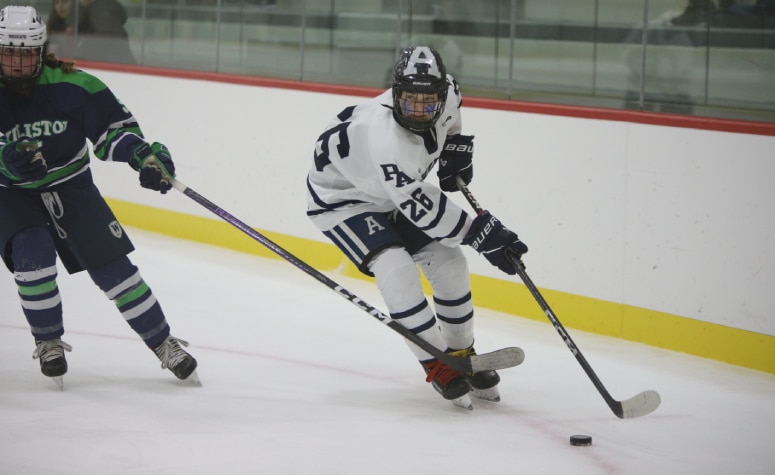

Massachusetts had a presence in Blaine, Minn., this week.
Of the 30 skaters chosen for USA Hockey's final selection camp for the U18 Women's World Championship, 11 hailed from New England. Of those 11, nine were Massachusetts natives. The final roster isn't expected to be announced until mid-November.
"It's great to see that many girls being considered and it's refreshing and rewarding to see a large number of Massachusetts girls get the opportunity," Mass. Hockey executive director Kevin Kavanagh said. "We have a strong talent pool and there are a lot of deserving players that didn't get the opportunity still, and the ones that did hopefully are rewarded with an opportunity to play in the world championships."
Caroline Averill (Wayland, Mass.), Kassidy Carmichael (Westford, Mass.), Alanna Devlin (Marshfield, Mass.), Morgan McGathey (Braintree, Mass.), Quinn Taylor (Centerville, Mass.) and Hannah Weyerhaeuser (Cambridge, Mass.) make up the five forwards heading to Blaine this weekend.
Meanwhile, Margaret Averill (Wayland, Mass.), Molly Boyle (Scituate, Mass.) and Madelyn Murphy (Dorchester, Mass.) are vying for spots on defense.
Fellow Massachusetts native and Dartmouth head coach Liz Keady Norton (Braintree, Mass.) will be at the helm for Team USA when it heads to Zug, Switzerland, for the tournament in January. She and her staff will cut down to the final roster after the camp that ran from Oct. 29-31.
Mass. Hockey's director of girls player development Ed Bourget feels each skater has a chance to make the final roster. Considering the numbers, he likes the odds that Massachusetts will have a sizable contingent on the team, no matter what. The key will be their consistency over a short sample size.
"All nine of these players, they've been at the top of their games since they were younger," said Bourget, who is also the Buckingham Browne & Nichols girls head coach. "If they all go out there and play their game, they're very dynamic with their speed and the way they play the game. Their hockey IQ is off the charts, so I think if they just do that, they'll be fine."
With such a large crop of Bay Staters in the mix for the national U18 team, it begs the question, what does Massachusetts do right when it comes to girls hockey?
"First and foremost, hockey is a desirable sport for girls to play here," Kavanagh said. "The number of teams that are relevant in the area, combined with the prep school model as well, makes Massachusetts and the northeast, in general, a destination for girls hockey. Outside of Minnesota, there's not a higher concentration of girls playing hockey in the country. As a result, you're seeing some high-end talent developed here at a young age, and we're excited to see them continue into what is now an opportunity to play professional hockey."
There were 11,444 female skaters registered with USA Hockey from Massachusetts in the 2022-23 season. Only Minnesota, with 15,355 skaters, could boast more. There’s a considerable drop-off after the top two, as the state with the third-most registered female skaters was New York, with 6,938.
From youth and club teams to high schools, prep schools and academies that can lead to college playing time, Massachusetts offers layers of development opportunities.
Table: Female players across USA Hockey
Another major factor is relatively shorter travel, compared to other states. Bourget and Kavanagh see it as a distinct advantage that allows for more best-on-best competition and continually growing registration numbers.
"I think that really goes a long way towards helping develop elite talent, which is really when you talk about world championship level teams, what we're talking about," Kavanagh said. "That said, there are so many girls that play hockey here in Massachusetts that may never rise to that level. But the overall talent pool continues to get better and better, and the number of girls playing the sport continues to grow every year. That's something that we're very proud of in Massachusetts."
The amount of talent and competition across the region has a trickle-down effect, according to Bourget. Some of the players who made this year's camp have been cut and dealt with setbacks in years past. Behind them, there are droves of players pushing to reach the same level
"There's a nice competitiveness to it all, and from every level," he said. "From the elite level to the beginning level. ... That's kind of one of the nice things too, is to see even after four or five years, some of the girls that aren't in these USA categories still playing. I think that's part of the reason you see the numbers that we have this year is that even though there's a nice high number of elite players, it also just reflects how many more players there are who are so close to being at their level."
But in Bourget's eyes, it starts and ends with coaching. The high registration in the state tells him that coaches who "know the game and know how to make it fun" are sending the right messages. It's what keeps the kids coming back season after season.
For Massachusetts to have so many players in consideration for the worlds roster reflects not just the players' efforts, but also the support system in and around Mass. Hockey's player development.
"It's a celebration for everyone in Mass. Hockey, to be honest, like all the coaches," Bourget said.
"If you go to any rink for any team, whether it's a public town youth hockey team to a club team to an elite level team, you're gonna see coaches out there that are dedicated and are trying to send the right message, teaching these kids how to play the right way and how to be a great teammate. I think that's a big strong point."
Before COVID, the development staff began to implement programs and series that introduced younger players to practices that would feel like the type of tryouts run for the national team, while also emphasizing the finer details that may go unnoticed. This year's group of players was among those to experience the programs.
"We talked about what it means to play at a high level as far as all the little intangibles, like nutrition, off-ice, backchecking, working out and all the little things that you're not really going to see or hear much of in a game," Bourget said. "I think anyone that's coming in with a tryout to help out on the ice or off the ice when they talk to these players, they're very adamant about what it takes to get there, what they need to do and how each individual needs to take kind of ownership of their own development as well."
Kavanagh and Bourget believe the success can keep growing and be sustainable for Massachusetts. What certainly helps is the amount of younger prospects they already see in the pipeline.
"I think as you continue to see it growing here in Massachusetts, it's something that we'll continue to put high-end talent out there," Kavanagh said. "But you know, just because you're not playing on the World Championship team doesn't mean you're not a good player. There are a lot of college players, prep school players or girls who just enjoy playing the sport. The fact that there's an ability for them to play and just enjoy the game for a lot of them is phenomenal. There's not a lot of places around the country that have the depth that we do, and that makes it great."
Bourget said, "The kids, they're sponges. They want to learn, and I've seen it. They want to learn, they want to get better, they want to compete and they want to be on the national stage."
While the onus may fall on the players, it still comes down to coaching for Bourget. He believes increased collaboration is what will really keep the trend moving in the right direction.
Ultimately, it's all of the volunteers and coaches around Mass. Hockey buying into the system and serving as the main reason for development.
"That's kind of how I see it because really running the player development program, I know we only have like three or four weekends we really get together, and that's not really going to develop kids," he said. "But the long-term development is going to be the other coaches and the programs that really stick to the skill work, the skating, the puck handling and just teaching them positions of the game. ... I think our coaches do a great job of teaching those little things.
"That's the key to our success."