

This fall hockey season felt different.
Sure, there were the usual suspects full of top 18U, 16U, 15O and 14U players. The Boston Junior Eagles, Neponset Valley River Rats, East Coast Militia, Cape Cod Whalers, Mid Fairfield, Yale Junior Bulldogs, Northern Conn. Nor'Easter. Those are just a handful of them.
But more than ever, another trend emerged: prep teams playing together in the fall.
"It's the direction we're going," Deerfield head coach Tim McVaugh said.
This is nothing new. Peak Performance Prep Hockey has long had a strong group of teams in the fall. So, too, has the New England Fall Prep Hockey League, which is a huge destination for Lakes Region teams.
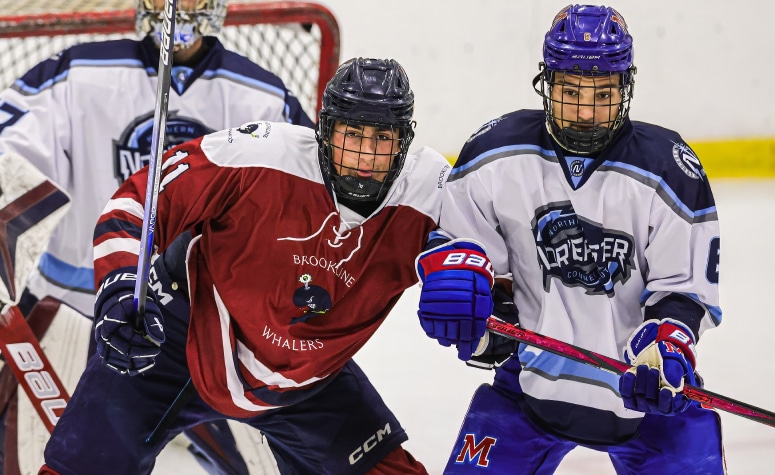
There were more this year. The C.E.M. fall league began, with schools like Salisbury, Frederick Gunn, Westminster, Taft and Deerfield participating. Dexter Southfield played as the Brookline Whalers at the 18U level.
Countless other prep schools were together. For some schools, this was their first rendezvous doing this, while others have been doing it for years. We'd be here a while if I named every prep school with a fall team.
It begs a big question: What is the future of New England fall hockey?
We could be on the cusp of some seismic changes.
The benefits of playing together
Berkshire is tucked in the far southwest corner of Massachusetts, making it roughly a two-and-a-half-hour drive to Boston or Foxboro. The drive to New York City is only 20 more minutes.
This was the second fall Berkshire played together as the Holy Name Bears. They're a national-bound team. Before that, Bears players were on their own for fall hockey.
READ MORE: 15 former prep players, locals who are starting strong in the QMJHL
"Our families really like it," Berkshire head coach Kevin Czepiel said of playing together as the Bears. "Playing the majority of our games on campus, not having to worry about travel or being away from campus every weekend. It's been really successful for us."
Deerfield is in the northwest part of Massachusetts. The Big Green typically had players on multiple high-end fall teams. They were on their own for transportation.
This fall was Deerfield's first in the new C.E.M. league.
"In the past, a lot of those families would have been driving here, picking up their kid or trying to figure out how to get their kid a ride," McVaugh said. "Now, those kids are getting picked up by a professional driver on a bus, and the logistics are so much smoother."
Frederick Gunn also opted for the same path as Deerfield.
"I really do think it's been a pretty resounding success," Frederick Gunn head coach Craig Badger said. "I think there will likely be some league expansion heading into next year. I continue to think this is the way to go."
That league expansion could go any number of directions. One flaw that will always come with teams playing together in the fall is that there isn't as much high-end talent in one game as there is when, say, the Junior Eagles 18U team faces the River Rats 18U team. Those club teams have the top players from multiple schools filling out lineups.
"I think we need to tweak the league and the leagues in general, whether it's the P.P.P. or the New England Fall Prep Hockey League or the C.E.M.," McVaugh said. "I think we need to come together and find ways to make it better. But I think that model is what's going to move prep schools forward."
It moves prep schools forward in that it simulates more of a full-season model. That's a strong selling point for schools.
"You're selling what you're going to be offering from the last week of August until the second week of November, and they're on campus more," Tilton head coach Brooks McQuade, whose players suit up for the Northern Cyclones U18 Prep Black team, said. "I think it's really helpful when you talk to families through the admissions process that the guys play together, they're skating a couple of times a week and they're getting touches. There's a development piece to that."
The benefits of playing on different teams and against your own age group
The Beantown Fall Classic 15O Invite was two weekends ago. Many of the top 15O programs from North America made their way into Boston. The stands were filled with junior hockey scouts, agents and college coaches.
Teams like the Minuteman Flames and Neponset Valley River Rats were full of players destined for prep. Many of those 2010-born players will impact prep hockey this winter, but probably not at the level they impact a 15O game.
PREP PREVIEWS: Deerfield | St. George’s | Brunswick | Winchendon | Salisbury | Choate | Nobles | Kent | Holderness | Dexter Southfield
"There is value to players playing within their age group in the fall," Milton Academy head coach Jim Gaudet said. "You might have a player who is playing on a 15O team, and he's running a power play. That player may not be doing that in the winter at the prep level, but he may in a few years' time. I think that experience of doing it in the fall, getting that confidence, getting that time on the puck, having maybe a little bit more time and space to make plays — I think that's pretty valuable for that player's development."
It should be noted that many '09s and '10s at prep schools playing together in the fall opted for 16U or 15O hockey. Gaudet's point, however, is correct.
"I personally feel like it's important for our guys to play with and against other good players and have a chance to go to nationals," Choate head coach Mike Pereira said. "You have to have families that are willing to do it. What I tell people is whatever you're going to do [for fall hockey], make sure that the experience is good for the kids. It certainly requires some dedicated parents and people."
All of these players came up playing for club teams. Winning a national championship for the Junior Eagles, the River Rats, Mid Fairfield or another club program means a lot.
"Some of these guys have grown up playing for the same club team, and there's something that they really enjoy about that," Belmont Hill head coach Brian Phinney said. "I'm very understanding of kids wanting to stick with their teams and to play with groups. If they're getting good coaching through that, great."
The Mass. State tournament is this weekend, as are the New England regionals. The stands will be packed with college coaches and junior scouts. The national championships, which are held in the early spring, are also heavily-scouted.
Brunswick head coach Mike Kennedy asked the players and their families what they wanted to do this fall. Many Bruins players grew up with programs like Mid Fairfield and the Yale Junior Bulldogs, which means something to them.
Kennedy also leads a day school. Students go home on the weekends. They don't have the weekend commitments that boarding schools have.
"Everybody sort of wanted to keep it status quo for what we were doing," Kennedy said. "I'm just letting the kids do what they want to do and the families do what they want to do."
Where is fall hockey headed?
All signs point to more teams offering a fall team for their players to play on.
Take Kent as an example. This was the first year the Lions mostly played together with the Northern Conn. Nor'Easters 18U team, which was one of two Nor'Easters squads in that age group. Three players opted to play with the Yale Junior Bulldogs' 16U team, while three others chose the Bulldogs' 18U squad.
"It's been a positive experience for them," Kent head coach Dale Reinhardt said. "Selfishly, I wish that they were all playing together, but I also want to be accommodating for families who believe the other model is better for them."
This will likely become the norm.
Teams around Metro Boston will have their players play for their club teams. Still, from talking to ISL coaches, there's an openness to someday play together in the fall.
READ MORE: Prep players leaving early for juniors, part 1 | Prep players leaving early for juniors, part 2 | Prep players leaving early for juniors, part 3
"Of course, I would be interested in having something where you can have your guys together," Phinney said. "I just don't have the answer for that right now."
The future is unclear. What is clear is that the landscape is ever-changing. Even fall hockey can't avoid that.