
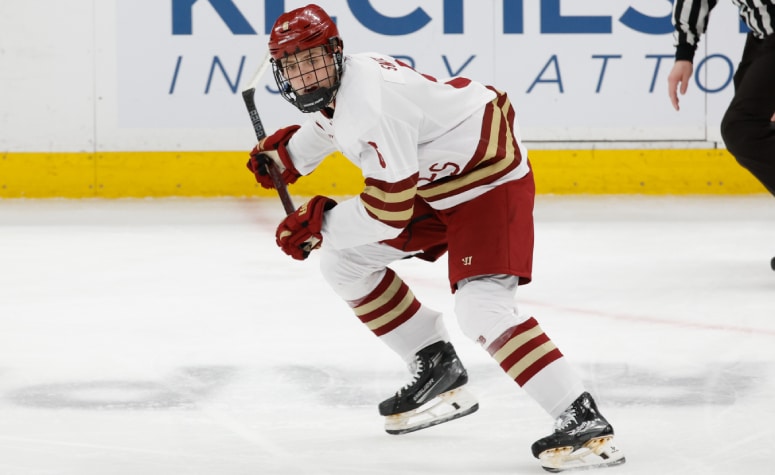

Stay or go?
Cale Makar stayed. He went back to UMass for his sophomore year. So did Matty Beniers (Hingham, Mass.) at Michigan, Charlie McAvoy at Boston University and Tage Thompson at UConn.
Jack Eichel (North Chelmsford, Mass.) decided to jump to the NHL after just one year at BU. So did Noah Hanifin (Norwood, Mass.) of Boston College, Brady Tkachuk of BU, and 2023 Hobey Baker Award winner Adam Fantilli of Michigan.
Whether to stay in school or not surely is on the minds of prime NHL prospect Macklin Celebrini of Boston University and first-rounders Will Smith (Lexington, Mass.), Ryan Leonard (Amherst, Mass.) and Gabe Perreault of Boston College as the college hockey season roars down the stretch.
What will they do? What should they do?
It’s a question that Boston College’s Cutter Gauthier faced a year ago.
In the end, he opted to come back for a second NCAA season. All he’s done is more than double his goal output from 16 in 2022-23 to 35 before the NCAA Tournament gets underway. He’s expected to sign an NHL contract and join the Anaheim Ducks as soon as BC’s season is over. By then Gauthier might be a Hobey Baker Award winner.
At this point in the season nine years ago, Eichel was in a similar position as Celebrini, Smith, Leonard and Perreault.
But Eichel was so good, so dominant as a BU freshman that there really wasn’t any question that he would move on from Commonwealth Avenue to whichever NHL team picked him in the 2015 draft and be an impact player right away.
“I don’t think we ever really thought he was coming back after about Jan. 1,” said Steve Greeley (Scituate, Mass.), who was a BU assistant coach that season and is now director of hockey strategy/scouting and development for the Dallas Stars. “In the back of your head, you’re always hoping, but he was just such a dominant player that there was no doubt he was ready for the NHL. Any hope that he was coming back was really just a little prayer. Any game we played, it didn’t matter how much hockey you’d seen or not seen. You knew he was the best player on the ice.”
After Eichel won the 2015 Hobey Baker Award, the Buffalo Sabres drafted him with the second pick that June — Connor McDavid went first, no surprise.
“You have some one-and-dones in college hockey, but more often than not, that player could have benefitted from another year. But Jack was the rare guy where you knew he didn’t need another year of college hockey. He was ready to help an NHL team the next season,” said Greeley.
And that’s just what Eichel did, putting up 24 goals and 66 points as a 19-year-old Sabres rookie.
Makar, on the other hand, was in a different place at the end of his freshman year compared to the more physically mature Eichel.
Without a doubt, Makar’s skating was elite from Day 1 at UMass. “He’s like a Ferrari. It’s crazy how dynamic he is,” said Michigan State associate head coach Jared DeMichiel (Avon, Conn.), a Minutemen assistant coach during Makar’s time in Amherst.
But he needed to get stronger. A second year at UMass helped take care of that.
“He was obviously an effective player for sure (as a freshman), but he wasn’t dominating. It seemed like Friday nights he was very strong. On Saturday, he wasn’t quite as effective,” said DeMichiel.
NHL DRAFT: 13 top NHL Draft prospects from New England prep hockey
“The second half of his first year, he started to take off after world juniors (where he tied for the tournament scoring lead among defensemen). I think that gave him a ton of confidence. I think the physical piece, he knew he needed to grow his body a little bit more.”
The second college season – during which Makar won the Hobey Baker Award – helped him to continue to build the swagger that allowed him to step into the NHL and be an impact player right away.
“I remember visiting with Cale and (UMass coach) Greg Carvel when he was finishing his freshman year,” said Pierre McGuire, who has been around the NHL for three decades as a coach, team executive, scout and broadcaster.
“You could see in practice he was strong enough, he was fast enough and talented enough, but that extra year allowed him to dominate in his own peer group. Then you get to the NHL and there’s not a crisis of confidence and you can just play. So that’s a big key. If you’re going to leave early, you’d better be a dominant player in your own peer group. With Cale it worked out fantastically well.”
So what should Celebrini, Smith (drafted by San Jose), Leonard (Washington) and Perreault (New York Rangers) — all of whom are teenagers — do?
There’s much more to take into consideration than simply the big contract and achieving the lifelong goal of reaching the NHL.
“There are not a lot of guys that are less than 20 years of age that are ready physically to play in the NHL. I think that’s the biggest thing,” said McGuire. “Speedwise, talent-wise, hockey sense-wise, most of these young players are ready to play. It’s the everyday grind that they’re not used to. You’ve got to guard against that, make sure guys are physically ready.”
Young players might think they are ready, but then reality smacks them in the face.
“It’s never been harder. The game’s never been better. The athletes have never been stronger or faster. Kids all think they’re working hard until they get in the gym with NHL players and it’s ‘Holy mackerel. Now I know what hard work is,’ ” said McGuire.
FULL BRACKET: Click or tap here for the full 2024 NCAA Tournament bracket
The situation a young player is going into in the NHL can be a factor, too.
“If you break in on a bad team and you’re a young player, it’s doubly hard. When Makar broke in in Colorado, they were just starting their climb. I did some of his first games, especially in the playoffs against San Jose. He was ready. Nathan MacKinnon was there to guide him. (Gabriel) Landeskog was there to guide him. They had good players there in place to help him get over whatever hurdles there were,” said McGuire.
Perreault, drafted in the first round by the Rangers last summer, might not be physically ready, but he would be stepping into a healthy situation in New York if he chooses to sign this year.
“They’re a good team. He’s not going to have to carry the ball. Leonard if he goes to Washington is going to a situation that’s up and down. They’re kind of trying to find a new identity. And Will Smith, obviously San Jose is struggling, so that’s part of the decision-making,” said McGuire.
And then there’s Celebrini, the consensus No. 1 pick in the 2024 draft. The youngest player in college hockey, he doesn’t turn 18 until June.
If Chicago gets the first pick, there’s a good chance they’d push to bring Celebrini out of school. Obviously, Connor Bedard and Celebrini would give the Hawks a pair of elite offensive players to build around.
What if Celebrini is selected by San Jose? Mike Grier (Holliston, Mass.) is the team’s general manager and David Quinn (Cranston, R.I.) is the coach. They are BU alums who know all about the value of time spent developing in college hockey. They might be more inclined to let Celebrini marinate for another season under coach Jay Pandolfo’s tutelage at BU.
What if Columbus, currently without a general manager, gets the first pick? Well, who knows what they’ll do.
GOING ON A RUN: Why each New England team could win the national championship
The thing is, with players as good as Celebrini, Smith, Leonard and Perreault, there is probably no such thing as a wrong decision. Whether they play college hockey in 2024-25 or sign NHL contracts, they are can’t-miss prospects.
“Jonathan Toews did two years at North Dakota. I can tell you Celebrini and Toews are almost identical at the same age. It didn’t hurt Jonny to go back,” said McGuire.
“Would it hurt Macklin to take the extra year? Probably not.”