
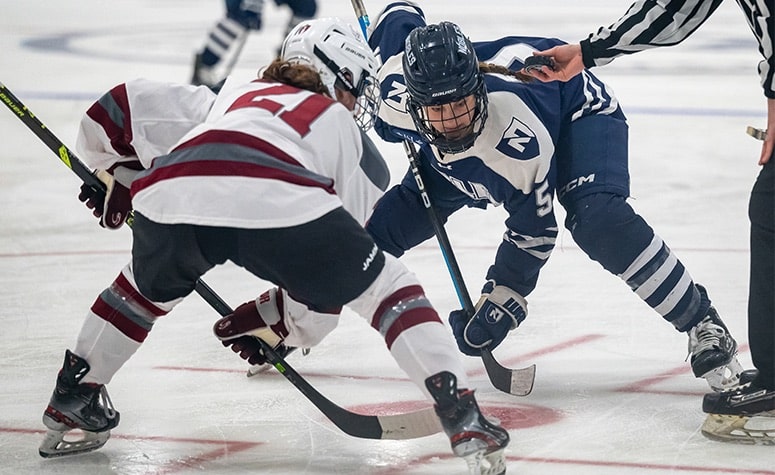

Notre Dame Academy, an all-girls school in Hingham, Mass., rang in 2024 with a championship win at the Tenney Cup.
A decade ago, that holiday tournament at the Bog in Kingston, Mass., didn’t exist.
The Tenney Cup, which organizers expect to grow into an even bigger event in future years, is one of many testaments to the explosion that women’s hockey is experiencing, both nationally and locally.
From 2013 to 2023, the number of girls and women participating in hockey nationally increased by 39 percent, from 65,700 players to 91,254. (By comparison, the growth of male hockey players over the same period was just 4.6 percent.)
New England is an epicenter for the growth of women’s hockey. The increase of female skaters has been strong here, especially in Massachusetts, which has experienced a 21 percent jump since 2013. Only one state, Minnesota, has more female hockey players than Massachusetts.
“First and foremost, hockey is a desirable sport for girls to play here,” Mass. Hockey executive director Kevin Kavanagh said. “The number of teams that are relevant in the area, combined with the prep school model as well, makes Massachusetts and the Northeast, in general, a destination for girls hockey.
“As a result, you’re seeing some high-end talent developed here at a young age.”
So what’s driving the growth in girls hockey?
‘WHAT OUR GAME DESERVES’: Women’s Beanpot upgrades to TD Garden
“I think USA Hockey has been really deliberate about offering hockey for free, giving kids an opportunity to try it,” said Christa Talbot Syfu, who has coached Williston Northampton’s girls team since 2004. “I think there’s more of an effort there, where maybe five years ago that wasn’t happening.”
More girls than ever are entering hockey, particularly at young ages. And, in a big difference from a decade ago, there are more options for them to remain in the game — whether it’s youth and town organizations, club teams, high schools, prep schools or academies — as they get older.
“I think each program has made a concerted effort to sustain their girls program and really put in to make sure their coaching is good, but then also let those kids have fun and give them opportunities to grow,” said Ed Bourget, Mass. Hockey’s girls player development director and girls head coach at Buckingham Browne & Nichols School.
Be it USA Hockey’s initiatives or other efforts, it’s no wonder that the growth has been most explosive at the younger levels. Nationally, the number of girls registered in the 6-U age group is up 65.4 percent from a decade ago. In the 7-to-8-year-old range, it’s up 70 percent.
“Girls are starting at an earlier age,” Bourget said. “Within Mass. Hockey, they’ve done a great job of allowing the girls to play with the boys, if they want to, early on. In the very beginning, we have a lot of programs here that are coed, like the foundational programs, the learn-to-plays, the Mites and the Squirts. … That allows for more kids to have roster spots and play in that club setting, and it trickles down to the youth programs, too.”
Bourget also is the Mite development director for the Bay State Breakers. The in-house Mites program features six teams with roughly 10 kids per team.
“I could probably make two or three teams just full of girls,” Bourget said. “I think we probably have about 25 of almost 60 kids that are female hockey players.”
Be it with clubs like the Breakers or Boston Junior Eagles — who introduced their girls program in 2010 — or town programs like Hingham, opportunities abound for girl-specific offerings. It wasn’t that long ago that female skaters had limited options when choosing teams, particularly all-girl teams.
“I just think about programs having U-8 and U-10 (teams) that are competitive and the girls love hockey, like that's pretty cool to have,” Talbot Syfu said. “When I was growing up — I graduated from high school in 1998 — I played on a team that was U-19, and I was 12 years old. So, the fact that you can play with your age group and play with all girls is really cool.”
Tom Resor, who is in his 23rd and final season as coach at Noble and Greenough School, saw his daughters, Nina and Carry, have similar experiences as Talbot Syfu, coming up in the late 1980s and ’90s before both played at Yale in the 2000s. The Resors played on boys teams in Dedham, Mass., until PeeWees, before body-checking became a factor. Assabet Valley, a club team, and another program in Chelmsford, Mass., were some of their only options.
“We started going to Assabet, but they didn’t really have much of a choice,” Resor said. “I mean, I look at the makeup of my team now, and I think we represent at least six or seven different club programs. Some of these kids started probably at U-10 with their club programs. … Back in those days, you might have had U-12, U-15 and U-19 because there weren't enough to sort of fill in every two-year increments.
“We just didn’t have the array of programs that there are now.”
MIDSEASON REPORT: Surprises, questions and more in girls prep hockey, so far
More kids are on the ice than ever, too, even if the amount of available ice hasn’t necessarily grown in lockstep.
“I think the small-area games and the ADM (American Development Model) have helped with that. Doing cross-ice up to a certain age has put more players on the ice,” said Cheri Bonawitz, the girls director of USA Hockey’s New England District. “I think people are being more creative in the ways they're using the ice time.”
Bonawitz has seen similar growth of girls teams in Connecticut, southern New Hampshire and Rhode Island. Areas that are much more spread out, like Vermont, Maine and northern New Hampshire, have needed to get creative.
“I think when you get into the more rural states, such as Maine and Vermont, it's harder to have that many girls together,” said Bonawitz, who lives in Maine. “So I think what you're seeing in those types of areas is girls are playing on the youth teams, but then they're having a special event for all the girls maybe once a week to play together. … Up here in Maine, there's a lot of high schools that are merging their girls programs.”
For more populous areas, relatively shorter travel leads to more best-on-best competition, collaborative coaching efforts and getting more kids in rinks.
“It used to be hard for different regions to kind of collaborate, because you would have to drive,” Bourget said. “Mass. Hockey and everyone, in general, has seen the growth of the girls game and made it more accessible by keeping it close to home.”
Female players across USA Hockey
At the high school and prep school level, the number of opportunities at schools certainly has grown, particularly in Massachusetts.
“Where you really see the growth and where it’s sort of indicative of how hockey has grown, is how many programs offer JV teams,” said Dan Najarian, the girls varsity coach in Duxbury, Mass. “I’ve been with Duxbury for eight years, and when I started, we always had a JV program, but maybe it was three or four girls, then you had a fourth line from the varsity play down.”
Gone are the days of Duxbury’s JV team playing maybe eight games in a season, mainly against the same few schools. Now the Dragons compete in an eight-team JV league.
It speaks to how deep the talent pool has become. Look no further than Malden Catholic, which introduced its varsity program in 2021 before reaching the MIAA Division 2 Elite 8 last year. The Lancers have been one of the state’s strongest teams to begin this season.
The number of Massachusetts schools offering girls hockey increased from 125 to 211 — a jump of 69 percent — from 2013 season through 2023, according to data from the MIAA and the National Federation of State High School Associations. MIAA schools offering boys hockey dipped from 298 to 279 in that span.
CHECKING IN: What have we learned in MIAA girls hockey so far?
“There are so many programs that are so strong on the girls side,” Najarian said. “Back maybe 10 years ago, when Duxbury was on their run, it was kind of Duxbury, then everybody else. Hingham was there, too. But now you've got (Notre Dame Academy), you've got Archbishop Williams and Malden Catholic, which has kind of burst onto the scene.
“There's just so many good girl hockey players that can now fill out these teams and make them competitive.”
There’s been growth elsewhere in New England, too. New Hampshire has nearly doubled its number of girls high school teams since 2013, going from nine to 17. Maine and Rhode Island each have added schools offering the sport.
The explosion of female skaters has had a big effect on prep schools as well, with a deeper pool of players now available.
“I look at my own rosters from my first years where maybe I had 15 or 16 players,” said Resor, who has coached the Nobles girls team since 2000. “But now I haven't had a team with fewer than 20 players in at least 10 years, probably more.”
“I think just the overwhelming depth to the girls game is what strikes me most. When I first started coaching, rosters were much thinner. You would see maybe one or two players play almost the entire game, especially a defender. Then slowly over time, you started to see teams gain more depth.”
BB&N has 77 girls playing hockey from grades 6 through 12, according to Bourget.
“Ten years ago when I first started, it was like each team had one or two really good players and the teams like Nobles would have the full team. You would get geared up for that one game,” Bourget said. “It's not like that anymore. You have to prepare for every team, every game. Every team has depth. Every team's first line is elite. … Pretty much every prep school over the last five years has been sending kids to college regularly. It makes a huge impact.”
Najarian’s daughter, Annabelle (Duxbury, Mass.), is a senior goaltender at BB&N. They opted to go with the Knights over other prep and high school programs, but it certainly wasn’t due to a lack of options.
“Historically in the girls world, if you didn't want to live away, how many choices did you really have? But now for a kid from Duxbury, you've got Buckingham Brown and Nichols — we did that — Thayer Academy, Milton Academy, Nobles, Dexter and so on,” he said. “Those are five right off the top of my head that were options for Annabelle, because they have these robust women's programs and you don't have to live away from home.”
RANKINGS: Westminster re-enters latest girls prep top 10 amid big shakeup
When Resor first assumed the job at Nobles, many roster spots were filled by talented multi-sport athletes, and hockey was just another sport they played. But with more club options and development paths, as well as better coaching, hockey has become the primary focus of the majority of girls on rosters, especially as specialization has become a bigger factor.
“You've just seen the quality of hockey improve as more kids are playing,” Resor said. “They're getting better coaching and spending more time before they come into a school program. It used to be only a small percentage of kids putting in the time outside of the winter season. … Now, I’d say on my hockey team, 90 to 95 percent of the kids would probably say hockey is their number one and they want to play that in college.”
That growth of the talent pool has shown itself in player evaluation events.
From 2014 to 2023, Mass. Hockey’s girls CCM High Performance Festival increased from six skater groups to 18. And in the tryouts for New England District’s competition, the increase in participants has forced the district to restructure and break players into smaller groups.
“Last year, we had 280 girls try out, as opposed to the 240 the year before, and we’re expecting higher numbers this year,” Bonawitz said. “What a great atmosphere to see all the girls playing together and seeing what it's all about to play against the best.”
As the number of girls playing hockey has grown, so has the number of coaches. One difference now from a decade ago is there are more female coaches, many of whom already have gone through the process as a player and are now giving back to the younger generation and sharing their experiences and knowledge of the game.
Katie Burt (Lynn, Mass.), Toni Ann Miano, Makenna Newkirk, Sara DeCosta (Warwick, R.I.) and Vicki Lamoriello (Lexington, Mass.) are examples of women who played high-level college and/or pro hockey and are now coaching in New England.
“These elite female athletes that are really quality people are staying within the game and helping the younger kids,” Bourget said. “I think that passion and that enthusiasm, coupled with the fact that they're such good people, is leading to little girls wanting to play and stay with the game.”
Said Bonawitz, “The players are using them as role models, too. I think that’s what we’re seeing in the youth programs. In Rhode Island, DeCosta can come back and be a coach of a program. That’s a real person that they’re looking at. I think that’s the increase, and it’s great the girls are getting that push, too.”
With all these aspiring female hockey players around New England, perhaps it’s no surprise that the region notched 11 skaters on Team USA’s roster for the U-18 Women’s World Championship in January.
Later this spring, there’s sure to be more New Englanders representing the U.S. in the Women’s World Championship in Utica, N.Y.
With the dramatic spikes in girls playing hockey, the increases in available opportunities, the continued development of elite talent from New England and more, women’s hockey is in perhaps the best shape it’s ever been in.
“It's sort of a perfect storm for the growth of the game,” Najarian said.