

Jared DeMichiel and Ben Barr shared an office at UMass in the years building up to that school’s national championship in 2021. A frequent topic was the theoretical timeline for bringing a struggling program up to speed.
“We would say, hey, when you’re turning around a program or getting a program where you want it to go, it’s usually a three-year thing,” said DeMichiel, now the associate head coach at Michigan State. “That’s lofty expectations. I think most people would say it takes a little bit longer, but Benny’s got very high standards and expectations.”
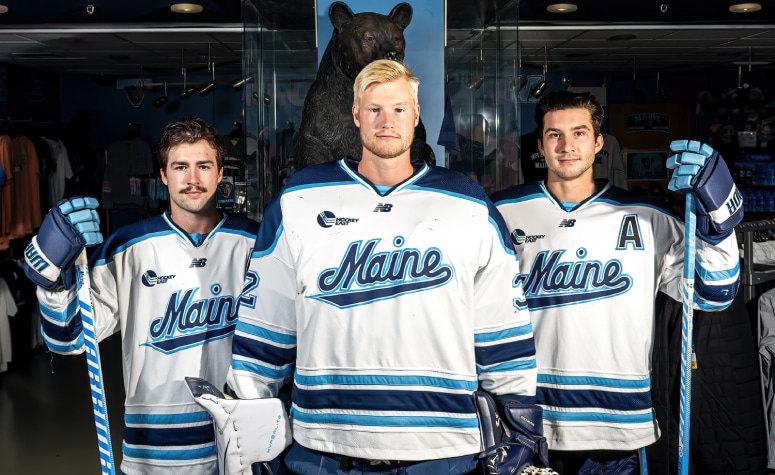
As Barr starts his third season as head coach at Maine, the Black Bears already have come a long way in a short time.
And DeMichiel is not the least bit surprised by how much his friend has accomplished so far.
“Not for a second,” he said.
After winning only seven games in Barr’s rookie year, the Black Bears went a surprising 15-16-4 last season after being picked for last in the Hockey East preseason coaches poll.
Among the Black Bears fan base — historically one of the most passionate and loyal in college hockey — there are more positive vibes around the program now than there have been in years.
“They know Ben Barr has recruited for three national championship teams (Union, Providence College, UMass). They’ve noticed the dramatic strides he’s made in creating a culture. He’s brought in good players. People believe in the buzz up here,” said Larry Mahoney, who has covered Maine hockey for the Bangor Daily News for many years.
Eric Soltys, who joined Barr’s staff as an assistant this summer, agrees. “You can feel it around town," he said. "There’s more hype. There’s more season tickets being sold than in previous years, more of an allure with some of these high-end recruits coming our way now.”
Millions of dollars are being spent to upgrade Alfond Arena, one of college hockey’s great barns, starting with the sound system and video board and eventually including locker rooms, a strength-training area and other amenities.
“Our fans, for years, haven’t been able to hear anything,” said Barr, because of a subpar audio system. “The scoreboard hasn’t been very functional. That’s a big thing. We get unbelievable support up here. It’s important that we take care of the people that support us.”
Obviously, last year’s 15 wins were only a first step. There are miles to go to reach the ultimate goal, a return to the days when Maine was a perennial Hockey East and national contender under legendary coach Shawn Walsh, who brought home NCAA championships in 1993 and 1999.
No one is more aware of that than the 41-year-old Barr.
“I’ve been through this a few times, so you try to do the same thing,” Barr said. “You’re just trying to get a little bit better every year. You’re trying to get really good kids that maybe are the next level of guys. Lots of times those guys end up being as good or better than a lot of the high-profile players. Then you add in some high-profile guys and eventually you start to turn the tide a little bit.”
“We’ve got to use (last year) as a learning experience and realize everyone is going to think we should be really good this year. It’s not going to be easy. If anything, it’s going to be harder. Are we going to be OK with just, like, not being terrible, or are we really going to try to push?
“We had 15 wins last year. You need to get four or five more to give yourself a chance, at the very end, to get in (to the NCAA tournament). That’s not even going to be in our vocabulary, to be honest. All of our returning players have to get a little bit better. And we need some of the young guys or transfers to make a difference. If we do that, we’ll have a chance to get better this year. And if we’re better this year, we’re on that cusp a little bit."
Men’s hockey is the centerpiece sport at the school. College hockey has become an arms race, and competing requires a certain level of commitment that goes beyond money.
“The school is realizing that — and sometimes they’re hard conversations to have — but you can hope for everything to happen and say, ‘Hey, we were really good back in the ’90s and early 2000s,’ and you can hope those things come back. But the reality is so much has changed in college hockey and in NCAA athletics in general,” Barr said.
“It’s not, ‘Hey, give the hockey team more money or more resources.’ That’s not what it is. It’s how can we be a beacon for this university and help the whole university, not just the University of Maine hockey team. Up here, (the hockey team) has the ability to do that for the whole state. So I think there’s a recognition that these things need to happen. There’s still a lot more things that we need to continue to improve structurally with how we operate. The nice thing is we’re having the conversations rather than just saying, ‘OK, let’s hope that 1993 returns.’”
Barr loves the fervor of the fans.
“Outside of maybe North Dakota, there’s not a more passionate hockey market than this. I’ve been on the visiting side with PC and UMass. Whether Maine is winning or losing, it’s always a tough place to play and an unbelievable atmosphere. The support for this program and the passion for the program is unbelievable.
“So a lot of people wonder, why do you care about all these things, non-hockey things? It’s because this should be a destination spot in college hockey, like it was in the 1990s and early 2000s," Barr said. "We have what everyone else tries to build for decades. Last year in the second half of the season, the rink was full for an hour before the game starts. That’s what every pro, junior, college team is trying to build. We have that up here already. It has nothing to do with me. It has everything to do with what’s happened before.
“There’s an unbelievable passion and buzz. People are excited about the progress we made last year. There’s still a long way for us to go to become a team that can sustain something special over time. That’s the challenge for our team, for our staff and for me as the head coach and for the school. If we can do it, you’ve seen what can happen.”
You can experience one of the positive changes Barr has overseen during the summer. A majority of the team stays on campus, training and taking classes, which was not the case in the past.
“You have to provide an environment where if the players want to come back and train, they can. That wasn’t even on the radar up here, which is again one of those structural things we’ve been working on. To think that we’d have any chance to compete without having the option for our players to do that is silly,” Barr said.
“Our guys have really bought in. They love it. Our strength coach has done a really good job with it. Our ice is in up here all summer. They have, really, unlimited ice time if they want it. On the weekends, they go to the beach, they do things together and they enjoy being around each other. A huge part of any improvement we made last year is our guys were in shape, as crazy as that sounds. That was not the case a few years ago."
On the ice this season, having a top goalie should help the Black Bears continue to make progress. Victor Ostman, who earned All-Hockey East second-team honors last year, could have left for a pro contract but is back for his senior year.
“Any time you get a senior goalie back who’s had some success, it’s huge,” Barr said.
Ostman was a standout last season, but “if he’s going to have a career in this, I think he realized that there needs to be a bigger body of work than that. He’s had a really good summer. He’s a good kid, a mature kid. There’s still more room for growth. He still knows he can get better, and I think that’s why he’s back,” Barr said.
The defense gained valuable experience last season, which should help this year.
“I think we have a tremendous amount of depth on our [defensemen] corps. Last year we had to play four or five freshmen [defensemen] every night, no matter what. This year it’s going to be a little bit harder to make the lineup. You’ve got to be practicing and playing really well to get in the lineup, which as a coach is what you want,” Barr said.
Up front, Maine has one of the top forwards in Hockey East in senior captain Lynden Breen. He led the league in goals last season with 21 and was named to the All-Hockey East second team.
“He’s obviously not the biggest guy. He’s not the most skilled guy. He’s not the fastest guy. But he just loves being out there. He loves having the puck on his tape, making plays. In the two years since I’ve been here he’s really improved,” Barr said.
“He’s kind of a throwback player. You’ve got to kick him off the ice every day. He’s a huge part of our culture. I’ve seen him grow a lot as a person. He’s not, naturally, the guy that’s going to tell everyone what to do or anything like that. He’s found a way to be a really effective leader in his own way. Obviously, his play on the ice is a huge part of that, but he’s turned into a guy that off the ice is a really exemplary leader for us. That’s been the fun part to see.”
The jewel of Barr and his staff’s recruiting efforts thus far is Bradly Nadeau, who led the BCHL in scoring last season and was drafted in the first round (No. 29) by the Carolina Hurricanes in June. Nadeau’s older brother, Josh, finished second in BCHL points and will join his brother at Maine this season.
It’s possible the Nadeaus will play with Breen, but nothing’s been decided.
“We’ll see how it works. On paper, you do that and that makes sense. But you know what? It might work and it might not work. (The Nadeau brothers) have unbelievable chemistry together,” Barr said.
For all the skill the Nadeaus are expected to add to Maine’s lineup, “the strength of our team always has to be our work ethic. I know that’s a super cliché, but we didn’t beat anybody last year on talent,” said Barr.
“We have to be a harder working, more detailed team than anybody if we’re going to have a chance at success. I think that was the strength of our team last year and it has to be again this year.”
Barr’s work ethic defined him during his prep playing career at Shattuck St. Mary’s and in college at RPI, where he was captain as a senior. The way Barr approaches his job and the way the Black Bears play is a reflection of their coach.
At Shattuck, on a team that featured the Eaves brothers, Ben and Patrick, “(Barr) was the glue. Always reliable. Always below the puck. Two-way effort,” said Soltys, who coached goalies at Shattuck during Barr’s senior year. “If we needed someone out there to protect a lead in the last minute of the game, you knew that Benny was going to do his job. He was for sure a coach in the making back then because he understood both sides of the game at a time when kids just want the puck on their stick.”
FULL MAGAZINE: Check out the rest of the September/October edition
Kirk MacDonald, Barr’s college teammate and now the coach of the USHL’s Dubuque Fighting Saints, is well-acquainted with Barr the player and Barr the coach.
“Maine works really, really hard,” said MacDonald, who played three-plus seasons with the Providence Bruins after college. “That’s how Benny played. There wasn’t a whole lot of glamor to his game. It was just work his bag off and find a way. Benny grinds. That’s why he’s found a way to be successful everywhere he’s gone.”
Two years in, Barr looks to be well on his way to succeeding in Orono, too.