

College hockey recruiting is one of the hot-button topics in the sport at the moment. Friday’s announcement that the NCAA had passed legislation to curb the recruitment of young players was met with positivity, skepticism, cynicism, and condemnation from various people across the hockey landscape.
According to College Hockey Inc., the “rule changes approved by the NCAA’s Division I Council (Friday) will significantly alter the recruiting timeline for Division I men’s hockey prospects with the goal of slowing down and improving the recruiting experience.”
The new rules eliminate all recruiting conversations (whether initiated by the coach or the prospect) prior to Jan. 1 of a prospect’s sophomore year. Also, the new legislation aims to establish Aug. 1 prior to a prospect’s junior year as the earliest a coach can make a verbal offer to a prospect.
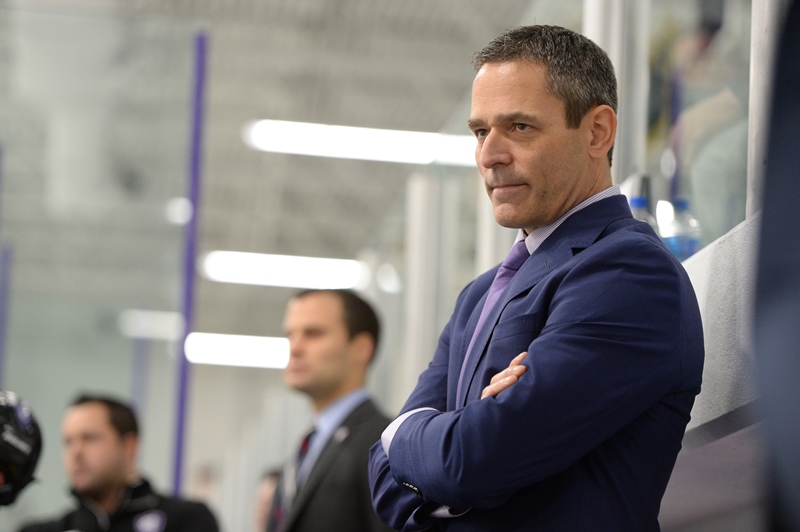
“The changes are really positive step forward for college hockey because it had gotten out of control,” said Holy Cross head coach Dave Berard, speaking to the amount of deferments and stockpiling of recruits.
After the annual American Hockey Coaches Association Convention in Naples in 2016, a committee was formed to look into how the recruiting culture in college hockey could be improved. The group was spearheaded by National Collegiate Hockey Conference (NCHC) Commissioner Josh Fenton.
“It was put in motion almost three years ago coming out of Naples in 2016. The Division I men’s coaching body stated the need to have a group to look into recruiting. Recruiting in a variety of ways had gone in a wrong direction, especially in terms of early recruiting,” Fenton explained.
Each of the six Division I college hockey conferences, including the three with New England teams, Hockey East, ECAC Hockey, and Atlantic Hockey were represented. There were a total of 18 people representing the six conferences. Each conference had its commissioner, a head coach, and an athletic department administrator. Mike Snee and Nate Ewell of College Hockey Inc. also sat in on the meetings.
“We met three to four times in person and had multiple phone conversations. We addressed the recruiting timeline. The model we came up with was approved last Friday. It was vetted with the NCAA Division I Student-Athlete Experience Committee,” Fenton stated.
“We went back and forth. When we got comfortable with them and our committee, it was presented to the NCAA Division I Council,” continued Fenton, the commissioner of the NCHC, the conference that has won the last four national championships in men’s hockey.
Men’s college hockey was granted an earlier start date in terms of when coaches could begin communicating with prospective student-athletes due to the complications in the hockey landscape. With major junior being an attractive option for some prospects, especially in the Midwest where the OHL has a large footprint, colleges need to be able to begin communications before the drafts in that league and the QMJHL.
“It was important to keep Jan. 1 given the unique landscape of junior hockey,” added Fenton.
“The argument is if we push this off, major junior will use this against us. We’re going to lose guys because of it, but everyone is kind of disgusted with the recruiting process. We talk about the fact that we don’t like recruiting 14 year olds, but we have to because of the climate and nature of the beast,” said Berard.
Few coaches in today’s game are as familiar with the positives and negatives of recruiting as Berard. He’s gone through the process as a head coach, but also as the father of two teenage sons. His oldest son, Brett, a forward with USA Hockey’s NTDP U-17 team, committed to Providence as a 16-year-old.
Despite Berard’s son committing at a rather young age, he’s fully behind the new legislation as he thinks it will benefit both the prospects and the schools.
“Being a couple years older, you’re wiser, smarter, more worldly, and it’s not as emotional of a decision. You probably have more options. It’s good for everyone,” said Berard, who played college hockey at Providence.
“There will still be mistakes made. Even making an offer to a 16-year-old, things might change, but the number of them will decrease. It won’t feel as a coach or a player that you have to be in a rush,” he added.
While the curbing of young recruiting will likely make college programs less susceptible to making rushed or poor decisions, and thus causing problems in deferments or stockpiling, the main objective of the committee was to make the process better for the student-athlete.
“The underlying goal was to improve the prospect’s recruiting experience. We felt the time frame was getting younger. We wanted to do right by the process and have coaches not have to discuss recruiting with ninth and eighth graders,” said Fenton. “We felt it was right until the particular date. We know we live in this unique world with junior hockey in North America.”
With coaches unable to speak with players until Jan. 1 of a prospect’s sophomore year, the role of College Hockey Inc. will take on an even greater importance. Ewell and Snee are the promotional arm of college hockey. As they have done so well previously, they will seek to continue to inform and educate prospects and their families on the benefit of the college hockey developmental path.
"It is important for us to still provide an educational process so they have enough information,” said Fenton.
“It’s where College Hockey Inc. comes in, to educate these people who are weighing their options. Potentially, we’ll take a hit, but all in all, the whole process will be much cleaner and you’ll avoid the pitfalls,” said Berard.
Also important to college hockey coaches and administrators was having the support of USA Hockey and the NHL when implementing these changes. Consider both boxes checked, according to Fenton.
“There are significant hockey entities indirectly involved helping us think this through. The NHL was very supportive and USA Hockey was very supportive. When we put this together, the sport and the coaches were behind trying to fix the recruiting culture,” Fenton explained.
One common theme in discussing the changes with coaches, agents and others since Friday’s announcement has been that many in the hockey world thinks little will change. While many, like Berard and Fenton are behind the new legislation, others aren’t as convinced.
Several assistant coaches, who spoke on the condition of anonymity, believe that programs will still be able to skirt around the rules and find a way to get the word out, especially to top prospects. However, Fenton made clear that third-party communication, including through agents or prep, high school or midget coaches, is prohibited.
"Coaches and compliance administrators will know the rule and know how to work within the rules. If they’re going to take a chance, they’re subjecting themselves to recruiting violations in the future,” said Fenton.
As Berard noted, these rules will impact the big schools, such as Boston College and Boston University in this area, more so than the smaller schools that haven’t typically gotten into the young recruiting.
“Everyone will now be dealing with the same circumstances. It opens up the process. Kids might have more offers and make better decisions. There are way more positives than negatives,” said Berard.
The landscape of college hockey is constantly evolving, and this legislation will be an interesting follow on how it impacts schools and prospects over the coming years.