

The NCAA Division 1 men's hockey tournament will be underway in just under two months, as the puck drops on regionals on March 28.
While there's no way to know what will happen over the rest of the season, what is rather certain is that several New England schools will be vying for the national championship.
Two of the last three national champions — Quinnipiac last season and UMass in 2021 — hail from the region.
So let's stop and project how the bracket will fill up.
For starters, we identified the top four seeds based on the PairWise and assigned them a region. The four regions are Providence, R.I., Sioux Falls, S.D., Springfield, Mass. and Maryland Heights, Mo. We also made sure that if all four No. 1 seeds make it to the Frozen Four in St. Paul, Minn., No. 1 would play No. 4 and No. 2 would play No. 3.
To seed the final 12 spots, we had to consider many things.
The first was travel. UMass is one of the host schools at the Springfield regional, meaning if it makes the tournament, it has to play there. While Providence College isn't directly hosting the Providence regional, we still put Providence College in Providence. We made necessary accommodations for non-New England schools at non-New England regionals, too.
Another was each conference champion from the six conferences (Atlantic, Big Ten, CCHA, ECAC, Hockey East, NCHC) is seeded. The Big Ten, ECAC, Hockey East and NCHC all had representation in the top 16 for PairWise, so we selected the highest-seeded team as the projected champion.
As for the Atlantic and CCHA, we picked the top team in each conference's standings as the projected champion. Those two schools were No. 15 and 16 seeds.
X-FACTORS: 5 keys for New England's college hockey contenders in the second half
Then, we seeded each team off of two things: the PairWise and avoiding inter-conference matchups in the first round. That resulted in some unfortunate travel for some, but it also resulted in some intriguing battles.
We'll be doing more of these as the tournament gets closer. Here's our first bracket projection two months out from the tournament.
Providence, R.I. regional
- Boston College (1)
- Michigan State
- Providence College
- RIT
This regional would have plenty appeal around the region, between Boston College, the top seed, and Providence as the host. The Eagles would make the arduous journey down I-95 to Providence to face RIT, which is gunning for its fourth tournament appearance as a D1 program. The Eagles are fresh off an emotional sweep of BU in the Battle of Comm. Ave. They rank near the top of the nation in both goals for (4.13; third) and against per game (2.35; sixth). It's no wonder, especially with their potent "Freshman Line" of Will Smith (Lexington, Mass.), Ryan Leonard (Amherst, Mass.) and Gabe Perrault.
Meanwhile, PC and MSU would be an intriguing matchup. The Spartans sit seventh in the PairWise and haven't made the tournament in 11 seasons. As for the Friars, they're 10th in the PairWise. Both sides have gotten it done in different ways this season. MSU boasts a potent attack, ranked No. 5 in goals per game (4.12), while Providence averages the seventh-fewest goals against per game (2.35).
Sioux Falls, S.D. regional
- North Dakota (2)
- Wisconsin
- St. Cloud State
- St. Thomas
This regional wouldn't mean much to those in New England. North Dakota and Wisconsin playing in the regional final would be the favorite outcome here. Two college hockey powerhouses duking it out to head to the Frozen Four. North Dakota's only date with local teams was a series with Boston University in November and it was a split.
Springfield, Mass. regional
- Boston University (3)
- Quinnipiac
- UMass
- Michigan
A lot of people complain about attendance at the neutral regional sites, but this potential slate for Springfield would have no issue filling the MassMutual Center. Quinnipiac and UMass aren't far at all, just quick trips up or down I-91. BU fans would surely make the trip down the Mass Pike, while Michigan always travels well.
'I GOT CHILLS': How Northeastern women's hockey claimed a historic victory at TD Garden
As for the actual hockey in this regional, there's a case to be made that it would have the most compelling matchups. Quinnipiac, the defending champion, is one of the best teams, top to bottom, in the nation, averaging the fourth-most goals per game (4.12) and second-fewest goals-against per game (1.96). But UMass still has experience from its 2021 championship, and Greg Carvel's teams always play their best around March.
Meanwhile, BU draws the shortest straw of the No. 1 seeds, having to face Michigan first. We have the Wolverines in Springfield as our only way to avoid intra-conference matchups in the first round. So, BU gets a team that is No. 2 in goals per game (4.71) with six skaters with at least 30 or more points. Meanwhile, the Terriers took a hit in their weekend sweep at the hands of BC, but they still boast two of the NCAA's most talented skaters in Lane Hutson and Macklin Celebrini. They rose to the occasion down the stretch last season to reach the Frozen Four.
Maryland Heights, Mo. regional
- Maine (4)
- Denver
- Minnesota
- Western Michigan
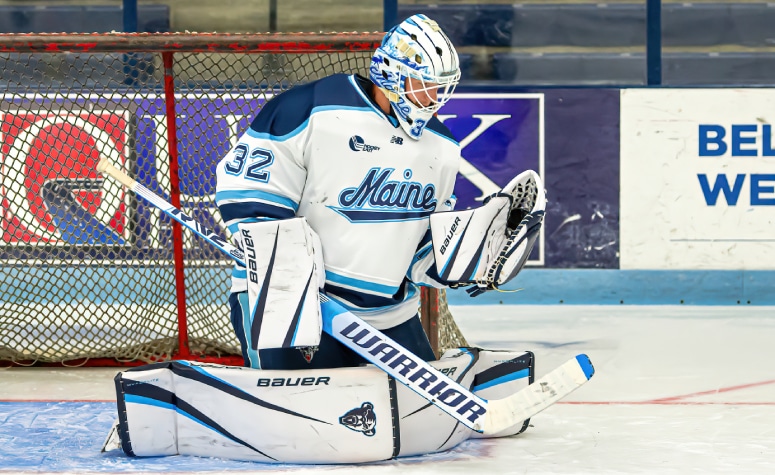
Unfortunately, Maine has to travel to Missouri. How cool would it be if Maine was at one of the local regionals and the Black Bears faithful showed out in full force? Anyway, this is far from an easy regional for Maine. Western Michigan would be a formidable opponent in the first round, as the Broncos are battle-hardened from playing in the NCHC. Maine ranks No. 8 in the country in goals per game (3.82) while Western Michigan ranks ninth (3.75). Western Michigan holds the advantage on defense, however, only allowing 2.29 goals against per game, which is good for fifth in the nation. Maine isn't too far behind at No. 8 with 2.36 goals against.
RECRUITING: What's been happening on the college hockey recruiting scene?
If Maine were to make it past Western Michigan, both Denver and Minnesota would be tough outs. Denver has struggled a bit defensively, but won the national championship in 2022. Minnesota was one goal away from winning the national championship last season.
The good news for Maine is that playing in Hockey East all season should prepare the team for when it has a target on its back.