
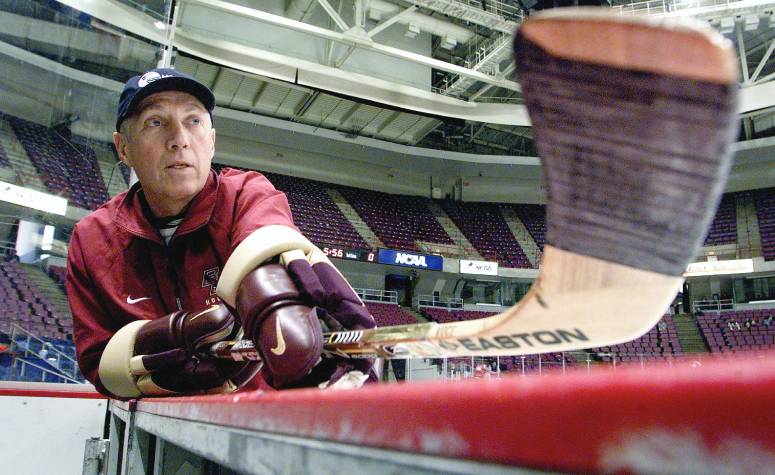

Jerry York’s passion for hockey and for Boston College took root early.
At Victory Field in his beloved Watertown, Mass., in the 1950s, the city would open a fire hydrant and flood the tennis courts so youngsters like York had a place to skate.
“You had to dodge (the posts that held up the tennis nets), but it was great ice,’’ York said.
The eighth of 10 children, York’s earliest hockey heroes played for the Boston Bruins and for BC.
“I loved Bronco Horvath, the way he handled the puck and made plays. That was someone I aspired to be,’’ York said of the former Bruins star. “As I got older, it was Billy Daley and Red Martin at Boston College. I used to watch all the BC games.’’
And so began a remarkable life centered around hockey.
On April 13, when the 76-year-old York stepped down after 28 years at Boston College, he held every coaching record worth having. He spent 50 consecutive years as a head coach, won a record 1,123 games and five national championships. He’s a member of the Hockey Hall of Fame.
Along the way he earned the respect and admiration of nearly everyone he encountered.
“He’s one of the finest human beings I’ve ever been around in my entire life,’’ said former BC athletic director Pat Kraft. “I believe he’s the greatest coach in the history of college sports.’’
University of Connecticut coach Mike Cavanaugh, a member of York’s staff at BC for 18 years, calls him “the Bear Bryant, the John Wooden of our sport.’’
Early on, York set his sights on BC.
“My aspirations were always, ‘Can I go to BC, actually play hockey at BC?’ ” he said.
The answer was a resounding yes.
After starring at Boston College High School, York moved on to a standout career as a center at BC, scoring 134 points in 81 games and earning first-team All-America honors in 1967.
He was hired as an assistant coach at Clarkson in 1971. A year later he took over as head coach when Len Ceglarski left Clarkson for BC. At 27, York was the youngest D-1 coach in the country.
At his final news conference at BC on April 19, York recalled a conversation with his father-in-law, a trial lawyer, during his second year at Clarkson.
“He said, ‘Jerry, when are you going to get a real job?’ I said, ‘Ten years or so and I’ll be ready.’ He never held me to that,” said York.
York was on his way to greatness. One of York’s first recruits at Clarkson was Dave Taylor, a future Los Angeles Kings star who led the 1976-77 Golden Knights to a 25-6 record.
After being a finalist for the Michigan State job that went to Ron Mason, York was hired by Bowling Green in 1979. He led the Falcons to the national championship in 1983-84 with a four-overtime win against Minnesota Duluth. That Bowling Green team went 34-8-2 and included future NHLers Garry Galley, Dave Ellett and Gino Cavallini.
Boston College came calling in 1994. That had always been York’s dream job.
At the time, the program was in shambles. Steve Cedorchuk, who had succeeded Ceglarski as head coach, had promised more scholarships than he had to give and was let go. Former Bruins player and coach Mike Milbury was hired but bailed after a few weeks when the scholarship situation came to light.
Enter York.
“Jerry walked in and cleaned it up in an instant. The second he came in, we knew it was different,” said David Hymovitz, one of the top scorers on the 1994-95 team, York’s first.
Jerry Buckley was the senior captain that first season.
“Things had been run a little bit loose. He tightened everything up,’’ said Buckley, a Bruins draft pick who is now a well-known player agent and adviser.
York quickly went to work instilling the culture that became the foundation for BC’s long run of success. It didn’t take long for the players to jump onboard.
“Jerry had his way of doing things and he wasn’t moving off it. It was black and white to him. Within a few months everyone understood, ‘Hey, if you want to play here, you adhere to these rules,’ ” said Buckley.
On the ice, it was an uphill climb. There were three straight losing seasons.
“We lost to UMass in the eight-nine play-in game, we were getting hammered by BU,’’ said Cavanaugh, who worked as a grad assistant for York at Bowling Green and joined the BC staff in 1995.
Off the ice, however, the Eagles started to reel in blue-chip recruits. Future St. Louis Blues first-rounder Marty Reasoner of Deerfield Academy was a major get, sending the message that in short order BC would a force to be reckoned with.
The Eagles soon landed Brian Gionta, who would go on to become a Hockey East superstar, captain the Montreal Canadiens and Buffalo Sabres and the 2018 U.S. Olympic team, and Mike Mottau, winner of the Hobey Baker Award in 2000.
They were on their way, going 22-8-5 in 1997-98, though there were hurdles ahead.
“All of a sudden that fourth year we had the breakout season, won the Hockey East tournament, lost to Michigan in overtime in the national championship game,” said Cavanaugh.
York recalled that 1998 OT game against Michigan at the FleetCenter in Boston as a sign of good things on the horizon for BC, which at the time hadn’t won an NCAA title since 1949.
Jamie O’Leary of the Eagles rang the crossbar and Jeff Farkas hit the post in overtime before Josh Langfeld of the Wolverines broke BC’s heart with the game-winner.
Despite the loss, in the dressing room afterward “the feeling among the players was, ‘We’ve really done something special, Coach, and we’re going to get more of these,’ ” York said.
Still, the Eagles couldn’t quite get over the hump. They went to the Frozen Four again in 1999 and 2000 but came home empty-handed.
They finally broke through in 2001. Krys Kolanos scored in overtime to beat North Dakota in Albany and give BC its long-awaited second national title.
“I almost broke my ankle on the bench there, falling off” after the winning goal, York remembered with a laugh.
BC lost in the NCAA title game in 2006 and 2007 but won again in 2008, 2010 and 2012.
“From ’98 to 2012 was a heck of a run. Ten Frozen Fours. Eight national championship games,’’ said Cavanaugh.
Year after year, York’s roster was filled with players who would go on to be NHL stars — Johnny Gaudreau, Chris Kreider, Brooks Orpik, Kevin Hayes, Brian Boyle, Cory Schneider, Cam Atkinson. More recently, Spencer Knight, Alex Newhook and Matt Boldy starred at BC. Eighteen NHL draft first-rounders played for the Eagles under York.
Over the years, York had interest from NHL teams. Taylor, the former Clarkson star, and George McPhee, who won the Hobey Baker Award playing for York at Bowling Green, were both NHL GMs, Taylor with the Kings and McPhee with the Capitals.
“We had some serious talks about it,” York said, but each time he decided to stay at BC.
“In 50 years I never got fired. At the NHL level, you’re going to go four years, then you’re going to get fired,” he said.
“When it got down to, ‘Do you want to come?’ I said, (BC) is where I belong. I was smart enough to recognize that. BC degree, you know,” York quipped.
Buckley believes York would have been successful in the NHL.
“He’s smart and he knows he would have to change a little bit. Not change in what he believes in, in terms of behavior or acting responsibly, but he’d figure out the changes he’d need to make,” Buckley said.
“People ask me all the time: What made Jerry so good?” said Cavanaugh. “I think what made him so good, what I learned from him, was recruit good players, instill a level of discipline and respect, and then let them play.
“He didn’t pigeonhole players. And he didn’t really sweat the small stuff. There were a lot of things he could let go. I learned so much about dealing with referees. You so rarely see Jerry get rattled because it doesn’t help his team.”
York’s willingness to make an effort to keep up with changing times was important in dealing with young athletes.
“Think about how much life changed from 1972 to 2022. I remember at Bowling Green he’d come in with the latest CDs when everyone was getting out of cassettes. Then the next thing you know he had an iPhone,” said Cavanaugh.
“He would adapt with the times. That was one way he could relate to the kids. Now, if you were late for a meeting, if didn’t matter if it was ’72 or ’22, he’s going to throw you out of the meeting.”
One thing that never changed with York: He didn’t use profanity. Ever.
Brian Boyle, well into his second decade as an NHL player, was quoted recently as saying that York is the only coach he’s ever had who didn’t swear.
Said Hymovitz: “We’ve never heard the guy swear. Cripes is his word. I don’t how many players have gone through BC in 28 years and literally not one has heard him use profanity. Nobody. It’s absolutely amazing.”
Of course, York was always much more than just a hockey coach to his players.
“He was a mentor to me. At 18-19, you’re young, maybe you’re immature. He develops you the right way. He values developing you as a person as well as a player,” said Marc McLaughlin, BC’s captain for the last two years who signed with the Boston Bruins in March.
“I learned so much from a leadership standpoint, a culture standpoint, how to carry myself in the community. What it takes to act like a professional hockey player. There’s so many life lessons that I learned from him over the years. He’s such a unique and special person.”
York texted McLaughlin, who was still enrolled in classes and living in a BC dorm, after he scored a goal in his first NHL game.
“I think one of the first things he said to me was, take care of your classes. That just shows the type of person he is. You’ve got to be the complete person if you want to play for Coach York,” McLaughlin said.
As Buckley puts it, “He was one of a kind and the last of his kind."