
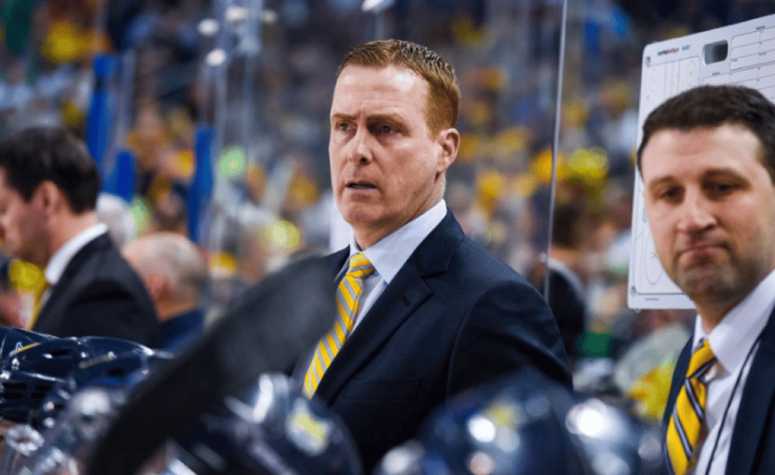

There isn’t a lot that Rand Pecknold hasn’t seen or done in his 29 years behind the Quinnipiac bench, but coaching the United States team to a bronze medal at the 2023 World Junior Championship was a totally new experience.
“Trying to throw 25 players together, from all different programs, coaches and styles. Jam them together and get six practices and then we’re playing Finland in an exhibition. I’ve never done anything like it,’’ Pecknold said on Monday, the same day that his Bobcats (17-1-3) took over the No. 1 slot in both national college hockey polls.
“You have to prepare completely differently, you have to choose what you want to cover and what you want to coach. Every drill you run in practice has so much value, as opposed to when you’ve got the whole month of September to get ready for your first game on Oct. 1. It was great. I really enjoyed it. I think I’m a better coach from going.”
Pecknold was impressed — and who wouldn’t be — by the talent, top to bottom, of the U.S. team.
“It’s an exciting experience having talent like that to coach. We put in structure, you need structure, but you don’t realize they’re going to make plays outside that structure and that’s OK, but there were times I was just on the bench really impressed with some of the things they would do on the ice,” said Pecknold.
The elite players for the American team – Logan Cooley of Minnesota, Luke Hughes of Michigan, Cutter Gauthier of Boston College, to name just three – would get any coach excited.
“It was fun to watch. Some of those high-end first-rounders, they’re going to be elite NHL players in a short time. It was a unique experience and sometimes I found myself sitting back and just letting the guys make plays.”
LATEST RANKINGS: Quinnipiac in the driver's seat, while BC and BU improve
Pecknold had a good staff – Pat Ferschweiler of Western Michigan, Reid Cashman of Dartmouth and Nick Fohr of the NTDP U17 team.
“It basically was like a 27-day hockey think tank," he said. "You’re just immersed with your staff and watching other staffs and what they do. It’s a little different type of hockey just because it’s got such an international flavor, but I really enjoyed the experience.”
After a disappointing 6-2 loss to Canada in the semifinals, the U.S. won the bronze with a wacky overtime victory over Sweden by an 8-7 score.
“My first thought was, I am not an 8-7 type of coach, so I was a little shocked at that,” said Pecknold, whose Quinnipiac teams are known for stingy defense.
“It was one of those games where I don’t think you can explain or understand how tough it is to lose your chance for gold in the semifinals and then have to reload and reset for a bronze medal game the next day, for both teams. For 18-, 19-year-old kids, you can’t even begin to grasp.
“As much as we tried to get our guys back up for that game, the passion, the emotion, the rollercoaster of the whole tournament, it comes crashing down. Not to mention the way the Canada game ended for us, with the goals being called back, all the drama. It just was a lot emotionally, I think, in a lot of respects, for both teams. That’s the reason it was an 8-7 game,” said Pecknold.
“Emotionally, the kids were trying and they wanted it, but they weren’t all invested in defending, neither team was. I think it was really hard on the goalies, too.”
Connor Bedard was the talk of the hockey world as he led Canada to the gold medal and was selected as tournament MVP.
I reminded Pecknold that I’d watched a game with him at the Beantown Fall Classic in Marlboro in 2019 in which Bedard played. At the time, I’d never heard of Bedard, but Pecknold was well aware of him, thanks to his son, Tate, who plays at St. George’s (Middletown, R.I.).
TIME MACHINE: Check out how Connor Bedard played at the 2019 Beantown Fall Classic
“My ’05, he’s a Mid-Fairfield kid. They were talking about Connor Bedard when he was nine or 10. They always talked about him, ‘He’s the best ‘05 in the world.’ I’d be like, ‘How do you guys know that?’ And then we would see him from time to time. A lot of times he played up. I do remember that at Marlboro. I think he was 13 or 14 then, playing with 16- or 18-year-olds.”
For a coach, going up against a player like Bedard is no fun.
“No, I wasn’t enjoying coaching against him, but watching him, obviously, you use the term 'generational player,' he is that. He’s different than [Sidney] Crosby, he’s different than [Connor] McDavid, but he’s a guy that comes along once every 10 years and is special. We don’t know where he’s going to end up in the draft, but he’s going to turn somebody’s franchise around,” Pecknold said.
The U.S. went into the game with a plan, but no one’s yet found a way to shut down Bedard at the U-20 level. He had a goal and an assist with six shots in the semifinal game.
“We felt, you’ve just got to take away time and space," Pecknold said. "And the other thing, he’s so good on the power play. He was tracking downhill on his strongside flank. He was getting almost to the dot and making a decision from there. There’s not enough time for the goalie to react. We really pushed to get out on him and try to make somebody else beat us on Canada’s power play. Make him make that decision at the top of the circle. Give our goalie and our defenders that extra 15 feet.
“I thought we did a good job against him on that. I noticed the Czechs did the same thing the next day against him. They didn’t do it in Game 1, but they kind of took our strategy and did the same thing (in the gold medal game). You open somebody else up elsewhere, but let’s make somebody else make the play. That was kind of our plan.”
Back at Quinnipiac, associate head coach Joe Dumais and assistant coach Mike Corbett were in charge while Pecknold was away.
“They did a great job,” said Pecknold.
“I wasn’t calling them every day – ‘what did you guys do in practice today?’ Honestly, even the Holy Cross game (a 4-1 win on Dec. 30), I couldn’t even watch it. I was like, I can’t watch this game, I’ll be a mess. I allowed myself, every 30 minutes, to check the score, and then the next day I did watch the scoring chances, for and against.
“I basically had to stay out of it. You can’t be hovering over and coaching over their shoulders.”
The Bobcats have gone 15-0-1 since their only loss of the season, at Maine on Oct. 22.
“I knew we’d have a good team this year, but I think we’re even better than I thought. It’s a credit to the boys. When you’re ranked top five in the country, every game is the Super Bowl for that other team,” said Pecknold.
“I’ll tell you, there’s been a lot of games we’ve really had to grind out a win and found a way. I give our players a lot of credit. It’s a mature group. We’ve got an excellent culture. Over and over again in some of these games our culture helps us find a way. It’s hard to play this many games and have one loss in January. We probably should have more, but we embrace the grind and we find a way to win.”
While a No. 1 ranking in the polls obviously isn’t going to carry any weight at NCAA Tournament time, it’s still a feather in Quinnipiac’s cap.
“It is all about the Pairwise (rankings), 100 percent for me, but I’m not going to sit here and say it’s not nice to get voted No. 1 because it is. It’s great for Bobcat Nation and our fans and our Board of Trustees and our president. People are excited about it,” Pecknold said.
Heading into the weekend, Minnesota is first in the Pairwise and Quinnipiac is second.
Pecknold just finished coaching four of the Gophers’ top players – Cooley, Jimmy Snuggerud, Luke Mittlestadt and Ryan Chesley – at the WJC. When asked if that might help if the Bobcats and Gophers were to meet in the national tournament, he answered, “absolutely,” but was not about to share any details.
A LOOK BACK: The biggest storylines of the first half in college hockey
“I’ll leave it at that. You’re always learning, you’re always adapting," Pecknold said. "I feel like I know them better as players, probably know how to coach against them better now. We’ll see if it actually plays out that way, but I feel like I learned something.”