
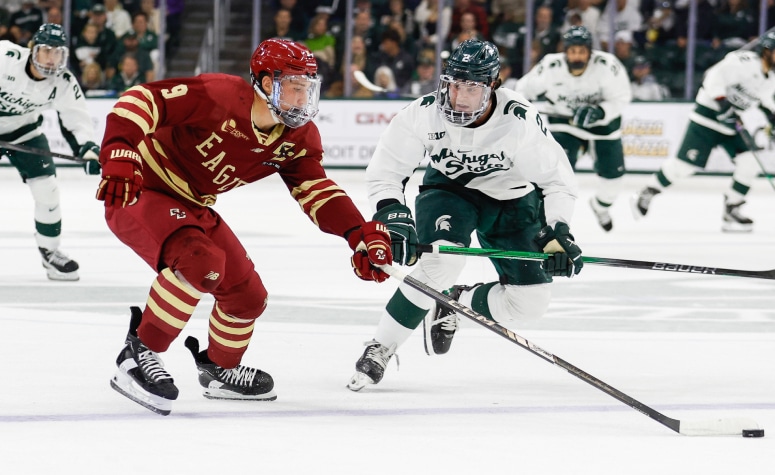

When the NCAA opened up Division 1 college hockey eligibility to CHL players on Nov. 7, 2024, the common thought was that the hockey world would change drastically.
How the ruling would manifest itself in the NCAA, junior and prep hockey was unknown. But in the three months since, some clear signs have emerged.
In part 1, we covered how the ruling would trickle down to impacting prep hockey and players leaving the region early.
This story goes in-depth on how the ruling will affect Division 1, Division 3 and junior hockey.
Some of the ways are already becoming clear. Others will take time to manifest themselves.
Recruiting for Division 1
There was a fear that because of the CHL ruling, Division 1 college hockey programs would put a hold on committing players already eligible to play in the NCAA.
That hasn’t been the case. Commits have flowed in like normal.
“I wouldn’t say we’re holding off from committing anybody,” Providence assistant coach Joel Beal said. “If we see a good player, I don’t care where he’s from. If he can help Providence, we’re going to recruit them.”
The life of an assistant coach, however, has changed. There are now three new leagues for them to recruit since the CHL ruling.
“Are we spending a little more time watching and recruiting CHL players? Yes, and it’s because it’s more of an unknown,” Beal said. “The available player pool has changed so now I need to make sure that what was a quality Division 1 college hockey player in Hockey East is still a really quality Division 1 player in Hockey East based on these rule changes.”
College coaches have spent the past three years getting to know players from the 2004-07 birth years who already were eligible to play NCAA hockey. Now there’s a wider pool of players to discover.
“There’s always that recency bias, the shiny new toy,” Yale assistant coach Rob O’Gara said. “A lot of the guys that work in college hockey, myself included, we’ve seen these American-born ’04s play for four years now. Right or wrong, you see an older guy who’s been playing in the QMJHL for three years and it might look sexier than a kid that played two in the NAHL.”
This could hurt those players who’ve spent seasons in the NAHL, BCHL or even the NCDC who previously thought that success in that league equated to a Division 1 commitment.
“The pool is bigger,” O’Gara said. “In the interim, those are the kids who are working their butts off in whatever league, probably went into the year being told, ‘Hey, if you crush it here, you’re going to get a Division 1 commitment.’ Now it’s like, ‘Oh man, I’m competing against double the amount of guys for those spots.’ It’s tough.”
That pool getting bigger also will impact players currently at the Division 1 level. If a player from the CHL comes in and takes someone else’s spot, that could squeeze out a player who already was on the roster.
“You’ll see that trickle-down effect all the way from one league to another league,” Beal said. “If there’s a kid that gets pushed out from a certain league that might be a valuable player for another school, they’re going to try and recruit that player.”
Another unknown: How many CHL players actually might want to play college hockey?
“A lot of guys are thinking about it for the first time realistically,” O’Gara said. “Whether it’s the education or the extra runway for pro hockey, these kids can seriously consider that for the first time.”
Another question: will CHL players have the grades to get in, especially for Ivy League schools?
“I don’t think it’s going to be too much different than what we’re looking at now,” Harvard assistant coach James Marcou said. “They’ve got to be elite students and committed to the academic piece like anyone else.”
When the CHL ruling first happened, numerous rumors surrounded Michael Misa. The ’07 from Oakville, Ontario, has been a standout with the OHL’s Saginaw Spirit for the past three seasons. The 17-year-old projects to be a top-five pick in this June’s NHL Draft.
Immediately, people speculated whether he’d opt to play in the NCAA. This has become the case for multiple high-end players in the CHL — and it’s a slippery slope.
“If you’re not a player that is aging out of the CHL, it’s been a little more secretive in terms of those discussions (with colleges),” Beal said. “I don’t think players are really comfortable with their CHL teams knowing they’re talking to colleges because they’re afraid of retribution from a CHL team if they were seen as possibly leaving before their CHL team wants them to leave for college.”
It’s been roughly two months since the ruling, meaning colleges and CHL players haven’t had ample time to connect. Both are in the middle of grueling seasons.
Things might change when the schedules die down in the spring.
“I think at the end of the season, once players get away from their teams for the year, you’re going to see a much more honest recruiting process between the players and the colleges in terms of what their options might look like for next fall,” Beal said. “If a player decides to go to school the next fall versus going back to their CHL team, there’s no real retribution or punishment for that player leaving their CHL team.
PREP RANKINGS: St. Mark's proves it's for real in wild week
“Those (high-end) players are being recruited now and they’re considering their options. I think there are kids committed to schools right now that just haven’t announced it.”
It could be especially prevalent with younger players who’ve already spent considerable time in the CHL. Those players are high-end, legitimate difference-makers with the big programs after them.
“I think what you’re going to see is the higher-end kids that have played major junior for two or three years are going to want to go on to the next stop,” Beal said. “That’s college hockey. It’s just better.”
Improving Division 3
In January of last year, Middlebury College had one player committed for its freshmen class that fall. It wasn’t a huge deal — six freshmen eventually would join the class. It wasn’t a deviation from other seasons.
This January, however, has been different. Middlebury head coach Jack Ceglarski and assistant Jack Fitzgerald already have four forwards and four defensemen lined up for next season.
“That’s a big surprise,” Fitzgerald said.
In any other year, it would be. However, due to the CHL ruling, the pool of players who could (key word: could) play Division 1 hockey has gotten bigger.
“It’s already really difficult to play any level of college hockey,” Frederick Gunn head coach Craig Badger said. “Now you’ve added 500 to a thousand more kids into the mix who are eligible to play college hockey. College hockey just isn’t expanding at a rate that is going to be able to absorb that.”
The CHL ruling allows CHL players to go to only Division 1 schools — it doesn’t cover Division 3. Still, by broadening the selection of players, borderline Division 1 prospects might become Division 3 commits.
“It’s just gotten these fringe (Division 1 players) to wrap their head around it a little bit more,” Fitzgerald said. “It’s allowing kids to look themselves in the mirror a little bit more.”
That group of “fringe” Division 1 players won’t automatically become Division 3 players. But the odds are longer now.
“Schools are still going to watch them and hopefully these fringe players are getting better every year,” Marcou said. “Obviously, Division 3 is really good. I think this will just make the line between Division 1 and Division 3 a lot closer.”
Along with the fringe Division 1 players, there also are the fringe Division 3 players.
“You look at these guys who are third- or fourth-line guys in Division 3, they’re probably now not college hockey players,” Badger said. “Everyone wants to say this is good for the kids. Well, it’s good for some kids and it’s not good for others.”
Times have changed in the Division 3 world. Fitzgerald’s playing days, which weren’t all that long ago, are a perfect example. After playing at Westminster from 2012-15, he went straight to Amherst College, where he was the captain as a senior in 2018-19.
TRICKLE-DOWN EFFECT: How the transfer portal is impacting junior hockey
Junior hockey was far from his radar.
“I had no idea about anything with junior hockey,” Fitzgerald said. “If someone was like, ‘Go to the BCHL,’ I would’ve been like, ‘What is that?’ I knew about the USHL and that was it. Now, these kids have so much access to so much information via their phones and they can tell you who the leading scorer is for the Lone Star Brahmas in the NAHL.”
In other words, recruiting out of junior leagues has become more commonplace in Division 3, which could become even more frequent since the CHL ruling.
“Our rationale is nothing against the (prep) kid who is an ’05 or an ’06, but those kids are two to three years younger that they’re playing against,” Fitzgerald said. “I just found that the pool of 18-year-olds either aren’t ready to wrap their heads around going straight to school or we don’t find that they are ready to jump in and play.
“We’re not just bringing in an 18-year-old to scratch them. I’d rather you go and play a year of junior and then come in and be more prepared to play than come here and not see ice time and just essentially practice.”
It’s not the only way in which the CHL ruling will impact junior hockey.
“It’s a trickle-down effect,” Beal said.
A long line coming out of junior
On Nov. 25, UNH committed a trio of ’04s. Alex Carr and Sam Oliver play in the QMJHL, while Nicholas DeAngelis plays in the OHL. They’re all age-outs in the CHL and opted for college hockey less than a month after the ruling.
UConn, Providence, Maine, Vermont and other schools got similar commitments from players in the CHL.
All of these players are ’04s. All are slated to begin this fall.
Had the ruling never happened, players who committed to these schools years ago would’ve finally arrived. Instead, those players will spend more time in junior.
Will there be a backlog?
“One-hundred percent,” Beal said. “Now that the CHL is open, college teams, us included, are trying to find the best players and field the best possible team we can next year. We’ve gone out and committed a couple of ’04s to fill some holes. A lot of other schools have committed ’04s and now they’re going to have to evaluate based on incoming players they have committed and ’04s they have committed and returners, try and put together that puzzle to have the best possible roster while still not losing committed players.”
Since COVID-19 hit, college hockey’s transfer portal mixed with players getting a fifth year of eligibility created a backlog in junior. That was supposed to pass after the fifth-year eligibility rule ended this season.
Now, the CHL ruling could hold players in junior for longer as their start time in college becomes even more delayed.
“There’s a big batch of ’04s and ’05s that might’ve been highly touted prospects going into major junior (the CHL), but now things didn’t pan out exactly the way they wanted them to,” O’Gara said.
What O’Gara is accounting for is the majority of players enter the CHL for a path to pro hockey. Now, when those players get to the end of their eligibility, they can move over to the NCAA to further their hockey career, get a strong education and potentially sign as a free agent in professional hockey.
PART 1: How the CHL ruling could impact prep and academy hockey
That also could create more action in the transfer portal as these new ’04s from the CHL battle for spots with established players.
“The fifth-year stuff will have a slowdown of those kinds of transfers, but the rate of players transferring will continually be steady and potentially increase because of the CHL stuff,” Marcou said. “You’ll have more players coming into the NCAA. There will be more changes in recruiting in terms of the new landscape of opting into revenue sharing. We don’t know what the consequences are or what the benefits will be.
“There’s still a lot of unknown. But I don’t see transfers slowing down.”
There are still a lot of unknown. That’s not easy to hear for prospects searching for a college commitment. And it’s not easy on those with a college commitment as they’re left to marinate longer in the junior hockey world.