
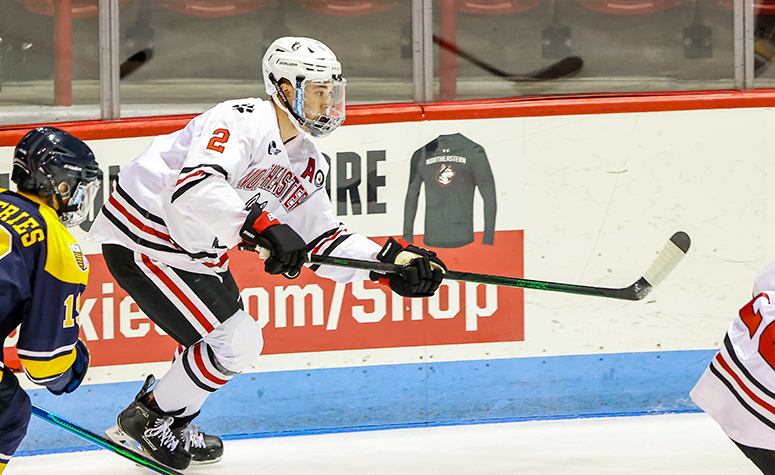

For Northeastern University, the 2021-22 hockey season signals a season of change, with a new head coach and high expectations. Senior captain Jordan Harris is one of the keys to his team’s high hopes; a rarity in modern college hockey as someone who made the jump straight from prep hockey to the Hockey East three years ago.
The 21-year-old left-shot defenseman from Haverhill, Mass. is coming off a junior year that saw him post six goals and 19 points in as many games. The Montreal Canadiens prospect is preparing to take his two-way game to another level under longtime associate and first-year head coach Jerry Keefe.
Northeastern has an impressive core of experienced returning players that qualified for the 2021 NCAA tournament last spring, and that group will be bolstered by the arrival of an impressive freshman group. That Harris is wearing the ‘C’ for the Huskies only begins to speak to his impressive developmental trajectory since his prep school days at Kimball Union Academy in Meriden, N.H. which led to him being drafted in the third round of the 2018 NHL Entry Draft.
Success didn't happen overnight for Harris, and as he prepares for his final season of college hockey, he took time to reflect on his path and how it helped him to develop into one of the Canadiens organization's top prospects.
Harris as a player and person
“In a word, he’s special,” Keefe told New England Hockey Journal. “He’s one of the most mature kids, one of the hardest working kids, he has a way about him with his teammates that he doesn’t even have to say a lot, but he earns the trust and respect from everyone around him. He’s the epitome of exactly what we want in a hockey player at Northeastern. He’s a special kid and we’re really fortunate to have him.”
Listed at 5-foot-11 and 196 pounds, Harris is a competitive, cerebral two-way defender who prioritizes his defensive play, but also has the skating and high hockey IQ to be a staple in the transition game. He is poised to put up big numbers as a senior, but Harris’ overall game and ability to impact the play over all 200 feet of the ice surface and his character is what defines him as one of the best players in the Hockey East and all of college hockey.
“As a someone who is considered an undersized defenseman I need to be able to show that I can defend,” Harris said recently. “Being able to defend at the next level is the biggest thing because you’re a defenseman- that’s what you need to do unless you’re going to put up 80 points in the NHL. For most guys, it’s defending and that’s what I’ve been working on a lot and what I take great pride in.”
How prep hockey helped him get here
Harris is poised to take his game to another level, but none of it would have been possible without the success he had in his developmental path before he got to St. Botolph St. Leaving his hometown to play for Tim Whitehead at KUA was a critical turning point for him and paid off not only in terms of opening the door for a professional hockey career, but preparing him to be an impact player at NU right away.
“One of the best decisions I ever made,” Harris said of going to Kimball Union. “First, just having Coach Whitehead there, with the college experience he had previously, you don’t really get that at the high school level too often. It was everything off the ice, though. I think that’s a really underrated part about prep school; the things that you learn that help you off the ice that will help you in college and professional hockey like the time management skills, being around your teammates all the time.
“Hockey-wise, there are a lot of good players in prep school. Definitely a lot of good hockey players going to prep school earlier, and I think that was definitely a big jump going to college right after (KUA) but there were a lot of skills that I learned that made the transition easier.”
The majority of young players in prep, high school or midget AAA-level hockey these days follow a path to junior hockey. Harris was drafted by the USHL’s Youngstown Phantoms and played five games in that league during his senior season at KUA. He was prepared to spend the 2018-19 season playing junior hockey, but the Northeastern staff felt strongly enough about him that he was ready.
Why Harris succeeded right away
“He had a lot of maturity in his game,” said Keefe of Harris’ ability to make that immediate transition from prep to college hockey. “In terms of preparation, he was way ahead of a lot of guys his own age so that really helped him.”
Harris went in as a true freshman in the fall of 2018. When asked about the biggest challenges he faced in making that jump, Harris cited the same speed and physical factors that players universally recognize as requiring a big adjustment. As someone who stands under 6-foot in height, and as an 18-year-old playing with an against 24- and 25-year-olds in his first year of college, Harris learned quickly about contact.
“I’ve always taken pride in the gym to get stronger,” he said. “But physicality in hockey is the little things like hitting someone before you get to the puck, or shielding when you’re driving to the net or you’re taking the right angle. Those little details are the biggest thing because in prep school, if you’re a good skater, you can just make your way down the ice and outskate a lot of people. But most guys at the college level are good skaters so those physical things I never thought of before like back-ending someone when you’re going into the corner to retrieve a puck. It's just those little things you learn how to do to kind of gain an edge.”
However, as is the case with his reputation as a thinking man’s hockey player, the Hobey Baker hopeful took it a step further when discussing the most challenging aspects of making the prep-to-college jump.
“I think the biggest thing was the structure and the preparation that went into each weekend,” said Harris. “We played a different team, we had a pre-scout, we had all week to prepare. We had our own systems that we try to do and a lot of things we keep in mind so that everyone is on the same page. In high school, we had a certain team identity, but there wasn’t as much structure, so just making sure that at the college you get those details down so that when you have to think really quickly, that stuff is just second nature.”
As July gives way to August, the new season is right around the corner. Harris remains at home putting in the work to try and take his team to the next level of advancing and having a chance to play for a national championship in Boston next spring.
“I don’t know if I have enough time in the day to talk about Jordan and what he means to our team,” Keefe said. “And he’s not looking for it, either. He just goes about his business of getting better and focuses on doing things right.”
That mindset, plus a NHL-caliber skill set, can only mean big things going forward.