

The Biakabutuka football pipeline met its end the day 9-year-old Jeremie Biakabutuka got a small concussion at football practice.
Jeremie, the oldest of four, set the tone for the rest of his siblings. Football may have been the family’s primary sport ever since Uncle Tim’s success as a standout running back at Michigan and the eighth overall draft pick in 1996 who had a six-year NFL career, but no more Biakabutuka kids would play football.
When it came time to sign Anthony, one of Jeremie’s younger brothers, up for football at age 10, Beya, his father, and Veronique, his mother, didn’t put pen to paper.
“I wanted to play football just to see what it was like,” Anthony Biakabutuka said. “I did other sports when I was young like soccer, basketball, everything. But I never got to try football.”
Anthony shrugged it off. By then, the family had found the next sport it planned to conquer: hockey. It had speed, skill and contact, and was safer than football. It also helped that the family lived in Quebec.
Even more of an aid to get Anthony to love hockey? Big brother Jeremie was thriving in it.
“Ever since I was young, hockey was my main thing,” Anthony said. “When I was young, I was just playing hockey for fun. Then I was like, ‘Maybe I can go somewhere with it and keep working hard,’ and then I had my big brother who also plays hockey and it was pretty much my main thing.
“I wanted to be like him, as a little brother you want to be like your big brother and do what he does and it was to play hockey. And I just loved doing it and we played hockey together and I just fell in love with it.”
Both Anthony and his older brother played bantam hockey for Rive-Sud College Francais in Richelieu, Quebec.
But then came time for Anthony to make a big decision and he chose to chart a new horizon.
The prep/college route
In hockey, there was only one thing the Biakabutuka family knew — the Quebec Major Junior Hockey League. And that's exactly where Jeremie went.
“He was the first one to go and play hockey at this level,” Anthony Biakabutuka said of Jeremie. “No one in my family, whether it’s on my father’s side or mother’s side, played hockey at this level. We just knew the [QMJHL] — Sidney Crosby and lots of other players went through this path.”
But after a year in the Q for Jeremie, the family started to see the pros and cons of what that life brings.
“You still do your high school and you have a schedule that I’m having right now, but you have hockey every single day in the morning,” Anthony Biakabutuka said of what he observed as life in the QMJHL. “During school, you have to go to your practice and when you go far away, you miss a whole week of class and you’ve got to keep up and it’s hard because [class material] is getting harder. You need to be in class to learn the right stuff and then you’re kind of on your own.
“It’s just hard to keep up with the rest of the class when you’re away. You still have to go to school but it’s pretty hard. It makes it harder to play hockey in the Q.”
As the family saw that, it was clear the younger Biakabutuka also had a future playing the game.
They surmised that the QMJHL might not be the best fit for their defenseman son. Instead, a move to the United States to play at a prep school would better fit his hockey dreams.
It would also make more sense because of how much Biakabutuka valued academics.
“It’s more school-wise,” Biakabutuka said on why he chose to come to the United States. “For my parents, ever since I was young, it was school first and hockey comes second. If you get a bad grade, I don’t care, you are going to miss practice and you’ll study.”
There was one problem: they didn’t know anything about the prep school/college route in the United States.
Fortunately enough for them, Beya was motivated to find the best option for his son. He began thoroughly researching schools, and one of Jeremie’s teammates went to Salisbury School. Through connections on both sides, the Biakabutuka clan got the attention of Salisbury head coach Andrew Will.
“All of a sudden my dad tells me ‘there’s a school called Salisbury School and they’re interested and they’re going to come see you play.’ I was like ‘oh OK,’” Biakabutuka recalled.
Will made the trip north to watch Biakabutuka in Quebec and liked what he saw.
What helped convince the family that Salisbury would be the right choice was Will and his assistant Kurt Colling’s connections in Canada. Not only are they from Ontario, but both have had many players come from north of the border to Salisbury and find success.
ALL ABOUT LIAM KILFOIL: Another star from Canada heads to Salisbury
“I grew up in Toronto so first-hand experiences, but hockey and school aren’t really connected,” Will said. “It’s similar in a lot of ways to Tier 1 Elite down here and where the hockey piece is on one rail and academic and social development is on a separate track. So for those boys and families that are really excited about combining those two things at a high level, prep school and Salisbury have been places where they’ve found it to be a very successful match.
“I think that’s a reassuring layer for those families that we kind of understand and can relate to their sons and what they’ve been through and what they’re hoping to achieve.”
Will’s assurance, plus word of mouth, got Biakabutuka and his family to buy in. The idea of playing hockey in college also got Biakabutuka’s attention.
Biakabutuka summed it up in one sentence: “I want to play NCAA Division 1 for a good school.”
The raw talent
Biakabutuka’s favorite subject is math. He’s well aware that it’s an unpopular choice.
“I have fun doing it,” he said. “It’s like solving problems. Ever since I’m young, I’ve liked doing it. I know some people don’t because it’s really hard, but for me, I find it pretty easy.”
The critical thinking that high levels of math require translates to the ice for the 6-foot-2, 190-pound defender. His hockey sense is one of the first aspects of his game that Will noticed.
“What’s special is his athleticism and IQ,” the Salisbury head coach said. “For a big, strong guy, he’s a terrific athlete, has a very competitive streak to him, but also a guy that processes and anticipates the game extremely well.
“I think he’s one of those kids who’s just scratching the surface in that his best hockey is ahead of him.”
A lot rides on these next two years.
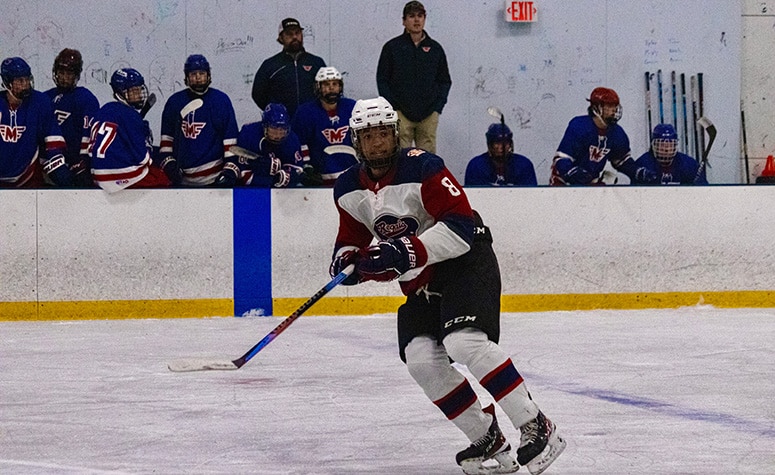
Upon arriving in the United States, a coach with a large hand in his development is Kyle Quick, the bench boss of the Buffalo Regals 16U team, a hotbed for Salisbury players, which is where Biakabutuka has been playing his fall hockey.
“The biggest thing is making him understand certain things,” Quick said. “Offensively, when’s the right time to go? When is the time to use those physical tools? Little things. Talking to him, what reads are good? What reads are risky for this level?
“When people are looking at him, how are the reads? How’s the skating? He has the tools. Everyone at the next level is focused on what is a player’s read? How does he read the game? How’s the IQ? So trying to put that together for him is probably his next big stride.”
Strengthening those reads should pair well with what Biakabutuka believes are his two biggest strengths.
“I think my first pass,” Biakabutuka said of his strengths. “The first pass that I make off a breakout. I think I’m pretty good at that and I can get out of the zone pretty easily and create some offense. Also, I can win my battles. I think I’m a pretty good size, so taking the puck away from the opponent and just making my first pass and jumping into the play.”
While Quick has Biakabutuka sporadically throughout the fall, Will’s fingerprints will be all over his development throughout the prep season.
“It’s important that kids kind of begin to find that identity and I think the default is sometimes people think that means you’re trying to box a kid in or make him into something,” Will said. “You want them to be as confident and excel in areas of the game that are real strengths for them while adding layers and pieces to it so that they add more completeness to their game. That’s a lot of conversation, a lot of video together, a lot of talking about players that he watches and aspires to be like and emulate and give some thoughts of other players that are guys that he can watch and take things from.
“It’s a process that we’re trying to work through with all of our guys on and off the ice to really help them get confident and settle into their evolving identity as a player. Can’t happen if you don’t have that receptiveness and want on the player’s end, you can’t force that in any way. With Anthony, it’s been so exciting to see how receptive and open and eager he is in those areas.”
All of this will lead to Biakabutuka discovering his on-ice identity — what kind of defenseman will he be when colleges pencil him into their long-term plans?
While Will sees Biakabutuka as someone who has all the tools to be a terrific shutdown defender who can make life miserable for forwards in their trips through the neutral zone and times in corners, he believes Biakabutuka has a lot of offensive potential too.
“I think he also is a guy who has the ability to be that fourth man up the ice,” the coach said. “I think he can pick his spots to jump into the play offensively. I think he’s a guy who can bring that versatility, and he’s not Cale Makar — that’s not what he’s going to be from an offensive standpoint. Because of his mobility and his ability to read the play, he can be that fourth man and fill that open lane and be active in the offensive zone where I think he can contribute in that area.”
Colleges are taking notice of the well-sized, left-shot defender with an equal appetite for hitting the opposition and the books. Schools from both the Ivy League and Hockey East have reached out to his coaches.
“I’ve had a number of calls from schools and conversations with schools about him,” Will said. “I think it’s interesting with a lot of these Canadian kids where there’s a little bit of a wait and see with college coaches in terms of ‘hey, is this player really genuinely interested in the college route?’
“I think now that Anthony’s made the decision to attend Salisbury and be down here, I think schools see a real genuine interest and commitment on his part to explore all the options down here.”
Biakabutuka knows the big-time schools, but because he and his family are from Canada, they’re not well-versed in the college hockey world, which means he won’t be rushed when the time comes to make a decision.
“It’s more about taking my time and seeing, exploring every option I could have and seeing what’s best,” Biakabutuka said.
No matter Biakabutuka’s knowledge of the United States college landscape, one thing is very certain: he wants and believes in this path he’s charted for himself.
“If I can get a degree, plus hockey, that would be the best thing on Earth,” said the 16-year-old defender. “That’s pretty much why we took the USA route.”