
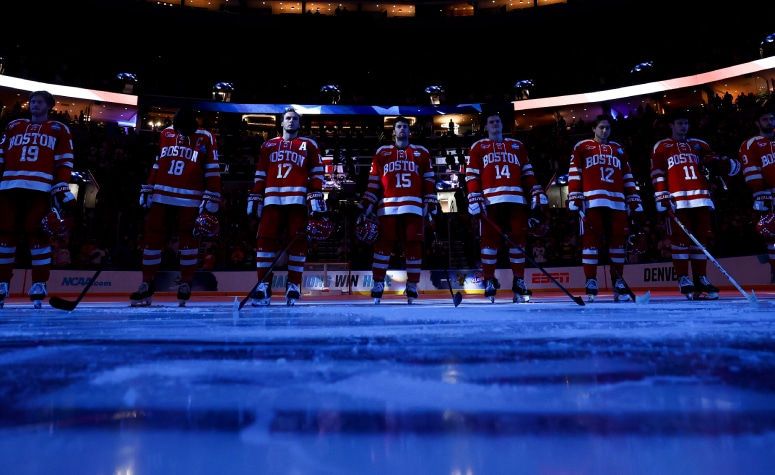

When Western Michigan took care of business against Boston University, 6-2, in this season’s Division 1 men’s college hockey national championship, a narrative that had been in the works for a long time began to bubble.
Young, high-end teams can’t win.
The Terriers had just lost. Boston College, the No. 1 team throughout most of the season, lost to Denver again — this time before the Frozen Four. Last season, BC, boasting some of the best freshmen in college hockey history, fell to Denver in the national championship. In 2023, a Minnesota team featuring freshmen such as Logan Cooley, Jimmy Snuggerud and sophomore Matthew Knies lost to Quinnipiac in the national championship.
College hockey has had an influx of top prospects choose the NCAA. BU’s Macklin Celebrini did so in 2023 and won the Hobey Baker. The year before, Adam Fantilli took the college hockey world by storm at Michigan, winning the Hobey Baker. Both were one-and-dones.
Hockey is a copycat sport. When a strategy works for one team, others try and use it to their advantage, too.
That can be true in recruiting, an ever-changing landscape.
So, are the young, high-end teams at a disadvantage? And will recruiting change due to this perception?
Looking at the narrative differently
While this was Western Michigan’s first national championship, the Broncos have been a program knocking on the door of a title for years. They were in the tournament in 2024. They were a No. 1 seed in 2022.
The same can be said about most other recent national champions, too. Quinnipiac was in the tournament in 2019, 2021 and 2022 before winning in 2023. Before winning in 2022 and 2024, Denver went to the Frozen Four in 2019. UMass won it in 2021 after falling in the national championship in 2019.
“When you look at the teams that have won the national championships, very few of them show up the first year and win,” Providence assistant coach Joel Beal said.
Those experiences lend themselves to the most important stat: games played.
“The biggest thing is games-played experience,” Michigan State associate head coach Jared DeMichiel said. “You don’t have to be a team of a bunch of 25-year-olds. I think it’s more experience in college hockey.”
READ MORE: 7 takeaways after 37 locals were picked in the 2025 QMJHL Draft
Locally, much of the focus has gone to Boston College and Boston University, and rightfully so. BC was the best team during the regular season for most of the past two regular seasons. BU has been to the past three Frozen Fours.
Neither school has any hardware to show for it. On the surface, that looks like gigantic missteps by both programs.
In 2024, BC had freshmen Will Smith (Lexington, Mass.), Ryan Leonard (Amherst, Mass.) and Gabe Perreault on the best line in the country, freshman Jacob Fowler as one of the best goalies in the NCAA and sophomore Cutter Gauthier, a top-five pick in the NHL Draft. Even after losing Smith and Gauthier, BC replaced them with the likes of James Hagens, a likely top-five pick in two weeks, and Teddy Stiga (Sudbury, Mass.), a second-round pick by the Nashville Predators last season. The Terriers have had players like Celebrini, two first-round picks in forward Cole Eiserman (Newburyport, Mass.) and defenseman Tom Willander, and a revolving door of Hutson brothers.
Dig a bit deeper, and it’s different.
“They just couldn’t find a way to win in that championship game,” DeMichiel said. “It’s not like these teams are getting absolutely smoked. It wasn’t like they had a horrible season.”
In 2024, BC outshot Denver, 35-26, in the national championship. If Denver goalie Matt Davis doesn’t play the game of his life, the Eagles are likely champs. BU kept with Western Michigan for most of the first two periods this year.
“That’s been shown to be successful with these Denver and Western Michigan teams. These are big, heavy, hard-to-play-against groups that, yeah, they have high-end skill, which is what shifts the scales,” Yale assistant coach Rob O’Gara said. “But it’s not like they’re bringing in the top five freshman class or anything crazy like that.”
Still, for the schools that are bringing in high-end recruiting classes (such as Denver), they seem to be getting to the Frozen Four consistently.
“Denver, Boston College and Boston University are getting (to the Frozen Four) relatively consistently over the last three years, and those teams are stacked with first-, second- and third-round picks,” Beal said. “If you’re looking at a one-game result, maybe you’re not really seeing the forest through the trees.”
That forest is player development, which is a two-way street. Schools like Boston College, Boston University, Denver, Harvard, Michigan, North Dakota, Providence and Michigan State are tasked with putting players on the best possible path to achieving success in the NHL. In return, those players help those colleges win.
“I’ve never worked at any Division 1 school that we didn’t sell that on,” DeMichiel said. “Like, ‘You can play here, you can develop here, you can win here and you can move on to the next level here.’ I think that sell is pretty similar at most places.”
READ MORE: How USA Hockey rule changes will impact you
There also will never be a day when a college coach turns down recruiting a prospect with the potential of being a high NHL Draft pick — or is currently one already.
“If you get a phone call on somebody that’s a first- or second-round pick, I think it’s hard for most teams to turn those players down,” DeMichiel said.
Aside from BC and BU as schools that have come oh-so-close but not quite over the finish line in recent tournaments, Michigan State is on that list. So, too, are Maine and Providence.
“It’s about having a team that’s good enough to get to the tournament and then make a run in the tournament, but then they bring enough guys back the next year that now they have the experience,” Beal said.
There’s just one problem: bringing players back has never been harder.
The art of retaining talent
DeMichiel recently turned 40, which means the Avon, Conn., native wasn’t a college hockey player all that long ago. He was in net for RIT from 2006-10.
“When I was in college, if you were a first- or second-round draft pick, you were in college for four years or three years,” DeMichiel said. “Nobody was leaving after one year, and after two years it was even an anomaly.”
Things are much different now. Players regularly leave for the NHL.
Take Providence College’s Trevor Connelly, who was taken 19th in last year’s NHL Draft by the Vegas Golden Knights. The freshman ranked 14th on his team in points (13) and opted to head to the NHL after this past season.
Connelly had the experience of this season’s NCAA tournament, which would’ve helped him and his team if the Friars got back there next year. That doesn’t matter anymore.
Connelly highlights a trend of higher draft picks leaving sooner. That’s partially due to how good college hockey has become and the caliber of coaching. Players are regularly leaving programs and making immediate impacts in the pros.
But it’s also due to the NHL salary cap.
“If I’m going to pay a guy (a rookie deal) and he’s going to be serviceable, especially whether it’s a playoff run or to get him experience so that he can be a good pro in the fall, it makes financial sense,” O’Gara said.
With the way NHL teams structure their rosters, there are typically high earners at the top and then players on cheaper contracts as depth pieces.
“There’s not a big middle class in the NHL,” DeMichiel said. “It’s upper class and lower class.”
Winning teams get value from their lower class. One way to do that is to pull prospects from college and hope they can pop in the NHL. Take the Toronto Maple Leafs with Knies as an example. They selected Knies in the second round in 2021. After only two seasons as a star at Minnesota, the Leafs signed him. In his second pro season, Knies had 58 points in 78 games as a top-six regular — that’s impeccable value for a player making $925,000.
There’s also this: NCAA players who have been drafted by an NHL team have four years from their draft to sign. After that, they become free agents.
It’s understandable, then, why teams pull from college early. Many were left wondering why BU sophomore captain Shane Lachance signed with the New Jersey Devils at the end of this past season. He was drafted in the seventh round in 2021. He followed that up with two seasons with the USHL’s Youngstown Phantoms before the past two years at BU.
FULL MAGAZINE: Check out the latest edition of the New England Hockey Journal magazine
Had he opted not to sign with the Devils, he would’ve become a free agent.
“NHL teams want to get in with these entry-level contracts because they’re cheaper,” DeMichiel said. “To sign these kids out of college and get them into their organizations and see if they can sink or swim.”
This leads to players having more leverage: Give me what I want on my first contract, or else I’ll return to school for senior year and you won’t have my rights. Typically, NHL teams find ways to oblige.
Some coaches want players drafted in later rounds before they enter school. That way, they’re able to play four years in college and still sign with their team.
“I want all of our guys to be drafted in rounds five, six or seven,” Beal said. “I want to have a kid who has 45 points after sophomore year and he’s in the sixth round, so he’s got two more years of eligibility. Unless he’s a bona fide ‘I have to play in the NHL next year,’ the team might tell him to go back for junior year. If you have a kid who has 45 points as a sophomore and he’s a free agent, he’s gone. He’s going to have 20 NHL offers.”
The other struggle with getting players to stay for four years is the transfer portal. Recruiting players who will stay for four years is hard, and not just because NHL teams will snatch them up. For those undrafted who might not be playing as much as they’d like to in their first year or two in college, they can enter the portal and go somewhere they feel has greener grass.
“It’s definitely something that we talk about in our office,” Beal said.
Liam Valente played two seasons at Providence from 2022-24, notching 20 points in 59 games. He transferred to Western Michigan before this season and broke out for 14 goals and 33 points in 42 games, helping the Broncos win a national title.
“I don’t know how realistic that is to say, ‘OK, you’re a veteran guy that’s not playing much at another school and we’re just going to take you and you’re going to play up in our lineup.’ I don’t think that’s repeatable again and again,” DeMichiel said.
But teams are still trying. Niagara forward Trevor Hoskin, a fourth-round pick by the Calgary Flames in 2024, was tied for first on the team in points with 39 this winter. He hit the portal once the season ended and picked Merrimack.
That’s an example of a misconception that the college hockey blue bloods — Boston College, Boston University, Michigan, North Dakota and Michigan State, to name a few — are scooping up all the players from lower conferences.
“It’s not like BU or BC or Michigan State or North Dakota or Denver stole him,” DeMichiel said. “I’m guessing that for a while, he wanted to go to a different conference, and he chose Merrimack and he’ll probably be a very good player there. That’s where there’s a misconception that all the big schools are taking all the big players.
AWARDS: Handing out the boys and girls prep awards from this past winter
“No, it’s just the bigger conferences. It’s where the agents and advisors want their players to be.”
So, how do teams hold onto players?
“It’s our job to try and put them in an environment where they understand that they’re going to continue to get better,” Beal said. “Give them a good experience so they don’t want to leave. That’s how you get guys to junior and senior year, and that’s when you get to combine a really talented roster with a roster that’s not just old, it’s not just age — it’s experience.”
It’s not easy, especially in an ever-changing landscape.