

Justin Pearson summed up the feelings of every Ivy League hockey player in a simple, single word.
“Excitement,” said the Nashua, N.H., native forward who is one of three seniors on Yale’s roster and the team’s top returning scorer entering the 2021-22 season. “We’re excited to get back to the rink for practice, excited to play that first game, excited to see what comes of this season. It’s an amazing feeling. Everyone has been working hard and raring to go.”
For Pearson, his Bulldogs and their New England-based rivals from Brown, Dartmouth and Harvard, that feeling hasn’t resonated in quite some time.
At the very beginning of the COVID-19 pandemic in March 2020, all of the Ivy League institutions were at the forefront of calling for an early, sudden end to the entire athletics calendar. Their playoff runs within ECAC Hockey ended in a flash, days before the quarterfinal round was set to begin.
Eventually, their entire 2020-21 season also would be canceled. The Ivy skaters could do nothing else but watch as teams from Hockey East, Atlantic Hockey and throughout the nation ended up taking the ice, and UMass ultimately earned its first-ever national championship at April’s Frozen Four in Pittsburgh.
Eighteen months have passed, but now, finally, a new campaign is imminent.
“We all obviously know guys on other teams, so watching games on Friday and Saturday nights on TV when we’d normally be playing was something that definitely made you feel jealous,” said Harvard junior defenseman Henry Thrun, a Southboro, Mass., native whose 21 points ranked sixth among freshman blueliners in 2019-20. The ECAC Hockey All-Rookie Team member led the Crimson with a plus-17 rating.
“It was extremely difficult, but it’s uncontrollable and it’s in the past. It motivated me just to realize that there’s a lot of good teams out there, but I think the group we have this year is pretty special.”
Indeed, a special winter could be in store for a Harvard team that is set to welcome back a trio of double-digit goal scorers from 2019-20 in All-American and ECAC Rookie of the Year Nick Abruzzese, senior captain Casey Dornbach, and Thrun’s junior classmate and former Dexter Southfield standout John Farinacci.
Thrun and his teammates will incorporate a group of seven freshmen and sophomores — including reigning USHL Forward of the Year Matthew Coronato, former St. Mark’s defenseman Ian Moore (Concord, Mass.), and USA Hockey Junior Player of the Year Sean Farrell (Hopkinton, Mass.) — who were drafted by NHL clubs since the Crimson last took the ice.
When Oct. 29 comes around, they will take the ice and begin aiming for Harvard’s fifth NCAA tournament appearance in its past six postseasons.
“We know this group has the talent, it’s just a matter of making sure everyone is comfortable and knows what it takes to win,” Thrun said. “I had a great foundation set for me and we contributed a lot my freshman year, so the older guys have been thinking a lot about that (team-building) aspect so we can try to replicate that success with this group.”
The college game can present a whole new level of speed and tempo to newcomers under normal circumstances, but that jump will be an even greater challenge in a post-COVID year.
While preseason practices over the first few weeks of the academic year will help to close that gap as much as possible, the speed of a game can’t truly be matched until the regular season begins.
“You can practice, do all these skill sessions and play summer scrimmages, but I think everybody knows that those things are not at the pace or level of contact that a real game brings,” said Brown junior defenseman Luke Krys (Ridgefield, Conn.). “It’s going to be a challenge just to get back into the groove of the speed, especially for the guys that haven’t done it at this level before. You can prepare all you want, but it’s a whole new level when you’re out there on a Friday night and people are watching.”
While Thrun spent part of his time away from the Harvard campus with the USHL’s Dubuque Fighting Saints and representing the United States on a gold medal-winning team at the IIHF World Junior Championship, Krys was in the BCHL until border restrictions brought him back down to the USHL. He used the later months to heal a knee injury that he suffered in January.
The former Salisbury School captain felt that the opportunity to practice and play competitive games helped him work on power skating and fine-tune his defensive gaps, giving him a head start on returning to “a different game” at the college level. Of course, the extended recovery time for injuries marked another positive point for him and other athletes during a year unlike any other.
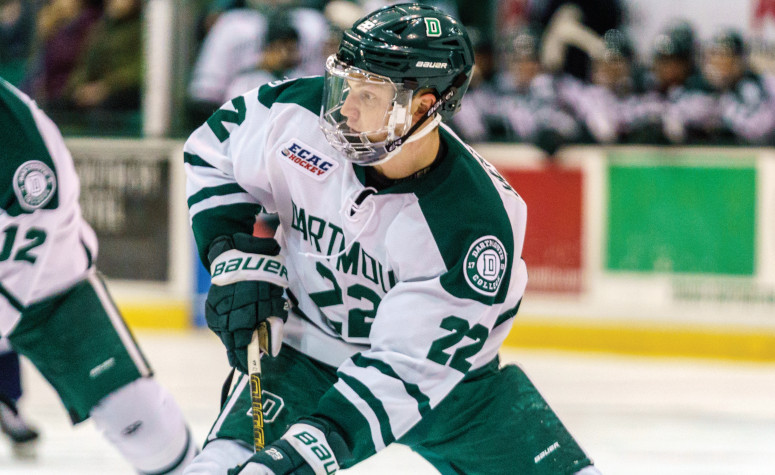
Up in Hanover, N.H., Sam Hesler (Boxboro, Mass.) and his Dartmouth Big Green had plenty of time to be introduced to new head coach Reid Cashman, who was hired in June 2020 before he entered the NHL bubble and completed his two-year tenure as an assistant coach for the Washington Capitals.
Hesler’s senior class had an off-campus housing arrangement throughout the last school year and joined the rest of the team for on-ice practice sessions and workouts with their new coaching staff. In retrospect, they made the most of an opportunity.
“We didn’t focus a lot on X’s and O’s, but we went really deep into some details of the game that you usually don’t have time to work on because you’re watching film and breaking things down for the next game,” Hesler said. “I think it also allowed us to get very close with the coaching staff (on a personal level) since we weren’t in the heat of a season.”
From an on-ice perspective, Hesler noticed an emphasis that should help the Big Green stack up with the competition heading into a new campaign.
“It was a lot of speed, a lot of skating with the puck and keeping your head up, which I don’t think you can ever work on too much,” the Belmont Hill graduate said. “Everything has to be done with a lot of speed. That’s how the league and the game is moving. I think that’s sort of going to be the mantra of our team this year.”
Hesler is one of just six forwards with any amount of college experience on the Dartmouth roster, which loses all of its top four scorers following classmate Drew O’Connor’s early departure to the Pittsburgh Penguins organization. Nine freshmen and seven sophomores will be added to the mix.
Youth will be a theme throughout the Ivy League, with both Brown and Yale counting its top offensive contributor, top defenseman and starting goaltender among the team’s losses.
But, as coaches often say, it won’t take long for freshmen to feel acquainted with the college game. The season can often turn into a “trial by fire” type of experience.
“Not playing for a whole year is obviously not good for anyone’s development, so it’s going to take a little time for everyone to get back into the routine of things and try to play the way we want to play once we get into games,” Krys said. “I think we have the leadership (16 juniors and seniors) to help bring everyone else along. It didn’t take very long to get past the awkward stage of getting used to one another. We have a close group.”
After well over a year without real, live hockey on Ivy League campuses, the clock is finally about to stop. The puck is finally about to drop. The fans are finally about to cheer. It all has been a long time coming.
Throughout the lost season, there were no X’s and O’s or games ahead. The pandemic provided a chance for student-athletes to reflect upon why they began playing the game in the first place — and long for the next trip to the ice.
“Besides the skills and training, the biggest thing for me (over the past season) was just appreciating and not taking for granted going to the rink every day,” said Thrun, who shared his trip to world juniors last December and January with Harvard coach Ted Donato (Dedham, Mass.), an assistant for USA Hockey under Providence’s Nate Leaman, and Farinacci.
“Since we’ve been back at Harvard, it’s something we’re super fortunate to be a part of and makes us super hungry for the year ahead. You just realize that it’s what I love to do and what we all love to do. The time away definitely taught me to value the game, the friendships and all the great memories you make.”
This article appeared in the print edition of the September/October 2021 New England Hockey Journal magazine.