
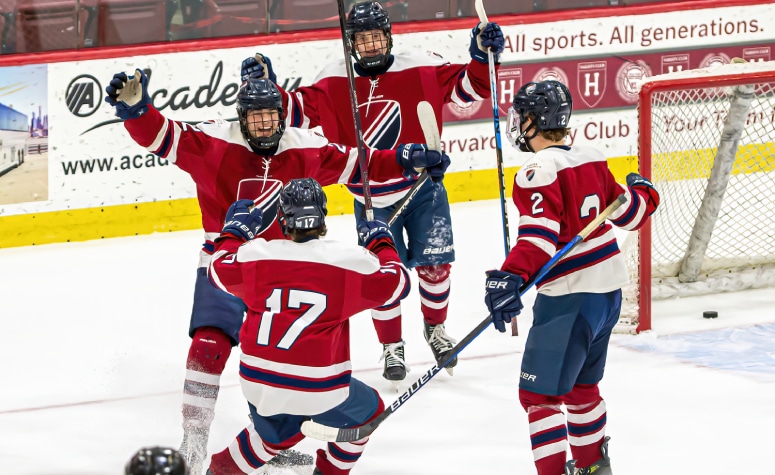

Despite all the wins and losses and players committed to Division 1 and 3 college hockey programs, there was no bigger story in boys prep hockey than Dexter Southfield's announcement that the boys of Brookline, Mass., were moving to a full-season model.
"How are you staying ahead of the curve?" Dexter boys coach Dan Donato said at the time. "We're just trying to stay ahead of the curve."
There is constant talk around the rinks of prep hockey needing to change. This was a big step in that direction.
It won't be the last.
In the third installment of our boys prep coaches survey, we asked coaches about the state of prep hockey. What do they think about the idea of a full-season model? What about players leaving prior to graduation to join junior teams? Both are topics that have been at the forefront of prep hockey discussion over the last 12 months.
And, most importantly, are they confident in prep hockey?
Let's dive in. All coaches were granted anonymity.
Should prep move to a full-season model?
Answers among coaches were split.
"This scenario is going to divide prep hockey," one coach said. "A lot of schools are pushing for this model and are already doing this in a way like the Cushing kids playing together under another umbrella in the fall and then rolling into their [prep] season come November."
What this coach is alluding to is Cushing faces other teams in the fall as the Central Mass. Penguins.
One common theme among coaches was the idea of extending the season.
"Full-season, no, but extended season, yes," another coach said. "We need to adapt to the landscape but not completely derail what these schools are about."
This is one thing prep schools have always promoted — the experience away from the rink. The high-end educational element, plus social events and a chance to play other sports.
"I believe that it is important for prep hockey to adapt and evolve if we plan to continue to be a significant avenue for player development and placement at higher levels (juniors and college)," a coach said. "We should not adopt the full-season or academy model, but I do believe there is a space for prep hockey to expand the length of the season and to provide student-athletes with a more concentrated developmental hockey experience, while also being able to take full advantage of other athletic, extracurricular and social offerings at our schools.
"If we were to lengthen the duration of our season and nominally increase the number of games played (40), our families would truly be getting the best of all existing options from an athletic, academic and social experience. Instead of playing catch-up, we would be setting the standard."
Multiple coaches mentioned that they aren't the only ones who want an extended or full-season model — families do, too.
"It's what our players, parents and coaches want," a coach said. "With all of the new fall leagues and teams playing as U18 teams, it's already happening in a roundabout way. The only thing that isn't happening is our kids aren't able to be coached by the coaches that are recruiting them to these [prep] schools. We could start playing after Oct. 1 and play a 45-game schedule."
"That's what most of our paying customers (parents) would like us to do," another coach said. "That would put many hockey academies out of business and raise the level of prep hockey even higher."
WEEK 1: 6 uncommitted standouts from Foxboro Prep League
One issue with going to a full-season model is its impact on other sports at each school.
"No," answered one coach. "Because then other sports will have to follow. I like the split-season model and then regular season. It gives kids opportunities to do other things and get more coaching."
Players who go to prep schools and play hockey typically join a fall team from late August through mid-November. Then the prep season, which runs roughly 30 games, spans until early March.
Still, one coach brought up the idea that a full-season model might mean too much hockey.
"I would love to see the season extended a little," they said. "Full season is ridiculous and not conducive to development. Youth players should not be playing more hockey than professionals."
And then there are coaches who don't want to see any change to the length of the season.
"The league is still working. The players are still very good," a coach said. "There are options for full-season teams and schools so those looking to be hockey players only can follow that path. I am still a believer in the prep model and think our kids develop as young men and student-athletes and aren't viewed as simply hockey players."
Are players leaving too early for junior hockey?
Boston University men's hockey coach Jay Pandolfo — a guest on the most recent episode of New England Hockey Journal's RinkWise podcast played his senior year at Burlington (Mass.) High School in 1991-92. The next season, he put up 38 points in 37 games as a freshman at BU.
"The landscape has changed so much now," Pandolfo said.
Going to prep school before playing Division 1 became a necessity. Over the last 10-15 years, doing an extra year of juniors before going to college became the norm. Quickly that became two or more seasons of juniors.
In the last slew of years, some players left prep before graduating to embark on their junior hockey careers.
"It's really stupid but kids are influenced by advisors and people who don't get the education side of life," one coach said.
Put a different way?
"This is not a new phenomenon for prep hockey," another coach said. "It has been happening for years. My concern centers on situations when players jump before they are ready. Unfortunately, there are a lot of people who are misleading or dishonest with kids and families. At the same time, more kids and families need to enjoy where they are at and trust the process and stop looking to rush forward.
"Very few kids hurt their development by finishing at prep; a lot of kids hurt themselves by leaving too early."
The common theme among coaches was that sometimes, leaving prep early is the right move.
"Depends on the kid," a coach said. "Some kids, it's the right move for. Some kids, it's the wrong move for. The race to nowhere is real and people should be leery of that. Dominate where you are before you move on. If you are already dominating, then time to move on."
GOALTENDING: What are the best developmental paths and techniques for young goalies?
The problem arises when it's quickly obvious that leaving was the wrong move.
"It's alarming to me how many players have gone early to play juniors and have fallen on their face," one coach said. "Kids are getting bad advice and it is hurting their development and future as hockey players. In most cases, it destroys their confidence."
An element of how the path to college hockey has changed is the time spent in juniors. But a big misconception has arisen.
"The problem now is that nobody goes from prep hockey directly to college hockey so juniors is always enticing to expedite the process," a coach said. "If you leave prep early, you are guaranteed to do at least two, if not three years of juniors. That could be a grind and not necessarily the best development for the player. It needs to really be the right situation in order to leave."
Many prep players mulling a move to juniors are watching what's happened to those who went before them.
"Some kids it makes sense and they are going to a junior club that has the infrastructure to truly support them," said a coach. "But, there are plenty of examples of kids leaving too early and struggling. Sometimes the infrastructure around that experience is now what they expected. I think those experiences are becoming, unfortunately, more frequent and that is getting back to families who have yet to leave for juniors."
Still, prep is a developmental league and whether coaches like it or not, prep filters more to junior hockey now than directly to college.
"As a coach, my job is to develop players and prepare them for their next step in their journey," a coach said. "If good enough and the player needs a new challenge, then I am comfortable sending that player away to juniors early."
Have the last 12 months made you more or less confident in prep hockey?
The overwhelming majority of coaches listed "more."
"The prep game was better and stronger than it has been in my tenure," said one coach.
"More," added another coach. "Every year I hear about the demise of prep hockey and every year it keeps being a fantastic brand of hockey. The general hockey circuit is watered down, so the ability level in all leagues is down with less concentration and the exception of the USHL."
Last season, only one player, Sean Keohane (Milton, Mass.), was selected in the NHL Draft straight out of prep. More players from prep project to be taken this season in St. Sebastian's Ben Merrill (Hingham, Mass.), Kent's Gio DiGiulian (South Burlington, Vt.) and Holderness' Caeden Herrington (Manchester, Vt.).
"College and pro scouts continue to attend prep games and college coaches continue to recruit prep players," a coach said. "The top prep teams often defeat hockey academies when they play. The number of admissions applications to the top prep programs from kids currently playing at hockey academies continues to rise each year. Most parents (and even kids now) are starting to realize that players are developing and growing more on the ice and in the weight room within prep school programs and there's certainly no comparison from an educational standpoint."
That well-roundedness that prep has held on to is something coaches point at as a win for the landscape.
"What is our goal with prep hockey? To have the best players in the country? To give kids the best education possible? To help them be successful beyond hockey?" one coach asked. "I continue to believe that the prep experience is special. People who care about you in so many different areas of your life. Being able to play in front of friends and teachers. Growth as a total person.
BOYS PREP COACHES POLL: Best newcomers and players this season, part 1 | Best players and teams next season, part 2
"But, I also see that college placement is becoming more difficult and that, while there is greater parity in prep hockey, we certainly don't see the older and better players sticking around."
Still, some answered, even in this section, that change is needed.
"I remain optimistic that change is going to continue gradually with prep hockey," a coach said. "Unfortunately, much of this change is happening at the individual school level as opposed to a cohesive, unified vision driven by NEPSAC. There has been a lot of talk, but with the evolving landscape at the junior and college levels, it's time for concrete and decisive action.